

record suggests that regional rainfall variability may
originate from the ocean. Decadal variability in a
280-year d
18 O record from a Panamanian coral indicates decadal periods in the strength and position
of the ITCZ.
Changes in the decadal variability of coral skeletal
D
14 C reveals information about the natural variability in ocean circulation, water mass movement
and ventilation rates in surface water. Biennial-todecadal shifts in D
14
C between 1880 and 1955 in a
Bermuda coral indicates that rapid pulses of increased mixing between surface and subsurface
waters occurred in the North Atlantic Ocean during
the past century and that these pulses appeared to
correlate with fluctuations in the North Atlantic
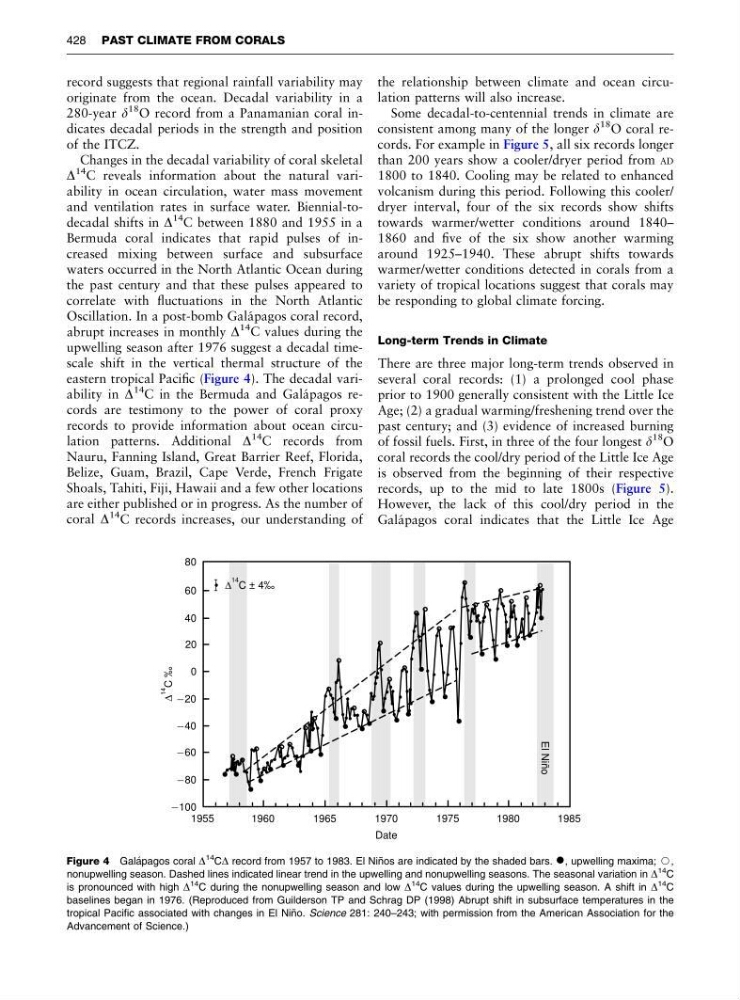
Oscillation. In a post-bomb Gala ´ pagos coral record,
abrupt increases in monthly D
14 C values during the
upwelling season after 1976 suggest a decadal timescale shift in the vertical thermal structure of the
eastern tropical Pacific (Figure 4). The decadal variability in D
14
C in the Bermuda and Gala ´ pagos records are testimony to the power of coral proxy
records to provide information about ocean circulation patterns. Additional D
14
C records from
Nauru, Fanning Island, Great Barrier Reef, Florida,
Belize, Guam, Brazil, Cape Verde, French Frigate
Shoals, Tahiti, Fiji, Hawaii and a few other locations
are either published or in progress. As the number of
coral D
14
C records increases, our understanding of
the relationship between climate and ocean circulation patterns will also increase.
Some decadal-to-centennial trends in climate are
consistent among many of the longer d
18 O coral records. For example in Figure 5, all six records longer
than 200 years show a cooler/dryer period from AD
1800 to 1840. Cooling may be related to enhanced
volcanism during this period. Following this cooler/
dryer interval, four of the six records show shifts
towards warmer/wetter conditions around 1840–
1860 and five of the six show another warming
around 1925–1940. These abrupt shifts towards
warmer/wetter conditions detected in corals from a
variety of tropical locations suggest that corals may
be responding to global climate forcing.
Long-term Trends in Climate
There are three major long-term trends observed in
several coral records: (1) a prolonged cool phase
prior to 1900 generally consistent with the Little Ice
Age; (2) a gradual warming/freshening trend over the
past century; and (3) evidence of increased burning
of fossil fuels. First, in three of the four longest d
18
O
coral records the cool/dry period of the Little Ice Age
is observed from the beginning of their respective
records, up to the mid to late 1800s (Figure 5).
However, the lack of this cool/dry period in the
Gala ´ pagos coral indicates that the Little Ice Age
1960
1965
1970
1975
1980
1985
_ 100
_ 80
_ 60
_ 40
_ 20
0
20
40
60
80
Date
1955
El
Niño
Δ
14
C ± 4‰
Δ
14
C ‰
Figure 4 Gala ´ pagos coral D
14 CD record from 1957 to 1983. El Nin ˜ os are indicated by the shaded bars. , upwelling maxima; J,
nonupwelling season. Dashed lines indicated linear trend in the upwelling and nonupwelling seasons. The seasonal variation in D
14 C
is pronounced with high D
14 C during the nonupwelling season and low D
14 C values during the upwelling season. A shift in D
14 C
baselines began in 1976. (Reproduced from Guilderson TP and Schrag DP (1998) Abrupt shift in subsurface temperatures in the
tropical Pacific associated with changes in El Nin ˜ o. Science 281: 240–243; with permission from the American Association for the
Advancement of Science.)
428 PAST CLIMATE FROM CORALS
originate from the ocean. Decadal variability in a
280-year d
18 O record from a Panamanian coral indicates decadal periods in the strength and position
of the ITCZ.
Changes in the decadal variability of coral skeletal
D
14 C reveals information about the natural variability in ocean circulation, water mass movement
and ventilation rates in surface water. Biennial-todecadal shifts in D
14
C between 1880 and 1955 in a
Bermuda coral indicates that rapid pulses of increased mixing between surface and subsurface
waters occurred in the North Atlantic Ocean during
the past century and that these pulses appeared to
correlate with fluctuations in the North Atlantic
Oscillation. In a post-bomb Gala ´ pagos coral record,
abrupt increases in monthly D
14 C values during the
upwelling season after 1976 suggest a decadal timescale shift in the vertical thermal structure of the
eastern tropical Pacific (Figure 4). The decadal variability in D
14
C in the Bermuda and Gala ´ pagos records are testimony to the power of coral proxy
records to provide information about ocean circulation patterns. Additional D
14
C records from
Nauru, Fanning Island, Great Barrier Reef, Florida,
Belize, Guam, Brazil, Cape Verde, French Frigate
Shoals, Tahiti, Fiji, Hawaii and a few other locations
are either published or in progress. As the number of
coral D
14
C records increases, our understanding of
the relationship between climate and ocean circulation patterns will also increase.
Some decadal-to-centennial trends in climate are
consistent among many of the longer d
18 O coral records. For example in Figure 5, all six records longer
than 200 years show a cooler/dryer period from AD
1800 to 1840. Cooling may be related to enhanced
volcanism during this period. Following this cooler/
dryer interval, four of the six records show shifts
towards warmer/wetter conditions around 1840–
1860 and five of the six show another warming
around 1925–1940. These abrupt shifts towards
warmer/wetter conditions detected in corals from a
variety of tropical locations suggest that corals may
be responding to global climate forcing.
Long-term Trends in Climate
There are three major long-term trends observed in
several coral records: (1) a prolonged cool phase
prior to 1900 generally consistent with the Little Ice
Age; (2) a gradual warming/freshening trend over the
past century; and (3) evidence of increased burning
of fossil fuels. First, in three of the four longest d
18
O
coral records the cool/dry period of the Little Ice Age
is observed from the beginning of their respective
records, up to the mid to late 1800s (Figure 5).
However, the lack of this cool/dry period in the
Gala ´ pagos coral indicates that the Little Ice Age
1960
1965
1970
1975
1980
1985
_ 100
_ 80
_ 60
_ 40
_ 20
0
20
40
60
80
Date
1955
El
Niño
Δ
14
C ± 4‰
Δ
14
C ‰
Figure 4 Gala ´ pagos coral D
14 CD record from 1957 to 1983. El Nin ˜ os are indicated by the shaded bars. , upwelling maxima; J,
nonupwelling season. Dashed lines indicated linear trend in the upwelling and nonupwelling seasons. The seasonal variation in D
14 C
is pronounced with high D
14 C during the nonupwelling season and low D
14 C values during the upwelling season. A shift in D
14 C
baselines began in 1976. (Reproduced from Guilderson TP and Schrag DP (1998) Abrupt shift in subsurface temperatures in the
tropical Pacific associated with changes in El Nin ˜ o. Science 281: 240–243; with permission from the American Association for the
Advancement of Science.)
428 PAST CLIMATE FROM CORALS