

Warmer / Wetter
Cooler / Drier
1600
1700
1800
1900
2000
Year
8. Seychelles
9. Red Sea
7. Phillippines
6. Great Barrier Reef
5. New Caledonia
4. Vanuatu
3. Tarawa
1. Panama
2. Galapagos
_ 1 ‰
Coral O‰
18
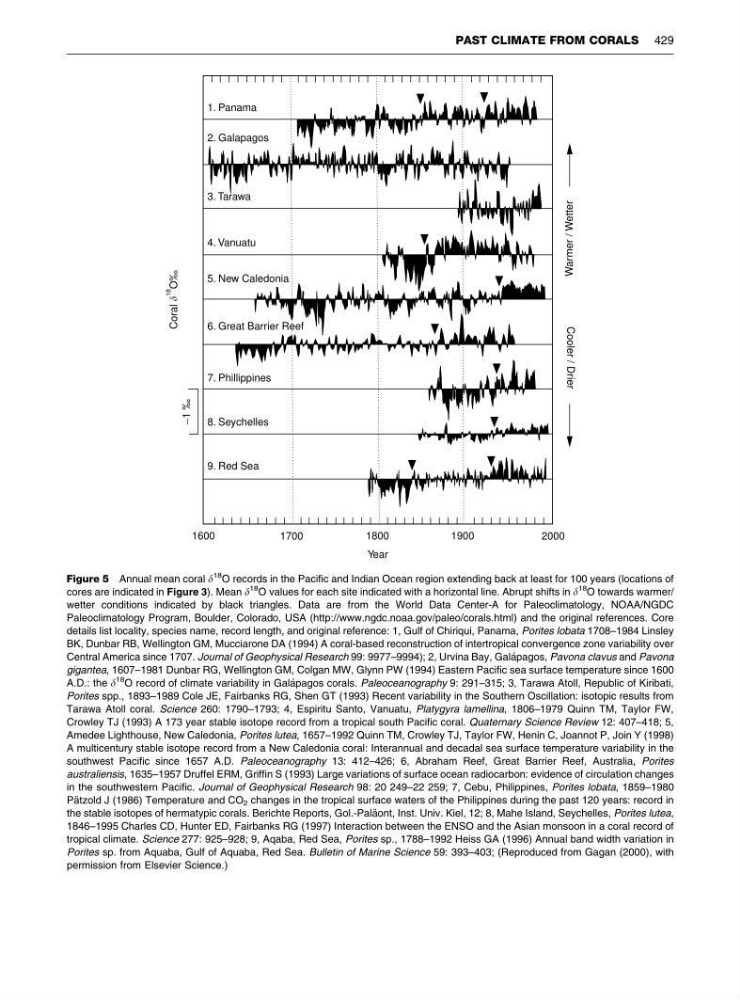
Figure 5 Annual mean coral d
18 O records in the Pacific and Indian Ocean region extending back at least for 100 years (locations of
cores are indicated in Figure 3). Mean d
18 O values for each site indicated with a horizontal line. Abrupt shifts in d
18 O towards warmer/
wetter conditions indicated by black triangles. Data are from the World Data Center-A for Paleoclimatology, NOAA/NGDC
Paleoclimatology Program, Boulder, Colorado, USA (http://www.ngdc.noaa.gov/paleo/corals.html) and the original references. Core
details list locality, species name, record length, and original reference: 1, Gulf of Chiriqui, Panama, Porites lobata 1708–1984 Linsley
BK, Dunbar RB, Wellington GM, Mucciarone DA (1994) A coral-based reconstruction of intertropical convergence zone variability over
Central America since 1707. Journal of Geophysical Research 99: 9977–9994); 2, Urvina Bay, Gala ´ pagos, Pavona clavus and Pavona
gigantea, 1607–1981 Dunbar RG, Wellington GM, Colgan MW, Glynn PW (1994) Eastern Pacific sea surface temperature since 1600
A.D.: the d
18 O record of climate variability in Gala ´ pagos corals. Paleoceanography 9: 291–315; 3, Tarawa Atoll, Republic of Kiribati,
Porites spp., 1893–1989 Cole JE, Fairbanks RG, Shen GT (1993) Recent variability in the Southern Oscillation: isotopic results from
Tarawa Atoll coral. Science 260: 1790–1793; 4, Espiritu Santo, Vanuatu, Platygyra lamellina, 1806–1979 Quinn TM, Taylor FW,
Crowley TJ (1993) A 173 year stable isotope record from a tropical south Pacific coral. Quaternary Science Review 12: 407–418; 5,
Amedee Lighthouse, New Caledonia, Porites lutea, 1657–1992 Quinn TM, Crowley TJ, Taylor FW, Henin C, Joannot P, Join Y (1998)
A multicentury stable isotope record from a New Caledonia coral: Interannual and decadal sea surface temperature variability in the
southwest Pacific since 1657 A.D. Paleoceanography 13: 412–426; 6, Abraham Reef, Great Barrier Reef, Australia, Porites
australiensis, 1635–1957 Druffel ERM, Griffin S (1993) Large variations of surface ocean radiocarbon: evidence of circulation changes
in the southwestern Pacific. Journal of Geophysical Research 98: 20 249–22 259; 7, Cebu, Philippines, Porites lobata, 1859–1980
Pa ¨ tzold J (1986) Temperature and CO 2 changes in the tropical surface waters of the Philippines during the past 120 years: record in
the stable isotopes of hermatypic corals. Berichte Reports, Gol.-Pala ¨ ont, Inst. Univ. Kiel, 12; 8, Mahe Island, Seychelles, Porites lutea,
1846–1995 Charles CD, Hunter ED, Fairbanks RG (1997) Interaction between the ENSO and the Asian monsoon in a coral record of
tropical climate. Science 277: 925–928; 9, Aqaba, Red Sea, Porites sp., 1788–1992 Heiss GA (1996) Annual band width variation in
Porites sp. from Aquaba, Gulf of Aquaba, Red Sea. Bulletin of Marine Science 59: 393–403; (Reproduced from Gagan (2000), with
permission from Elsevier Science.)
PAST CLIMATE FROM CORALS 429
Cooler / Drier
1600
1700
1800
1900
2000
Year
8. Seychelles
9. Red Sea
7. Phillippines
6. Great Barrier Reef
5. New Caledonia
4. Vanuatu
3. Tarawa
1. Panama
2. Galapagos
_ 1 ‰
Coral O‰
18
Figure 5 Annual mean coral d
18 O records in the Pacific and Indian Ocean region extending back at least for 100 years (locations of
cores are indicated in Figure 3). Mean d
18 O values for each site indicated with a horizontal line. Abrupt shifts in d
18 O towards warmer/
wetter conditions indicated by black triangles. Data are from the World Data Center-A for Paleoclimatology, NOAA/NGDC
Paleoclimatology Program, Boulder, Colorado, USA (http://www.ngdc.noaa.gov/paleo/corals.html) and the original references. Core
details list locality, species name, record length, and original reference: 1, Gulf of Chiriqui, Panama, Porites lobata 1708–1984 Linsley
BK, Dunbar RB, Wellington GM, Mucciarone DA (1994) A coral-based reconstruction of intertropical convergence zone variability over
Central America since 1707. Journal of Geophysical Research 99: 9977–9994); 2, Urvina Bay, Gala ´ pagos, Pavona clavus and Pavona
gigantea, 1607–1981 Dunbar RG, Wellington GM, Colgan MW, Glynn PW (1994) Eastern Pacific sea surface temperature since 1600
A.D.: the d
18 O record of climate variability in Gala ´ pagos corals. Paleoceanography 9: 291–315; 3, Tarawa Atoll, Republic of Kiribati,
Porites spp., 1893–1989 Cole JE, Fairbanks RG, Shen GT (1993) Recent variability in the Southern Oscillation: isotopic results from
Tarawa Atoll coral. Science 260: 1790–1793; 4, Espiritu Santo, Vanuatu, Platygyra lamellina, 1806–1979 Quinn TM, Taylor FW,
Crowley TJ (1993) A 173 year stable isotope record from a tropical south Pacific coral. Quaternary Science Review 12: 407–418; 5,
Amedee Lighthouse, New Caledonia, Porites lutea, 1657–1992 Quinn TM, Crowley TJ, Taylor FW, Henin C, Joannot P, Join Y (1998)
A multicentury stable isotope record from a New Caledonia coral: Interannual and decadal sea surface temperature variability in the
southwest Pacific since 1657 A.D. Paleoceanography 13: 412–426; 6, Abraham Reef, Great Barrier Reef, Australia, Porites
australiensis, 1635–1957 Druffel ERM, Griffin S (1993) Large variations of surface ocean radiocarbon: evidence of circulation changes
in the southwestern Pacific. Journal of Geophysical Research 98: 20 249–22 259; 7, Cebu, Philippines, Porites lobata, 1859–1980
Pa ¨ tzold J (1986) Temperature and CO 2 changes in the tropical surface waters of the Philippines during the past 120 years: record in
the stable isotopes of hermatypic corals. Berichte Reports, Gol.-Pala ¨ ont, Inst. Univ. Kiel, 12; 8, Mahe Island, Seychelles, Porites lutea,
1846–1995 Charles CD, Hunter ED, Fairbanks RG (1997) Interaction between the ENSO and the Asian monsoon in a coral record of
tropical climate. Science 277: 925–928; 9, Aqaba, Red Sea, Porites sp., 1788–1992 Heiss GA (1996) Annual band width variation in
Porites sp. from Aquaba, Gulf of Aquaba, Red Sea. Bulletin of Marine Science 59: 393–403; (Reproduced from Gagan (2000), with
permission from Elsevier Science.)
PAST CLIMATE FROM CORALS 429