

organic particles in the water column by the coral
animal). Photosynthesis is carried out by the endosymbiotic zooxanthellae. The bulk of photosynthetically fixed carbon is translocated directly to
the coral host. In some cases, the coral animal can
obtain all of its daily energy requirements via
photosynthesis alone. In general, as light intensity
increases, photosynthesis increases.
Skeleton
Corals deposit skeleton below the basal epidermis.
Typically, corals deposit one high-density and one
low-density band of skeleton each year. The highdensity band has thicker skeletal elements than the
low-density band. Each band is often composed of
several finer bands called dissepiments, deposited
directly at the base of the coral tissue. At discrete
intervals, the polyp presumably detaches from the
dissepiment, and begins to lay down a new skeletal
dissepiment. Some evidence suggests that dissepiments may form on a lunar cycle.
High- and low-density bands are deposited seasonally. Overall, high-density bands form during
suboptimal temperature conditions and low-density
bands form during optimal temperature conditions.
At higher latitudes (i.e., Hawaii, Florida) optimal
growth temperature occurs in summer. At lower
latitudes (i.e., Gala ´pagos, equatorial Pacific regions,
Australian Great Barrier Reef), optimal growth
temperatures occur in the cooler months. The width
and density of growth bands also vary with environmental variables such as light, sedimentation,
season length, and salinity. In general, as light levels
decrease due to increased cloud cover, increased
sedimentation or due to increasing depth, maximum
linear skeletal extension decreases, calcification decreases, and skeletal density increases.
The Interpretation of Isotopes, Trace
Elements, and Minor Elements in
Corals
Several environmental variables can be reconstructed
by measuring changes in the skeletal isotope ratios,
trace and minor elemental composition, and growth
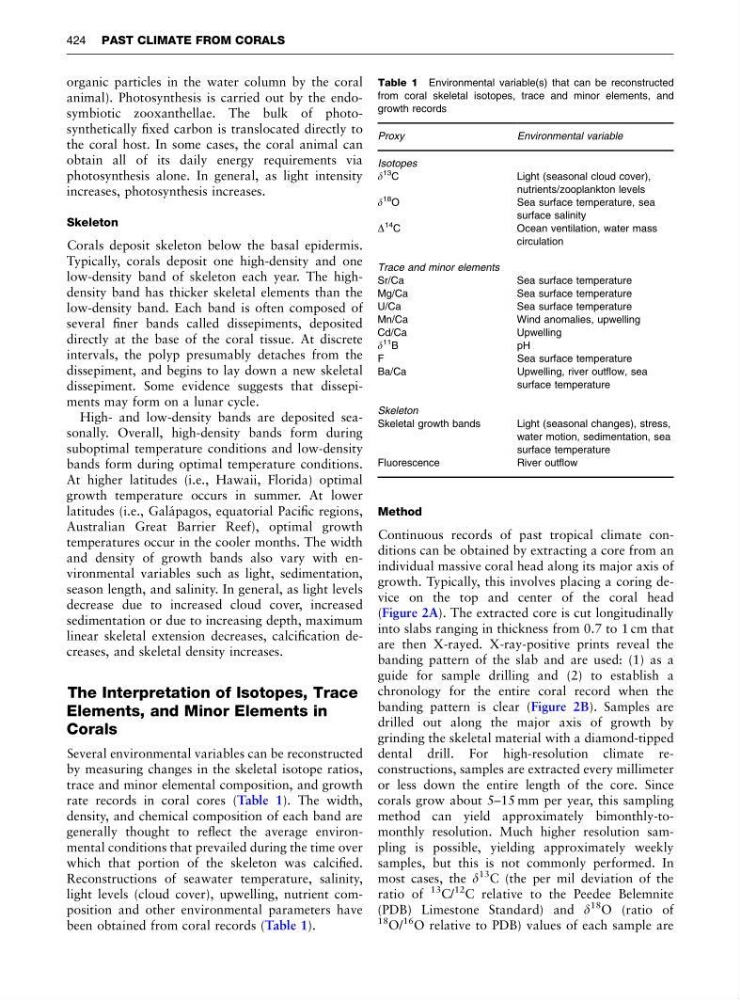
rate records in coral cores (Table 1). The width,
density, and chemical composition of each band are
generally thought to reflect the average environmental conditions that prevailed during the time over
which that portion of the skeleton was calcified.
Reconstructions of seawater temperature, salinity,
light levels (cloud cover), upwelling, nutrient composition and other environmental parameters have
been obtained from coral records (Table 1).
Method
Continuous records of past tropical climate conditions can be obtained by extracting a core from an
individual massive coral head along its major axis of
growth. Typically, this involves placing a coring device on the top and center of the coral head
(Figure 2A). The extracted core is cut longitudinally
into slabs ranging in thickness from 0.7 to 1 cm that
are then X-rayed. X-ray-positive prints reveal the
banding pattern of the slab and are used: (1) as a
guide for sample drilling and (2) to establish a
chronology for the entire coral record when the
banding pattern is clear (Figure 2B). Samples are
drilled out along the major axis of growth by
grinding the skeletal material with a diamond-tipped
dental drill. For high-resolution climate reconstructions, samples are extracted every millimeter
or less down the entire length of the core. Since
corals grow about 5–15 mm per year, this sampling
method can yield approximately bimonthly-tomonthly resolution. Much higher resolution sampling is possible, yielding approximately weekly
samples, but this is not commonly performed. In
most cases, the d
13 C (the per mil deviation of the
ratio of
13 C/
12
C relative to the Peedee Belemnite
(PDB) Limestone Standard) and d
18
O (ratio of
18 O/
16 O relative to PDB) values of each sample are
Table 1 Environmental variable(s) that can be reconstructed
from coral skeletal isotopes, trace and minor elements, and
growth records
Proxy
Environmental variable
Isotopes
d
13 C
Light (seasonal cloud cover),
nutrients/zooplankton levels
d
18 O
Sea surface temperature, sea
surface salinity
D
14 C
Ocean ventilation, water mass
circulation
Trace and minor elements
Sr/Ca
Sea surface temperature
Mg/Ca
Sea surface temperature
U/Ca
Sea surface temperature
Mn/Ca
Wind anomalies, upwelling
Cd/Ca
Upwelling
d
11 B
p H
F
Sea surface temperature
Ba/Ca
Upwelling, river outflow, sea
surface temperature
Skeleton
Skeletal growth bands
Light (seasonal changes), stress,
water motion, sedimentation, sea
surface temperature
Fluorescence
River outflow
424 PAST CLIMATE FROM CORALS
animal). Photosynthesis is carried out by the endosymbiotic zooxanthellae. The bulk of photosynthetically fixed carbon is translocated directly to
the coral host. In some cases, the coral animal can
obtain all of its daily energy requirements via
photosynthesis alone. In general, as light intensity
increases, photosynthesis increases.
Skeleton
Corals deposit skeleton below the basal epidermis.
Typically, corals deposit one high-density and one
low-density band of skeleton each year. The highdensity band has thicker skeletal elements than the
low-density band. Each band is often composed of
several finer bands called dissepiments, deposited
directly at the base of the coral tissue. At discrete
intervals, the polyp presumably detaches from the
dissepiment, and begins to lay down a new skeletal
dissepiment. Some evidence suggests that dissepiments may form on a lunar cycle.
High- and low-density bands are deposited seasonally. Overall, high-density bands form during
suboptimal temperature conditions and low-density
bands form during optimal temperature conditions.
At higher latitudes (i.e., Hawaii, Florida) optimal
growth temperature occurs in summer. At lower
latitudes (i.e., Gala ´pagos, equatorial Pacific regions,
Australian Great Barrier Reef), optimal growth
temperatures occur in the cooler months. The width
and density of growth bands also vary with environmental variables such as light, sedimentation,
season length, and salinity. In general, as light levels
decrease due to increased cloud cover, increased
sedimentation or due to increasing depth, maximum
linear skeletal extension decreases, calcification decreases, and skeletal density increases.
The Interpretation of Isotopes, Trace
Elements, and Minor Elements in
Corals
Several environmental variables can be reconstructed
by measuring changes in the skeletal isotope ratios,
trace and minor elemental composition, and growth
rate records in coral cores (Table 1). The width,
density, and chemical composition of each band are
generally thought to reflect the average environmental conditions that prevailed during the time over
which that portion of the skeleton was calcified.
Reconstructions of seawater temperature, salinity,
light levels (cloud cover), upwelling, nutrient composition and other environmental parameters have
been obtained from coral records (Table 1).
Method
Continuous records of past tropical climate conditions can be obtained by extracting a core from an
individual massive coral head along its major axis of
growth. Typically, this involves placing a coring device on the top and center of the coral head
(Figure 2A). The extracted core is cut longitudinally
into slabs ranging in thickness from 0.7 to 1 cm that
are then X-rayed. X-ray-positive prints reveal the
banding pattern of the slab and are used: (1) as a
guide for sample drilling and (2) to establish a
chronology for the entire coral record when the
banding pattern is clear (Figure 2B). Samples are
drilled out along the major axis of growth by
grinding the skeletal material with a diamond-tipped
dental drill. For high-resolution climate reconstructions, samples are extracted every millimeter
or less down the entire length of the core. Since
corals grow about 5–15 mm per year, this sampling
method can yield approximately bimonthly-tomonthly resolution. Much higher resolution sampling is possible, yielding approximately weekly
samples, but this is not commonly performed. In
most cases, the d
13 C (the per mil deviation of the
ratio of
13 C/
12
C relative to the Peedee Belemnite
(PDB) Limestone Standard) and d
18
O (ratio of
18 O/
16 O relative to PDB) values of each sample are
Table 1 Environmental variable(s) that can be reconstructed
from coral skeletal isotopes, trace and minor elements, and
growth records
Proxy
Environmental variable
Isotopes
d
13 C
Light (seasonal cloud cover),
nutrients/zooplankton levels
d
18 O
Sea surface temperature, sea
surface salinity
D
14 C
Ocean ventilation, water mass
circulation
Trace and minor elements
Sr/Ca
Sea surface temperature
Mg/Ca
Sea surface temperature
U/Ca
Sea surface temperature
Mn/Ca
Wind anomalies, upwelling
Cd/Ca
Upwelling
d
11 B
p H
F
Sea surface temperature
Ba/Ca
Upwelling, river outflow, sea
surface temperature
Skeleton
Skeletal growth bands
Light (seasonal changes), stress,
water motion, sedimentation, sea
surface temperature
Fluorescence
River outflow
424 PAST CLIMATE FROM CORALS