

measured. Since the d
13 C and/or d
18
O compositions
of corals usually have a strong seasonal component,
they are often used to establish an accurate chronology and/or to confirm the chronology established
from the X-rays.
Temperature and Salinity Reconstructions
Coral skeletal d
18
O reflects a combination of the
local SST and SSS. In the many regions of the tropical
ocean where the natural variation in salinity is small,
changes in coral skeletal d
18 O primarily reflect
changes in SST. The d
18 O of coral skeleton responds
to changes in temperature usually according to the
standard paleotemperature relationship for carbonates. Based on empirical studies, a 11C increase in
water temperature corresponds to a decrease of
about 0.22% (parts per thousand) in d
18 O. Precipitation has a low d
18
O value relative to that of sea
water. Therefore, in regions with pronounced variability in rainfall and/or river runoff, coral d
18 O
values reflect changes in SSS. Thus, depending on the
nature of the coral collection site, the d
18
O record is
used to reconstruct the SST and/or SSS. Additional
studies show that other proxy indicators of temperature include the ratios of strontium/calcium (Sr/
Ca), magnesium/calcium (Mg/Ca), and uranium/
calcium (U/Ca), fluorine levels (F) and skeletal band
thickness (Table 1). The ratios of Sr/Ca, Mg/Ca, and
U/Ca incorporated into the skeleton is largely determined by the temperature-dependent distribution
coefficient of Sr/Ca, Mg/Ca, and U/Ca between aragonite and sea water. As temperatures increase, the
Sr/Ca and U/Ca ratios decrease and the Mg/Ca ratio
increases.
Cloud Cover and Upwelling
d
13 C seems to indicate seasonal changes in cloud
cover and upwelling. Thus far, only a small number
of studies have used d
13
C records to confirm seasonal
rainfall patterns established using the d
18 O signature.
Only one study has directly linked a d
13 C record
with seasonal upwelling. d
13 C in coral skeletons has
been difficult to use as a paleoclimate tracer because
it is heavily influenced by metabolic processes,
1996
1995
1994
1993
1992
1991
1990
Porites sp.
(A)
(B)
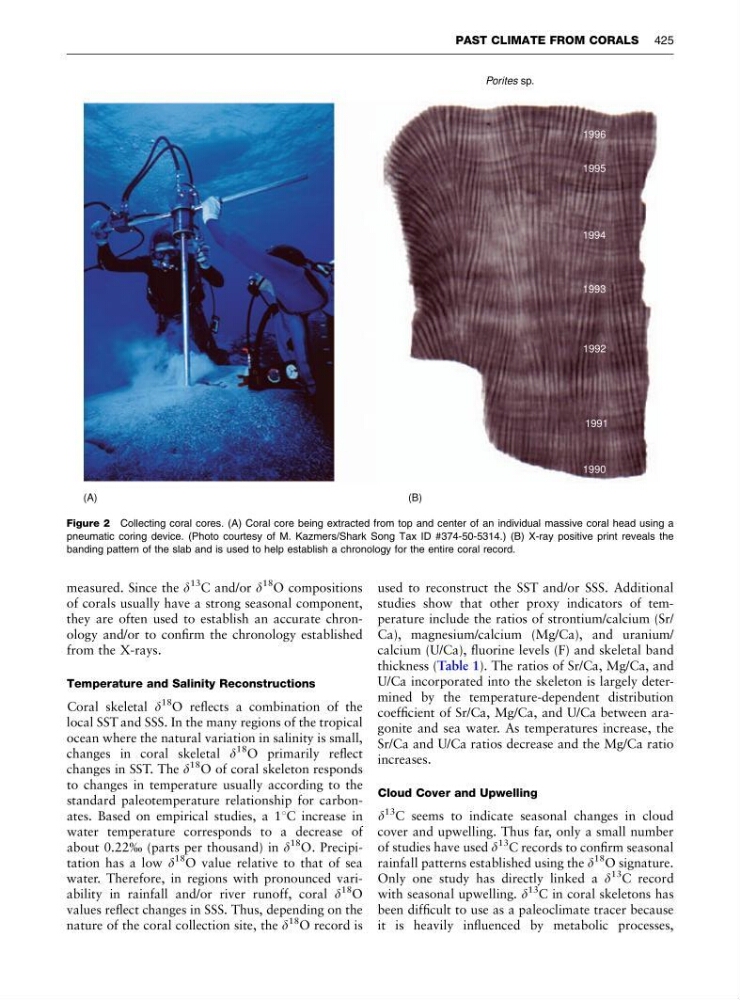
Figure 2 Collecting coral cores. (A) Coral core being extracted from top and center of an individual massive coral head using a
pneumatic coring device. (Photo courtesy of M. Kazmers/Shark Song Tax ID #374-50-5314.) (B) X-ray positive print reveals the
banding pattern of the slab and is used to help establish a chronology for the entire coral record.
PAST CLIMATE FROM CORALS 425
13 C and/or d
18
O compositions
of corals usually have a strong seasonal component,
they are often used to establish an accurate chronology and/or to confirm the chronology established
from the X-rays.
Temperature and Salinity Reconstructions
Coral skeletal d
18
O reflects a combination of the
local SST and SSS. In the many regions of the tropical
ocean where the natural variation in salinity is small,
changes in coral skeletal d
18 O primarily reflect
changes in SST. The d
18 O of coral skeleton responds
to changes in temperature usually according to the
standard paleotemperature relationship for carbonates. Based on empirical studies, a 11C increase in
water temperature corresponds to a decrease of
about 0.22% (parts per thousand) in d
18 O. Precipitation has a low d
18
O value relative to that of sea
water. Therefore, in regions with pronounced variability in rainfall and/or river runoff, coral d
18 O
values reflect changes in SSS. Thus, depending on the
nature of the coral collection site, the d
18
O record is
used to reconstruct the SST and/or SSS. Additional
studies show that other proxy indicators of temperature include the ratios of strontium/calcium (Sr/
Ca), magnesium/calcium (Mg/Ca), and uranium/
calcium (U/Ca), fluorine levels (F) and skeletal band
thickness (Table 1). The ratios of Sr/Ca, Mg/Ca, and
U/Ca incorporated into the skeleton is largely determined by the temperature-dependent distribution
coefficient of Sr/Ca, Mg/Ca, and U/Ca between aragonite and sea water. As temperatures increase, the
Sr/Ca and U/Ca ratios decrease and the Mg/Ca ratio
increases.
Cloud Cover and Upwelling
d
13 C seems to indicate seasonal changes in cloud
cover and upwelling. Thus far, only a small number
of studies have used d
13
C records to confirm seasonal
rainfall patterns established using the d
18 O signature.
Only one study has directly linked a d
13 C record
with seasonal upwelling. d
13 C in coral skeletons has
been difficult to use as a paleoclimate tracer because
it is heavily influenced by metabolic processes,
1996
1995
1994
1993
1992
1991
1990
Porites sp.
(A)
(B)
Figure 2 Collecting coral cores. (A) Coral core being extracted from top and center of an individual massive coral head using a
pneumatic coring device. (Photo courtesy of M. Kazmers/Shark Song Tax ID #374-50-5314.) (B) X-ray positive print reveals the
banding pattern of the slab and is used to help establish a chronology for the entire coral record.
PAST CLIMATE FROM CORALS 425