

PAST CLIMATE FROM CORALS
A. G. Grottoli, University of Pennsylvania,
Philadelphia, PA, USA
Copyright & 2001 Elsevier Ltd.
Introduction
The influence of the tropics on global climate is well
recognized. Our ability to understand, model and
predict the interannual, decadal and long-term variability in tropical climate depends on our knowledge
of past climate. However, our understanding of the
natural variability in tropical climate is limited because long-term instrumental records prior to 1950
are sparse or nonexistent in many tropical regions.
Continuous satellite monitoring did not begin until
the 1970s and in situ equatorial Pacific Ocean
monitoring has only existed since the 1980s. Therefore, we depend on proxy records to provide information about past climate. Proxy records are indirect
measurements of the physical and chemical structure
of past environmental conditions chronicled in natural archives such as ice cores, sediment cores, coral
cores and tree rings.
In the tropical oceans, the isotopic, trace and
minor elemental signatures of coral skeletons can
vary as a result of environmental conditions such as
temperature, salinity, cloud cover and upwelling. As
such, coral cores offer a suite of proxy records with
potential for reconstructing tropical paleoclimate on
intraannual-to-centennial timescales. Massive, symbiotic stony corals are good tropical climate proxy
recorders because: (1) they are widely distributed
throughout the tropics; (2) their unperturbed annual
skeletal banding pattern offers excellent chronological control; (3) they incorporate a variety of climate tracers from which paleo sea surface
temperature (SST), sea surface salinity (SSS), cloud
cover, upwelling, ocean circulation, ocean mixing
patterns, and other climatic and oceanic features can
be reconstructed; (4) their proxy records can be almost as good as instrumental records; (5) their records can span several centuries; and (6) their high
skeletal growth rate (usually in the range of 5–25 mm
y
À1 ) permits subseasonal sampling resolution. Thus
proxy records in corals provide the best means of
obtaining long seasonal-to-centennial timescale
paleoclimate information in the tropics.
Coral-based paleoclimate research has grown tremendously in the last few decades. Most of the
published records come from living corals and report
the reconstructed SST, SSS, rainfall, water circulation
pattern, or some combination of these variables.
Records from fossil and deep-sea corals are also increasing. The goal of this chapter is to provide an
overview of the current state of coral-based paleoclimate research and a list of further readings for
those interested in more detailed information.
Coral Biology
General
Corals are animals in the cnidarian family, order
Scleractinia (class Anthozoa). Their basic body plan
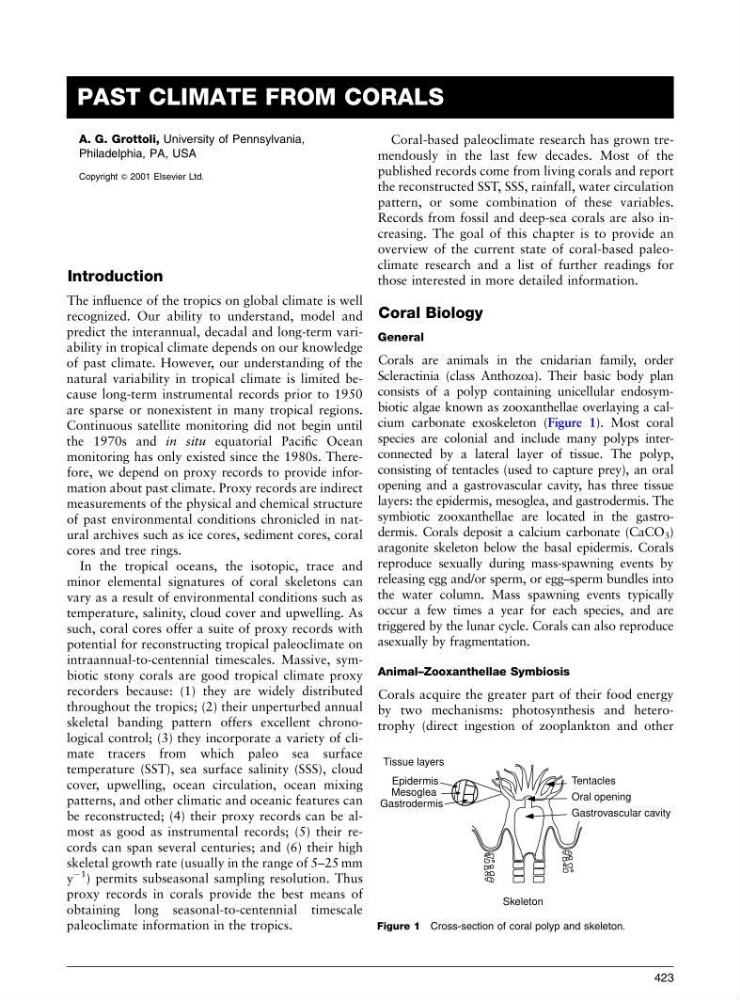
consists of a polyp containing unicellular endosymbiotic algae known as zooxanthellae overlaying a calcium carbonate exoskeleton (Figure 1). Most coral
species are colonial and include many polyps interconnected by a lateral layer of tissue. The polyp,
consisting of tentacles (used to capture prey), an oral
opening and a gastrovascular cavity, has three tissue
layers: the epidermis, mesoglea, and gastrodermis. The
symbiotic zooxanthellae are located in the gastrodermis. Corals deposit a calcium carbonate (CaCO 3 )
aragonite skeleton below the basal epidermis. Corals
reproduce sexually during mass-spawning events by
releasing egg and/or sperm, or egg–sperm bundles into
the water column. Mass spawning events typically
occur a few times a year for each species, and are
triggered by the lunar cycle. Corals can also reproduce
asexually by fragmentation.
Animal–Zooxanthellae Symbiosis
Corals acquire the greater part of their food energy
by two mechanisms: photosynthesis and heterotrophy (direct ingestion of zooplankton and other
Tentacles
Oral opening
Gastrovascular cavity
Skeleton
Tissue layers
Epidermis
Mesoglea
Gastrodermis
Figure 1 Cross-section of coral polyp and skeleton.
423
A. G. Grottoli, University of Pennsylvania,
Philadelphia, PA, USA
Copyright & 2001 Elsevier Ltd.
Introduction
The influence of the tropics on global climate is well
recognized. Our ability to understand, model and
predict the interannual, decadal and long-term variability in tropical climate depends on our knowledge
of past climate. However, our understanding of the
natural variability in tropical climate is limited because long-term instrumental records prior to 1950
are sparse or nonexistent in many tropical regions.
Continuous satellite monitoring did not begin until
the 1970s and in situ equatorial Pacific Ocean
monitoring has only existed since the 1980s. Therefore, we depend on proxy records to provide information about past climate. Proxy records are indirect
measurements of the physical and chemical structure
of past environmental conditions chronicled in natural archives such as ice cores, sediment cores, coral
cores and tree rings.
In the tropical oceans, the isotopic, trace and
minor elemental signatures of coral skeletons can
vary as a result of environmental conditions such as
temperature, salinity, cloud cover and upwelling. As
such, coral cores offer a suite of proxy records with
potential for reconstructing tropical paleoclimate on
intraannual-to-centennial timescales. Massive, symbiotic stony corals are good tropical climate proxy
recorders because: (1) they are widely distributed
throughout the tropics; (2) their unperturbed annual
skeletal banding pattern offers excellent chronological control; (3) they incorporate a variety of climate tracers from which paleo sea surface
temperature (SST), sea surface salinity (SSS), cloud
cover, upwelling, ocean circulation, ocean mixing
patterns, and other climatic and oceanic features can
be reconstructed; (4) their proxy records can be almost as good as instrumental records; (5) their records can span several centuries; and (6) their high
skeletal growth rate (usually in the range of 5–25 mm
y
À1 ) permits subseasonal sampling resolution. Thus
proxy records in corals provide the best means of
obtaining long seasonal-to-centennial timescale
paleoclimate information in the tropics.
Coral-based paleoclimate research has grown tremendously in the last few decades. Most of the
published records come from living corals and report
the reconstructed SST, SSS, rainfall, water circulation
pattern, or some combination of these variables.
Records from fossil and deep-sea corals are also increasing. The goal of this chapter is to provide an
overview of the current state of coral-based paleoclimate research and a list of further readings for
those interested in more detailed information.
Coral Biology
General
Corals are animals in the cnidarian family, order
Scleractinia (class Anthozoa). Their basic body plan
consists of a polyp containing unicellular endosymbiotic algae known as zooxanthellae overlaying a calcium carbonate exoskeleton (Figure 1). Most coral
species are colonial and include many polyps interconnected by a lateral layer of tissue. The polyp,
consisting of tentacles (used to capture prey), an oral
opening and a gastrovascular cavity, has three tissue
layers: the epidermis, mesoglea, and gastrodermis. The
symbiotic zooxanthellae are located in the gastrodermis. Corals deposit a calcium carbonate (CaCO 3 )
aragonite skeleton below the basal epidermis. Corals
reproduce sexually during mass-spawning events by
releasing egg and/or sperm, or egg–sperm bundles into
the water column. Mass spawning events typically
occur a few times a year for each species, and are
triggered by the lunar cycle. Corals can also reproduce
asexually by fragmentation.
Animal–Zooxanthellae Symbiosis
Corals acquire the greater part of their food energy
by two mechanisms: photosynthesis and heterotrophy (direct ingestion of zooplankton and other
Tentacles
Oral opening
Gastrovascular cavity
Skeleton
Tissue layers
Epidermis
Mesoglea
Gastrodermis
Figure 1 Cross-section of coral polyp and skeleton.
423