

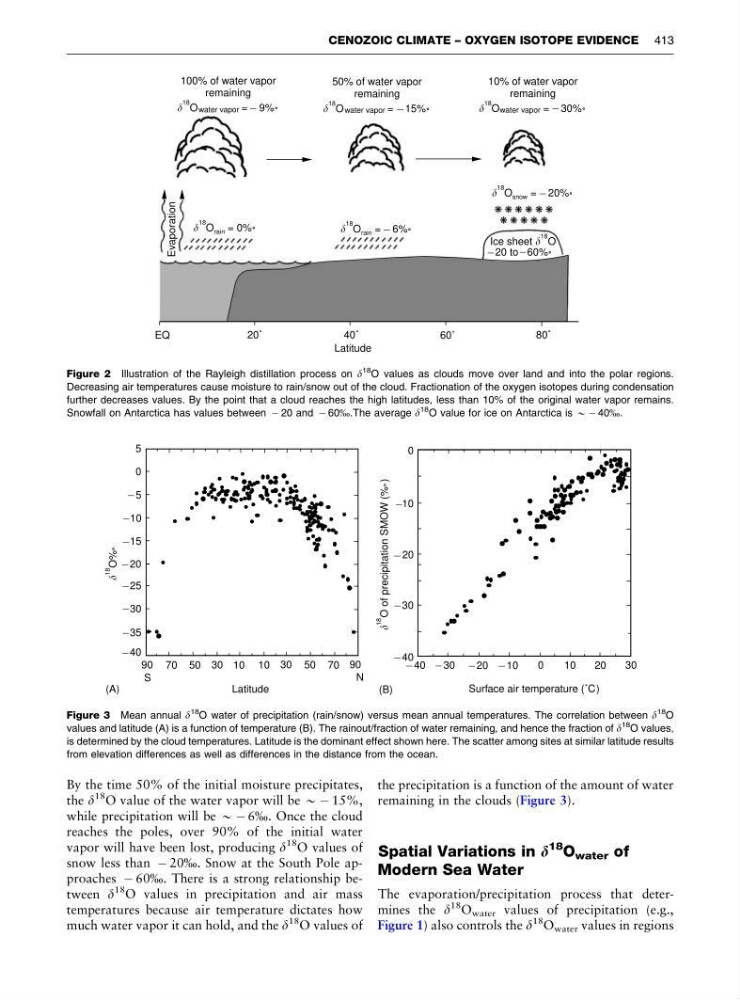
By the time 50% of the initial moisture precipitates,
the d
18 O value of the water vapor will be B À 15%,
while precipitation will be B À 6%. Once the cloud
reaches the poles, over 90% of the initial water
vapor will have been lost, producing d
18
O values of
snow less than À 20%. Snow at the South Pole approaches À 60%. There is a strong relationship between d
18 O values in precipitation and air mass
temperatures because air temperature dictates how
much water vapor it can hold, and the d
18 O values of
the precipitation is a function of the amount of water
remaining in the clouds (Figure 3).
Spatial Variations in d
18
O water of
Modern Sea Water
The evaporation/precipitation process that determines the d
18 O water values of precipitation (e.g.,
Figure 1) also controls the d
18 O water values in regions
100% of water vapor
remaining
O
= _ 9
18
% ˚
O = 0
18
rain
% ˚
O = _ 6
18
rain
%
˚
O
= _ 20
18
snow
%
˚
50% of water vapor
remaining
O
= _ 15%
18
˚
10% of water vapor
remaining
O
= _ 30
18
%
˚
Evaporation
EQ
20˚
40˚
60˚
80˚
Latitude
water vapor
water vapor
water vapor
Ice sheet O
18
_ 20 to _ 60%
˚
Figure 2 Illustration of the Rayleigh distillation process on d
18 O values as clouds move over land and into the polar regions.
Decreasing air temperatures cause moisture to rain/snow out of the cloud. Fractionation of the oxygen isotopes during condensation
further decreases values. By the point that a cloud reaches the high latitudes, less than 10% of the original water vapor remains.
Snowfall on Antarctica has values between À 20 and À 60%.The average d
18 O value for ice on Antarctica is B À 40%.
5
0
_ 5
_ 10
_ 15
_ 20
_ 25
_ 30
_ 35
_ 40
90 70 50 30 10 10 30 50 70 90
N
S
Latitude
18
O%
˚
(A)
18
O of precipitation SMOW (% )
˚
0
_ 10
_ 20
_ 30
_ 40 _ 40 _ 30 _ 20 _ 10
10
20
30
0
Surface air temperature (˚C)
(B)
Figure 3 Mean annual d
18
O water of precipitation (rain/snow) versus mean annual temperatures. The correlation between d
18 O
values and latitude (A) is a function of temperature (B). The rainout/fraction of water remaining, and hence the fraction of d
18 O values,
is determined by the cloud temperatures. Latitude is the dominant effect shown here. The scatter among sites at similar latitude results
from elevation differences as well as differences in the distance from the ocean.
CENOZOIC CLIMATE – OXYGEN ISOTOPE EVIDENCE 413
the d
18 O value of the water vapor will be B À 15%,
while precipitation will be B À 6%. Once the cloud
reaches the poles, over 90% of the initial water
vapor will have been lost, producing d
18
O values of
snow less than À 20%. Snow at the South Pole approaches À 60%. There is a strong relationship between d
18 O values in precipitation and air mass
temperatures because air temperature dictates how
much water vapor it can hold, and the d
18 O values of
the precipitation is a function of the amount of water
remaining in the clouds (Figure 3).
Spatial Variations in d
18
O water of
Modern Sea Water
The evaporation/precipitation process that determines the d
18 O water values of precipitation (e.g.,
Figure 1) also controls the d
18 O water values in regions
100% of water vapor
remaining
O
= _ 9
18
% ˚
O = 0
18
rain
% ˚
O = _ 6
18
rain
%
˚
O
= _ 20
18
snow
%
˚
50% of water vapor
remaining
O
= _ 15%
18
˚
10% of water vapor
remaining
O
= _ 30
18
%
˚
Evaporation
EQ
20˚
40˚
60˚
80˚
Latitude
water vapor
water vapor
water vapor
Ice sheet O
18
_ 20 to _ 60%
˚
Figure 2 Illustration of the Rayleigh distillation process on d
18 O values as clouds move over land and into the polar regions.
Decreasing air temperatures cause moisture to rain/snow out of the cloud. Fractionation of the oxygen isotopes during condensation
further decreases values. By the point that a cloud reaches the high latitudes, less than 10% of the original water vapor remains.
Snowfall on Antarctica has values between À 20 and À 60%.The average d
18 O value for ice on Antarctica is B À 40%.
5
0
_ 5
_ 10
_ 15
_ 20
_ 25
_ 30
_ 35
_ 40
90 70 50 30 10 10 30 50 70 90
N
S
Latitude
18
O%
˚
(A)
18
O of precipitation SMOW (% )
˚
0
_ 10
_ 20
_ 30
_ 40 _ 40 _ 30 _ 20 _ 10
10
20
30
0
Surface air temperature (˚C)
(B)
Figure 3 Mean annual d
18
O water of precipitation (rain/snow) versus mean annual temperatures. The correlation between d
18 O
values and latitude (A) is a function of temperature (B). The rainout/fraction of water remaining, and hence the fraction of d
18 O values,
is determined by the cloud temperatures. Latitude is the dominant effect shown here. The scatter among sites at similar latitude results
from elevation differences as well as differences in the distance from the ocean.
CENOZOIC CLIMATE – OXYGEN ISOTOPE EVIDENCE 413