

organism lived
1 and d
18
O calcite is the oxygen isotope
value of calcite measured in the mass spectrometer.
Eqn [2] shows that the changes in d
18
O calcite are a
function of the water temperature and d
18
O water value.
A one-to-one relationship between d
18
O calcite and
d
18
O water values dictates that a change in the d
18
O water
term will cause a similar change in the measured
d
18
O calcite value. However, an inverse relationship
between d
18
O calcite and T changes dictates that for
every 11C increase in temperature, there is a 0.23%
decrease in the measured d
18
O calcite value. These relationships enable us to interpret d
18
O calcite changes
generated from foraminifera, corals, and mollusks.
For many years, the convention was to plot d
18
O calcite
values with the axis reversed (higher values to the left
or bottom) so that d
18
O records reflect climate changes (e.g., colder to the left or bottom). More recently,
there has been a trend among some scientists to plot
d
18
O calcite values without reversing the axis.
The paleotemperature equation contains two unknowns (temperature, d
18
O water ). Although temperature is the main target in reconstructions, one
cannot ignore the d
18
O water term. In the modern
ocean, the equator-to-pole gradient measured in
planktonic foraminifera d
18 O calcite values is B5.0%
and largely reflects the temperature gradient
(B281C). However, if temperature were the sole influence on modern d
18 O calcite values, the equator-topole gradient would be B6.5% (281C Â 0.23%/1C).
The attenuated d
18 O calcite gradient measured in
planktonic foraminifera reflects the surface ocean
d
18 O water variability. Therefore, a key to using
d
18 O calcite records as indicators of past climates is to
understand the hydrographic parameters that produce the modern d
18
O calcite gradient. For instance,
ignoring the d
18
O water term results in a 5–61C
underestimation compared to the observed temperature gradient. This occurs largely because tropical temperature estimates will be too cold (B41C)
whereas polar estimates will be warm (B1–21C).
d
18
O Variation in the Natural
Environment
d
18 O water values in the ocean/atmosphere system
vary both spatially and temporally because fractionation between the H 2
18 O and H 2
16 O molecules
is temperature-dependent in the hydrologic cycle and
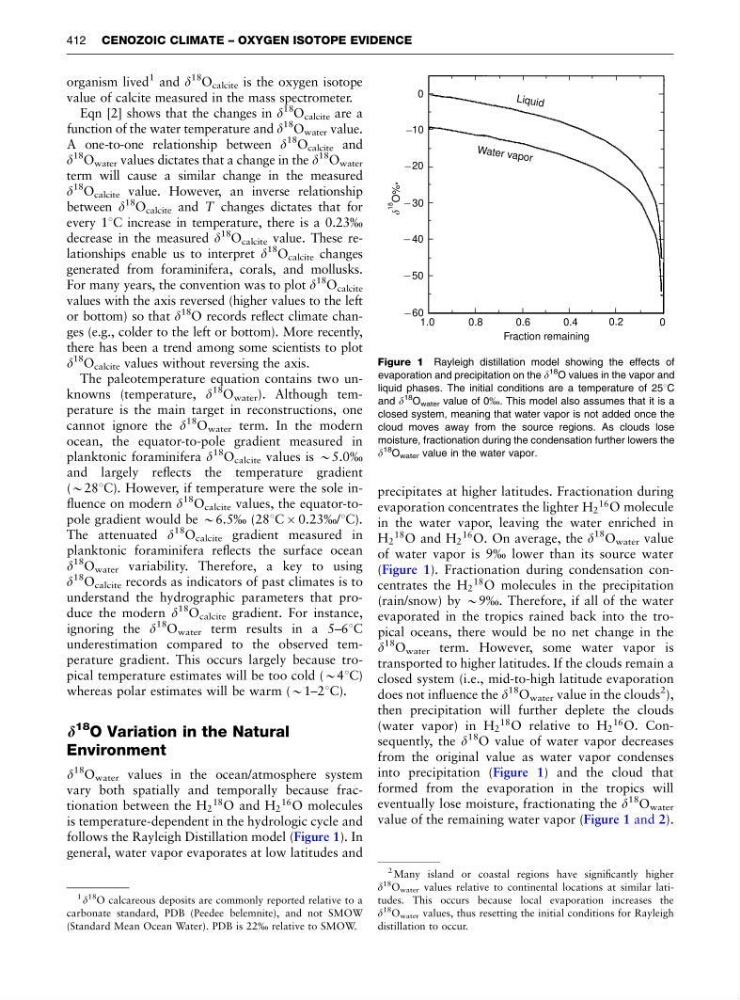
follows the Rayleigh Distillation model (Figure 1). In
general, water vapor evaporates at low latitudes and
precipitates at higher latitudes. Fractionation during
evaporation concentrates the lighter H 2
16 O molecule
in the water vapor, leaving the water enriched in
H 2
18 O and H 2
16 O. On average, the d
18 O water value
of water vapor is 9% lower than its source water
(Figure 1). Fractionation during condensation concentrates the H 2
18 O molecules in the precipitation
(rain/snow) by B9%. Therefore, if all of the water
evaporated in the tropics rained back into the tropical oceans, there would be no net change in the
d
18 O water term. However, some water vapor is
transported to higher latitudes. If the clouds remain a
closed system (i.e., mid-to-high latitude evaporation
does not influence the d
18 O water value in the clouds
2 ),
then precipitation will further deplete the clouds
(water vapor) in H 2
18 O relative to H 2
16 O. Consequently, the d
18 O value of water vapor decreases
from the original value as water vapor condenses
into precipitation (Figure 1) and the cloud that
formed from the evaporation in the tropics will
eventually lose moisture, fractionating the d
18 O water
value of the remaining water vapor (Figure 1 and 2).
0
_ 10
_ 20
_ 30
_ 40
_ 50
_ 60
18
O%
˚
1.0
0.8
0.6
0.4
0.2
0
Fraction remaining
Li qu id
W ate r va po r
Figure 1 Rayleigh distillation model showing the effects of
evaporation and precipitation on the d
18 O values in the vapor and
liquid phases. The initial conditions are a temperature of 251C
and d
18
O water value of 0%. This model also assumes that it is a
closed system, meaning that water vapor is not added once the
cloud moves away from the source regions. As clouds lose
moisture, fractionation during the condensation further lowers the
d
18 O water value in the water vapor.
1 d
18
O calcareous deposits are commonly reported relative to a
carbonate standard, PDB (Peedee belemnite), and not SMOW
(Standard Mean Ocean Water). PDB is 22% relative to SMOW.
2 Many island or coastal regions have significantly higher
d
18 O water values relative to continental locations at similar latitudes. This occurs because local evaporation increases the
d
18 O water values, thus resetting the initial conditions for Rayleigh
distillation to occur.
412 CENOZOIC CLIMATE – OXYGEN ISOTOPE EVIDENCE
1 and d
18
O calcite is the oxygen isotope
value of calcite measured in the mass spectrometer.
Eqn [2] shows that the changes in d
18
O calcite are a
function of the water temperature and d
18
O water value.
A one-to-one relationship between d
18
O calcite and
d
18
O water values dictates that a change in the d
18
O water
term will cause a similar change in the measured
d
18
O calcite value. However, an inverse relationship
between d
18
O calcite and T changes dictates that for
every 11C increase in temperature, there is a 0.23%
decrease in the measured d
18
O calcite value. These relationships enable us to interpret d
18
O calcite changes
generated from foraminifera, corals, and mollusks.
For many years, the convention was to plot d
18
O calcite
values with the axis reversed (higher values to the left
or bottom) so that d
18
O records reflect climate changes (e.g., colder to the left or bottom). More recently,
there has been a trend among some scientists to plot
d
18
O calcite values without reversing the axis.
The paleotemperature equation contains two unknowns (temperature, d
18
O water ). Although temperature is the main target in reconstructions, one
cannot ignore the d
18
O water term. In the modern
ocean, the equator-to-pole gradient measured in
planktonic foraminifera d
18 O calcite values is B5.0%
and largely reflects the temperature gradient
(B281C). However, if temperature were the sole influence on modern d
18 O calcite values, the equator-topole gradient would be B6.5% (281C Â 0.23%/1C).
The attenuated d
18 O calcite gradient measured in
planktonic foraminifera reflects the surface ocean
d
18 O water variability. Therefore, a key to using
d
18 O calcite records as indicators of past climates is to
understand the hydrographic parameters that produce the modern d
18
O calcite gradient. For instance,
ignoring the d
18
O water term results in a 5–61C
underestimation compared to the observed temperature gradient. This occurs largely because tropical temperature estimates will be too cold (B41C)
whereas polar estimates will be warm (B1–21C).
d
18
O Variation in the Natural
Environment
d
18 O water values in the ocean/atmosphere system
vary both spatially and temporally because fractionation between the H 2
18 O and H 2
16 O molecules
is temperature-dependent in the hydrologic cycle and
follows the Rayleigh Distillation model (Figure 1). In
general, water vapor evaporates at low latitudes and
precipitates at higher latitudes. Fractionation during
evaporation concentrates the lighter H 2
16 O molecule
in the water vapor, leaving the water enriched in
H 2
18 O and H 2
16 O. On average, the d
18 O water value
of water vapor is 9% lower than its source water
(Figure 1). Fractionation during condensation concentrates the H 2
18 O molecules in the precipitation
(rain/snow) by B9%. Therefore, if all of the water
evaporated in the tropics rained back into the tropical oceans, there would be no net change in the
d
18 O water term. However, some water vapor is
transported to higher latitudes. If the clouds remain a
closed system (i.e., mid-to-high latitude evaporation
does not influence the d
18 O water value in the clouds
2 ),
then precipitation will further deplete the clouds
(water vapor) in H 2
18 O relative to H 2
16 O. Consequently, the d
18 O value of water vapor decreases
from the original value as water vapor condenses
into precipitation (Figure 1) and the cloud that
formed from the evaporation in the tropics will
eventually lose moisture, fractionating the d
18 O water
value of the remaining water vapor (Figure 1 and 2).
0
_ 10
_ 20
_ 30
_ 40
_ 50
_ 60
18
O%
˚
1.0
0.8
0.6
0.4
0.2
0
Fraction remaining
Li qu id
W ate r va po r
Figure 1 Rayleigh distillation model showing the effects of
evaporation and precipitation on the d
18 O values in the vapor and
liquid phases. The initial conditions are a temperature of 251C
and d
18
O water value of 0%. This model also assumes that it is a
closed system, meaning that water vapor is not added once the
cloud moves away from the source regions. As clouds lose
moisture, fractionation during the condensation further lowers the
d
18 O water value in the water vapor.
1 d
18
O calcareous deposits are commonly reported relative to a
carbonate standard, PDB (Peedee belemnite), and not SMOW
(Standard Mean Ocean Water). PDB is 22% relative to SMOW.
2 Many island or coastal regions have significantly higher
d
18 O water values relative to continental locations at similar latitudes. This occurs because local evaporation increases the
d
18 O water values, thus resetting the initial conditions for Rayleigh
distillation to occur.
412 CENOZOIC CLIMATE – OXYGEN ISOTOPE EVIDENCE