

marine environment, being subject to oxidation to an
insoluble form that is coprecipitated with ferromanganese oxides. However, additional work is required to establish with any degree of certainty that
this element is in fact redox active in the marine
environment.
Rhodium (Rh)
The water column distribution of Rh has been investigated in only a single study. In analytical terms
Rh is perhaps the most difficult of the PGEs to
quantify because Rh has only one stable isotope,
103 Rh. Therefore, the efficiency of Rh preconcentration from sea water must be monitored
using a short-lived radiotracer. This methodology
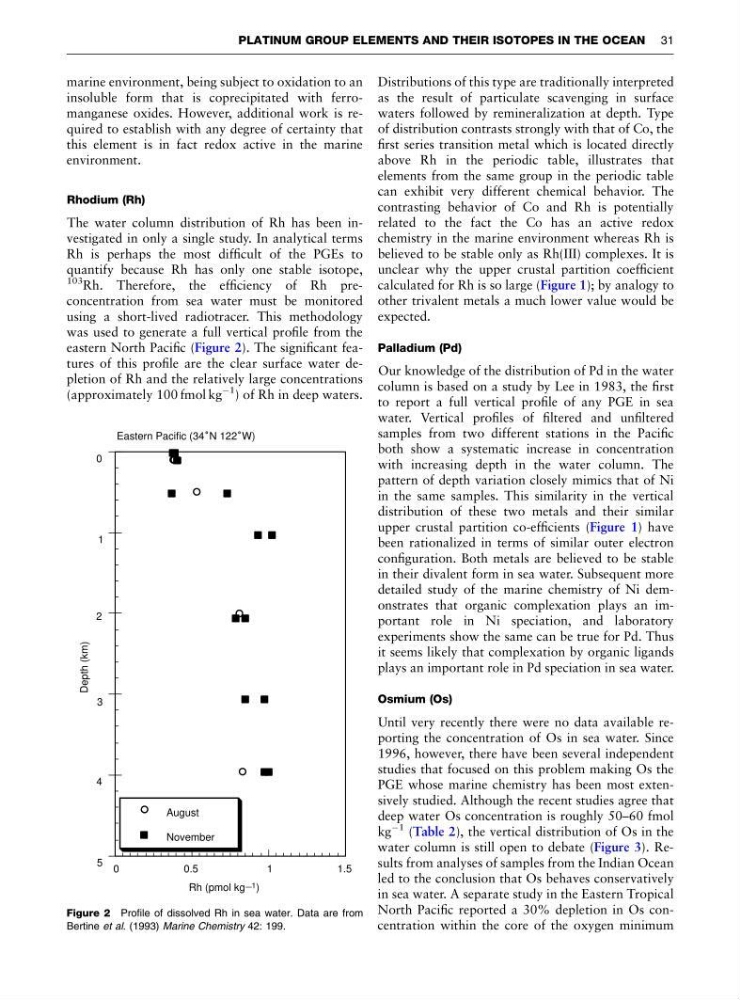
was used to generate a full vertical profile from the
eastern North Pacific (Figure 2). The significant features of this profile are the clear surface water depletion of Rh and the relatively large concentrations
(approximately 100 fmol kg
À1 ) of Rh in deep waters.
Distributions of this type are traditionally interpreted
as the result of particulate scavenging in surface
waters followed by remineralization at depth. Type
of distribution contrasts strongly with that of Co, the
first series transition metal which is located directly
above Rh in the periodic table, illustrates that
elements from the same group in the periodic table
can exhibit very different chemical behavior. The
contrasting behavior of Co and Rh is potentially
related to the fact the Co has an active redox
chemistry in the marine environment whereas Rh is
believed to be stable only as Rh(III) complexes. It is
unclear why the upper crustal partition coefficient
calculated for Rh is so large (Figure 1); by analogy to
other trivalent metals a much lower value would be
expected.
Palladium (Pd)
Our knowledge of the distribution of Pd in the water
column is based on a study by Lee in 1983, the first
to report a full vertical profile of any PGE in sea
water. Vertical profiles of filtered and unfiltered
samples from two different stations in the Pacific
both show a systematic increase in concentration
with increasing depth in the water column. The
pattern of depth variation closely mimics that of Ni
in the same samples. This similarity in the vertical
distribution of these two metals and their similar
upper crustal partition co-efficients (Figure 1) have
been rationalized in terms of similar outer electron
configuration. Both metals are believed to be stable
in their divalent form in sea water. Subsequent more
detailed study of the marine chemistry of Ni demonstrates that organic complexation plays an important role in Ni speciation, and laboratory
experiments show the same can be true for Pd. Thus
it seems likely that complexation by organic ligands
plays an important role in Pd speciation in sea water.
Osmium (Os)
Until very recently there were no data available reporting the concentration of Os in sea water. Since
1996, however, there have been several independent
studies that focused on this problem making Os the
PGE whose marine chemistry has been most extensively studied. Although the recent studies agree that
deep water Os concentration is roughly 50–60 fmol
kg
À1 (Table 2), the vertical distribution of Os in the
water column is still open to debate (Figure 3). Results from analyses of samples from the Indian Ocean
led to the conclusion that Os behaves conservatively
in sea water. A separate study in the Eastern Tropical
North Pacific reported a 30% depletion in Os concentration within the core of the oxygen minimum
5
4
3
2
1
0
Depth (km)
0
0.5
1
1.5
Rh (pmol kg _ 1 )
Eastern Pacific (34 ˚ N 122 ˚ W)
August
November
Figure 2 Profile of dissolved Rh in sea water. Data are from
Bertine et al. (1993) Marine Chemistry 42: 199.
PLATINUM GROUP ELEMENTS AND THEIR ISOTOPES IN THE OCEAN 31
insoluble form that is coprecipitated with ferromanganese oxides. However, additional work is required to establish with any degree of certainty that
this element is in fact redox active in the marine
environment.
Rhodium (Rh)
The water column distribution of Rh has been investigated in only a single study. In analytical terms
Rh is perhaps the most difficult of the PGEs to
quantify because Rh has only one stable isotope,
103 Rh. Therefore, the efficiency of Rh preconcentration from sea water must be monitored
using a short-lived radiotracer. This methodology
was used to generate a full vertical profile from the
eastern North Pacific (Figure 2). The significant features of this profile are the clear surface water depletion of Rh and the relatively large concentrations
(approximately 100 fmol kg
À1 ) of Rh in deep waters.
Distributions of this type are traditionally interpreted
as the result of particulate scavenging in surface
waters followed by remineralization at depth. Type
of distribution contrasts strongly with that of Co, the
first series transition metal which is located directly
above Rh in the periodic table, illustrates that
elements from the same group in the periodic table
can exhibit very different chemical behavior. The
contrasting behavior of Co and Rh is potentially
related to the fact the Co has an active redox
chemistry in the marine environment whereas Rh is
believed to be stable only as Rh(III) complexes. It is
unclear why the upper crustal partition coefficient
calculated for Rh is so large (Figure 1); by analogy to
other trivalent metals a much lower value would be
expected.
Palladium (Pd)
Our knowledge of the distribution of Pd in the water
column is based on a study by Lee in 1983, the first
to report a full vertical profile of any PGE in sea
water. Vertical profiles of filtered and unfiltered
samples from two different stations in the Pacific
both show a systematic increase in concentration
with increasing depth in the water column. The
pattern of depth variation closely mimics that of Ni
in the same samples. This similarity in the vertical
distribution of these two metals and their similar
upper crustal partition co-efficients (Figure 1) have
been rationalized in terms of similar outer electron
configuration. Both metals are believed to be stable
in their divalent form in sea water. Subsequent more
detailed study of the marine chemistry of Ni demonstrates that organic complexation plays an important role in Ni speciation, and laboratory
experiments show the same can be true for Pd. Thus
it seems likely that complexation by organic ligands
plays an important role in Pd speciation in sea water.
Osmium (Os)
Until very recently there were no data available reporting the concentration of Os in sea water. Since
1996, however, there have been several independent
studies that focused on this problem making Os the
PGE whose marine chemistry has been most extensively studied. Although the recent studies agree that
deep water Os concentration is roughly 50–60 fmol
kg
À1 (Table 2), the vertical distribution of Os in the
water column is still open to debate (Figure 3). Results from analyses of samples from the Indian Ocean
led to the conclusion that Os behaves conservatively
in sea water. A separate study in the Eastern Tropical
North Pacific reported a 30% depletion in Os concentration within the core of the oxygen minimum
5
4
3
2
1
0
Depth (km)
0
0.5
1
1.5
Rh (pmol kg _ 1 )
Eastern Pacific (34 ˚ N 122 ˚ W)
August
November
Figure 2 Profile of dissolved Rh in sea water. Data are from
Bertine et al. (1993) Marine Chemistry 42: 199.
PLATINUM GROUP ELEMENTS AND THEIR ISOTOPES IN THE OCEAN 31