

surface. In simplest terms the concentrations of the
PGEs in sea water are low compared to other elements because there is a relatively smaller inventory of
these elements in the earth’s surficial environment.
In the context of the marine chemistry of the PGEs
it is significant that the conceptual basis for considering these elements as a coherent group is more
closely linked to their behavior in the deep earth than
to their behavior in the ocean. Once the very low
average crustal concentrations of the PGEs is taken
into account it is clear that as a group these elements
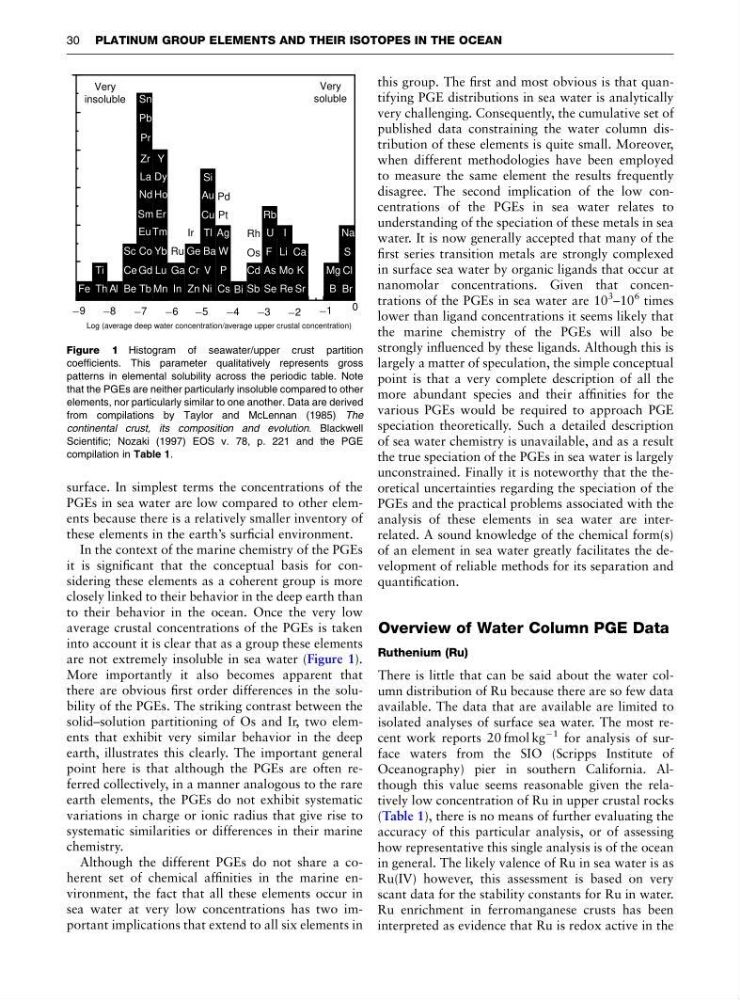
are not extremely insoluble in sea water (Figure 1).
More importantly it also becomes apparent that
there are obvious first order differences in the solubility of the PGEs. The striking contrast between the
solid–solution partitioning of Os and Ir, two elements that exhibit very similar behavior in the deep
earth, illustrates this clearly. The important general
point here is that although the PGEs are often referred collectively, in a manner analogous to the rare
earth elements, the PGEs do not exhibit systematic
variations in charge or ionic radius that give rise to
systematic similarities or differences in their marine
chemistry.
Although the different PGEs do not share a coherent set of chemical affinities in the marine environment, the fact that all these elements occur in
sea water at very low concentrations has two important implications that extend to all six elements in
this group. The first and most obvious is that quantifying PGE distributions in sea water is analytically
very challenging. Consequently, the cumulative set of
published data constraining the water column distribution of these elements is quite small. Moreover,
when different methodologies have been employed
to measure the same element the results frequently
disagree. The second implication of the low concentrations of the PGEs in sea water relates to
understanding of the speciation of these metals in sea
water. It is now generally accepted that many of the
first series transition metals are strongly complexed
in surface sea water by organic ligands that occur at
nanomolar concentrations. Given that concentrations of the PGEs in sea water are 10
3 –10
6 times
lower than ligand concentrations it seems likely that
the marine chemistry of the PGEs will also be
strongly influenced by these ligands. Although this is
largely a matter of speculation, the simple conceptual
point is that a very complete description of all the
more abundant species and their affinities for the
various PGEs would be required to approach PGE
speciation theoretically. Such a detailed description
of sea water chemistry is unavailable, and as a result
the true speciation of the PGEs in sea water is largely
unconstrained. Finally it is noteworthy that the theoretical uncertainties regarding the speciation of the
PGEs and the practical problems associated with the
analysis of these elements in sea water are interrelated. A sound knowledge of the chemical form(s)
of an element in sea water greatly facilitates the development of reliable methods for its separation and
quantification.
Overview of Water Column PGE Data
Ruthenium (Ru)
There is little that can be said about the water column distribution of Ru because there are so few data
available. The data that are available are limited to
isolated analyses of surface sea water. The most recent work reports 20 fmol kg
À1 for analysis of surface waters from the SIO (Scripps Institute of
Oceanography) pier in southern California. Although this value seems reasonable given the relatively low concentration of Ru in upper crustal rocks
(Table 1), there is no means of further evaluating the
accuracy of this particular analysis, or of assessing
how representative this single analysis is of the ocean
in general. The likely valence of Ru in sea water is as
Ru(IV) however, this assessment is based on very
scant data for the stability constants for Ru in water.
Ru enrichment in ferromanganese crusts has been
interpreted as evidence that Ru is redox active in the
_ 9
_ 8
_ 7
_ 6
_ 5
_ 4
_ 3
_ 2
_ 1
0
Fe
Ti
Th Al
Sn
Pb
Pr
Zr
La
Nd
Sm
Eu
Y
Dy
Ho
Er
Tm
Co Yb
Gd Lu
Sc
Ce
Be Tb Mn
Ga
In
Ge
Cr
Zn
Si
Au
Cu
Tl
Ba
V
Ni
Ag
W
P
Cs Bi
Cd
Sb
Rb
U
F
As
Se
I
Li
Mo
Re
Ca
K
Sr
Mg
B
Na
S
Cl
Br
Very
insoluble
Very
soluble
Pd
Pt
Rh
Os
Ru
Ir
Log (average deep water concentration/average upper crustal concentration)
Figure 1 Histogram of seawater/upper crust partition
coefficients. This parameter qualitatively represents gross
patterns in elemental solubility across the periodic table. Note
that the PGEs are neither particularly insoluble compared to other
elements, nor particularly similar to one another. Data are derived
from compilations by Taylor and McLennan (1985) The
continental crust, its composition and evolution. Blackwell
Scientific; Nozaki (1997) EOS v. 78, p. 221 and the PGE
compilation in Table 1.
30 PLATINUM GROUP ELEMENTS AND THEIR ISOTOPES IN THE OCEAN
PGEs in sea water are low compared to other elements because there is a relatively smaller inventory of
these elements in the earth’s surficial environment.
In the context of the marine chemistry of the PGEs
it is significant that the conceptual basis for considering these elements as a coherent group is more
closely linked to their behavior in the deep earth than
to their behavior in the ocean. Once the very low
average crustal concentrations of the PGEs is taken
into account it is clear that as a group these elements
are not extremely insoluble in sea water (Figure 1).
More importantly it also becomes apparent that
there are obvious first order differences in the solubility of the PGEs. The striking contrast between the
solid–solution partitioning of Os and Ir, two elements that exhibit very similar behavior in the deep
earth, illustrates this clearly. The important general
point here is that although the PGEs are often referred collectively, in a manner analogous to the rare
earth elements, the PGEs do not exhibit systematic
variations in charge or ionic radius that give rise to
systematic similarities or differences in their marine
chemistry.
Although the different PGEs do not share a coherent set of chemical affinities in the marine environment, the fact that all these elements occur in
sea water at very low concentrations has two important implications that extend to all six elements in
this group. The first and most obvious is that quantifying PGE distributions in sea water is analytically
very challenging. Consequently, the cumulative set of
published data constraining the water column distribution of these elements is quite small. Moreover,
when different methodologies have been employed
to measure the same element the results frequently
disagree. The second implication of the low concentrations of the PGEs in sea water relates to
understanding of the speciation of these metals in sea
water. It is now generally accepted that many of the
first series transition metals are strongly complexed
in surface sea water by organic ligands that occur at
nanomolar concentrations. Given that concentrations of the PGEs in sea water are 10
3 –10
6 times
lower than ligand concentrations it seems likely that
the marine chemistry of the PGEs will also be
strongly influenced by these ligands. Although this is
largely a matter of speculation, the simple conceptual
point is that a very complete description of all the
more abundant species and their affinities for the
various PGEs would be required to approach PGE
speciation theoretically. Such a detailed description
of sea water chemistry is unavailable, and as a result
the true speciation of the PGEs in sea water is largely
unconstrained. Finally it is noteworthy that the theoretical uncertainties regarding the speciation of the
PGEs and the practical problems associated with the
analysis of these elements in sea water are interrelated. A sound knowledge of the chemical form(s)
of an element in sea water greatly facilitates the development of reliable methods for its separation and
quantification.
Overview of Water Column PGE Data
Ruthenium (Ru)
There is little that can be said about the water column distribution of Ru because there are so few data
available. The data that are available are limited to
isolated analyses of surface sea water. The most recent work reports 20 fmol kg
À1 for analysis of surface waters from the SIO (Scripps Institute of
Oceanography) pier in southern California. Although this value seems reasonable given the relatively low concentration of Ru in upper crustal rocks
(Table 1), there is no means of further evaluating the
accuracy of this particular analysis, or of assessing
how representative this single analysis is of the ocean
in general. The likely valence of Ru in sea water is as
Ru(IV) however, this assessment is based on very
scant data for the stability constants for Ru in water.
Ru enrichment in ferromanganese crusts has been
interpreted as evidence that Ru is redox active in the
_ 9
_ 8
_ 7
_ 6
_ 5
_ 4
_ 3
_ 2
_ 1
0
Fe
Ti
Th Al
Sn
Pb
Pr
Zr
La
Nd
Sm
Eu
Y
Dy
Ho
Er
Tm
Co Yb
Gd Lu
Sc
Ce
Be Tb Mn
Ga
In
Ge
Cr
Zn
Si
Au
Cu
Tl
Ba
V
Ni
Ag
W
P
Cs Bi
Cd
Sb
Rb
U
F
As
Se
I
Li
Mo
Re
Ca
K
Sr
Mg
B
Na
S
Cl
Br
Very
insoluble
Very
soluble
Pd
Pt
Rh
Os
Ru
Ir
Log (average deep water concentration/average upper crustal concentration)
Figure 1 Histogram of seawater/upper crust partition
coefficients. This parameter qualitatively represents gross
patterns in elemental solubility across the periodic table. Note
that the PGEs are neither particularly insoluble compared to other
elements, nor particularly similar to one another. Data are derived
from compilations by Taylor and McLennan (1985) The
continental crust, its composition and evolution. Blackwell
Scientific; Nozaki (1997) EOS v. 78, p. 221 and the PGE
compilation in Table 1.
30 PLATINUM GROUP ELEMENTS AND THEIR ISOTOPES IN THE OCEAN