

PLATINUM GROUP ELEMENTS AND THEIR
ISOTOPES IN THE OCEAN
G. E. Ravizza, Woods Hole Oceanographic Institution,
Woods Hole, MA, USA
Copyright & 2001 Elsevier Ltd.
Introduction
The platinum group elements (PGEs) include three
second-series transition metals, ruthenium (Ru), rhodium (Rh) palladium (Pd), and three third-series
transition metals, osmium (Os), iridium (Ir) and platinum (Pt). The marine chemistry of this group of
elements is the least understood and most poorly
documented among the many elements in the periodic
table. During the 1970s and 1980s when the attention
of the marine chemistry community was focused on
characterizing the distribution of all the elements in
the ocean, direct measurement of the PGEs in sea
water was, for the most part, beyond the reach of
available analytical methods. Indeed, the most important attribute that links the marine chemistry of all
the PGEs is their very low concentration in sea water.
This group of metals accounts for 6 of the 10 least
abundant elements in sea water.
This article has three objectives. First, to explain
how the dissolved inventories of PGEs in the ocean
are maintained at such low concentrations relative to
most other elements. Second, to review the current
status of our knowledge regarding the vertical distribution of these metals in the oceanic water column. Third, to present a brief overview of areas of
marine PGE research that are the focus present research activity, and are likely to motivate future
investigation. These areas are (1) sea water Os isotope geochemistry; (2) Ir and the other PGEs as
tracers of extraterrestrial material in marine sediments; and (3) anthropogenic release of PGEs to the
marine environment.
The Apparent Rarity of the PGEs in
Sea Water
The underlying reason for the very low concentrations of all the PGEs in sea water has little to do
with the aqueous chemistry of these elements. Rather
it is the chemical partitioning of these elements
within the deep earth that explains their relative
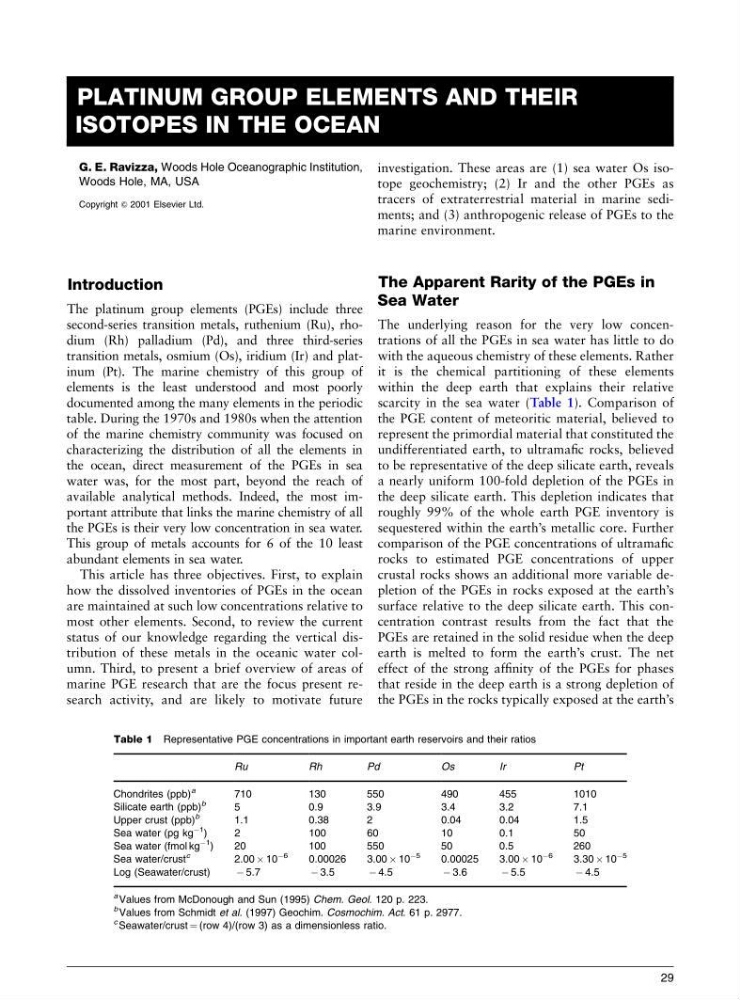
scarcity in the sea water (Table 1). Comparison of
the PGE content of meteoritic material, believed to
represent the primordial material that constituted the
undifferentiated earth, to ultramafic rocks, believed
to be representative of the deep silicate earth, reveals
a nearly uniform 100-fold depletion of the PGEs in
the deep silicate earth. This depletion indicates that
roughly 99% of the whole earth PGE inventory is
sequestered within the earth’s metallic core. Further
comparison of the PGE concentrations of ultramafic
rocks to estimated PGE concentrations of upper
crustal rocks shows an additional more variable depletion of the PGEs in rocks exposed at the earth’s
surface relative to the deep silicate earth. This concentration contrast results from the fact that the
PGEs are retained in the solid residue when the deep
earth is melted to form the earth’s crust. The net
effect of the strong affinity of the PGEs for phases
that reside in the deep earth is a strong depletion of
the PGEs in the rocks typically exposed at the earth’s
Table 1 Representative PGE concentrations in important earth reservoirs and their ratios
Ru
Rh
Pd
Os
Ir
Pt
Chondrites (ppb)
a
710
130
550
490
455
1010
Silicate earth (ppb)
b
5
0.9
3.9
3.4
3.2
7.1
Upper crust (ppb)
b
1.1
0.38
2
0.04
0.04
1.5
Sea water (pg kg
À1 )
2
100
60
10
0.1
50
Sea water (fmol kg
À1
)
20
100
550
50
0.5
260
Sea water/crust
c
2.00 Â 10
À6
0.00026
3.00 Â 10
À5
0.00025
3.00 Â 10
À6
3.30 Â 10
À5
Log (Seawater/crust)
À 5.7
À 3.5
À 4.5
À 3.6
À 5.5
À 4.5
a Values from McDonough and Sun (1995) Chem. Geol. 120 p. 223.
b Values from Schmidt et al. (1997) Geochim. Cosmochim. Act. 61 p. 2977.
c Seawater/crust ¼ (row 4)/(row 3) as a dimensionless ratio.
29
ISOTOPES IN THE OCEAN
G. E. Ravizza, Woods Hole Oceanographic Institution,
Woods Hole, MA, USA
Copyright & 2001 Elsevier Ltd.
Introduction
The platinum group elements (PGEs) include three
second-series transition metals, ruthenium (Ru), rhodium (Rh) palladium (Pd), and three third-series
transition metals, osmium (Os), iridium (Ir) and platinum (Pt). The marine chemistry of this group of
elements is the least understood and most poorly
documented among the many elements in the periodic
table. During the 1970s and 1980s when the attention
of the marine chemistry community was focused on
characterizing the distribution of all the elements in
the ocean, direct measurement of the PGEs in sea
water was, for the most part, beyond the reach of
available analytical methods. Indeed, the most important attribute that links the marine chemistry of all
the PGEs is their very low concentration in sea water.
This group of metals accounts for 6 of the 10 least
abundant elements in sea water.
This article has three objectives. First, to explain
how the dissolved inventories of PGEs in the ocean
are maintained at such low concentrations relative to
most other elements. Second, to review the current
status of our knowledge regarding the vertical distribution of these metals in the oceanic water column. Third, to present a brief overview of areas of
marine PGE research that are the focus present research activity, and are likely to motivate future
investigation. These areas are (1) sea water Os isotope geochemistry; (2) Ir and the other PGEs as
tracers of extraterrestrial material in marine sediments; and (3) anthropogenic release of PGEs to the
marine environment.
The Apparent Rarity of the PGEs in
Sea Water
The underlying reason for the very low concentrations of all the PGEs in sea water has little to do
with the aqueous chemistry of these elements. Rather
it is the chemical partitioning of these elements
within the deep earth that explains their relative
scarcity in the sea water (Table 1). Comparison of
the PGE content of meteoritic material, believed to
represent the primordial material that constituted the
undifferentiated earth, to ultramafic rocks, believed
to be representative of the deep silicate earth, reveals
a nearly uniform 100-fold depletion of the PGEs in
the deep silicate earth. This depletion indicates that
roughly 99% of the whole earth PGE inventory is
sequestered within the earth’s metallic core. Further
comparison of the PGE concentrations of ultramafic
rocks to estimated PGE concentrations of upper
crustal rocks shows an additional more variable depletion of the PGEs in rocks exposed at the earth’s
surface relative to the deep silicate earth. This concentration contrast results from the fact that the
PGEs are retained in the solid residue when the deep
earth is melted to form the earth’s crust. The net
effect of the strong affinity of the PGEs for phases
that reside in the deep earth is a strong depletion of
the PGEs in the rocks typically exposed at the earth’s
Table 1 Representative PGE concentrations in important earth reservoirs and their ratios
Ru
Rh
Pd
Os
Ir
Pt
Chondrites (ppb)
a
710
130
550
490
455
1010
Silicate earth (ppb)
b
5
0.9
3.9
3.4
3.2
7.1
Upper crust (ppb)
b
1.1
0.38
2
0.04
0.04
1.5
Sea water (pg kg
À1 )
2
100
60
10
0.1
50
Sea water (fmol kg
À1
)
20
100
550
50
0.5
260
Sea water/crust
c
2.00 Â 10
À6
0.00026
3.00 Â 10
À5
0.00025
3.00 Â 10
À6
3.30 Â 10
À5
Log (Seawater/crust)
À 5.7
À 3.5
À 4.5
À 3.6
À 5.5
À 4.5
a Values from McDonough and Sun (1995) Chem. Geol. 120 p. 223.
b Values from Schmidt et al. (1997) Geochim. Cosmochim. Act. 61 p. 2977.
c Seawater/crust ¼ (row 4)/(row 3) as a dimensionless ratio.
29