

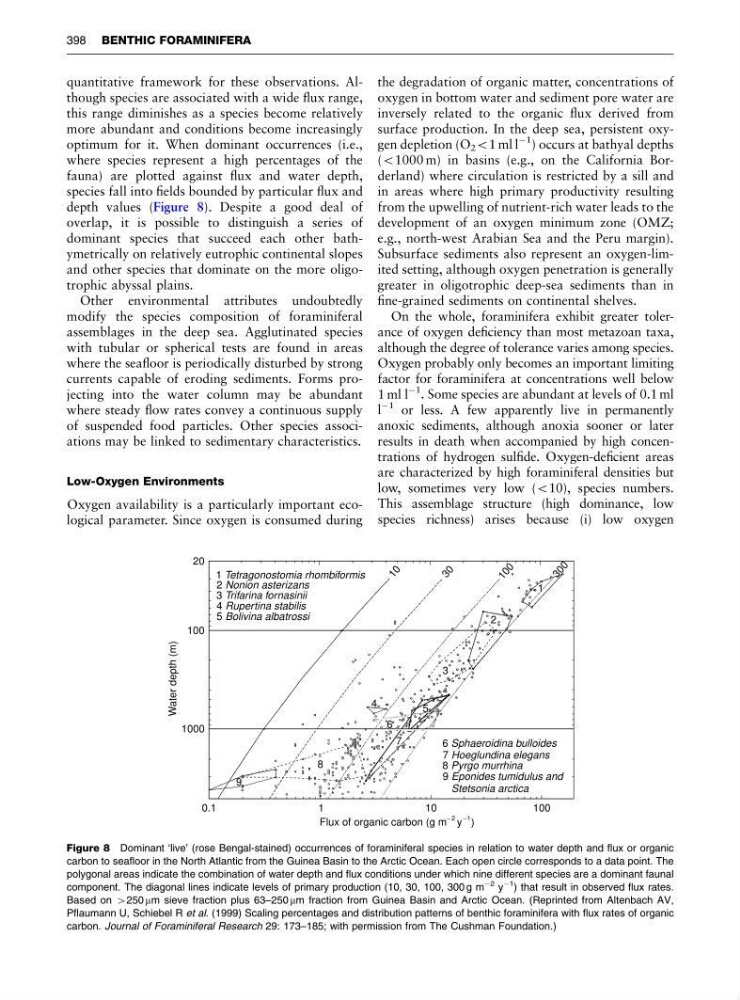
quantitative framework for these observations. Although species are associated with a wide flux range,
this range diminishes as a species become relatively
more abundant and conditions become increasingly
optimum for it. When dominant occurrences (i.e.,
where species represent a high percentages of the
fauna) are plotted against flux and water depth,
species fall into fields bounded by particular flux and
depth values (Figure 8). Despite a good deal of
overlap, it is possible to distinguish a series of
dominant species that succeed each other bathymetrically on relatively eutrophic continental slopes
and other species that dominate on the more oligotrophic abyssal plains.
Other environmental attributes undoubtedly
modify the species composition of foraminiferal
assemblages in the deep sea. Agglutinated species
with tubular or spherical tests are found in areas
where the seafloor is periodically disturbed by strong
currents capable of eroding sediments. Forms projecting into the water column may be abundant
where steady flow rates convey a continuous supply
of suspended food particles. Other species associations may be linked to sedimentary characteristics.
Low-Oxygen Environments
Oxygen availability is a particularly important ecological parameter. Since oxygen is consumed during
the degradation of organic matter, concentrations of
oxygen in bottom water and sediment pore water are
inversely related to the organic flux derived from
surface production. In the deep sea, persistent oxygen depletion (O 2 o1 ml l
À1
) occurs at bathyal depths
(o1000 m) in basins (e.g., on the California Borderland) where circulation is restricted by a sill and
in areas where high primary productivity resulting
from the upwelling of nutrient-rich water leads to the
development of an oxygen minimum zone (OMZ;
e.g., north-west Arabian Sea and the Peru margin).
Subsurface sediments also represent an oxygen-limited setting, although oxygen penetration is generally
greater in oligotrophic deep-sea sediments than in
fine-grained sediments on continental shelves.
On the whole, foraminifera exhibit greater tolerance of oxygen deficiency than most metazoan taxa,
although the degree of tolerance varies among species.
Oxygen probably only becomes an important limiting
factor for foraminifera at concentrations well below
1 ml l
À1
. Some species are abundant at levels of 0.1 ml
l
À1 or less. A few apparently live in permanently
anoxic sediments, although anoxia sooner or later
results in death when accompanied by high concentrations of hydrogen sulfide. Oxygen-deficient areas
are characterized by high foraminiferal densities but
low, sometimes very low (o10), species numbers.
This assemblage structure (high dominance, low
species richness) arises because (i) low oxygen
0.1
1
10
100
Flux of organic carbon (g m y )
_ 2 _ 1
20
1000
100
Water depth (m)
1 Tetragonostomia rhombiformis
2 Nonion asterizans
3 Trifarina fornasinii
4 Rupertina stabilis
5 Bolivina albatrossi
6 Sphaeroidina bulloides
7 Hoeglundina elegans
8 Pyrgo murrhina
9 Eponides tumidulus and
Stetsonia arctica
1 0
3 0
1 0 0
3 0 0
1
2
4
5
6
7
8
9
3
Figure 8 Dominant ‘live’ (rose Bengal-stained) occurrences of foraminiferal species in relation to water depth and flux or organic
carbon to seafloor in the North Atlantic from the Guinea Basin to the Arctic Ocean. Each open circle corresponds to a data point. The
polygonal areas indicate the combination of water depth and flux conditions under which nine different species are a dominant faunal
component. The diagonal lines indicate levels of primary production (10, 30, 100, 300 g m
À2 y
À1 ) that result in observed flux rates.
Based on 4250 mm sieve fraction plus 63–250 mm fraction from Guinea Basin and Arctic Ocean. (Reprinted from Altenbach AV,
Pflaumann U, Schiebel R et al. (1999) Scaling percentages and distribution patterns of benthic foraminifera with flux rates of organic
carbon. Journal of Foraminiferal Research 29: 173–185; with permission from The Cushman Foundation.)
398 BENTHIC FORAMINIFERA
this range diminishes as a species become relatively
more abundant and conditions become increasingly
optimum for it. When dominant occurrences (i.e.,
where species represent a high percentages of the
fauna) are plotted against flux and water depth,
species fall into fields bounded by particular flux and
depth values (Figure 8). Despite a good deal of
overlap, it is possible to distinguish a series of
dominant species that succeed each other bathymetrically on relatively eutrophic continental slopes
and other species that dominate on the more oligotrophic abyssal plains.
Other environmental attributes undoubtedly
modify the species composition of foraminiferal
assemblages in the deep sea. Agglutinated species
with tubular or spherical tests are found in areas
where the seafloor is periodically disturbed by strong
currents capable of eroding sediments. Forms projecting into the water column may be abundant
where steady flow rates convey a continuous supply
of suspended food particles. Other species associations may be linked to sedimentary characteristics.
Low-Oxygen Environments
Oxygen availability is a particularly important ecological parameter. Since oxygen is consumed during
the degradation of organic matter, concentrations of
oxygen in bottom water and sediment pore water are
inversely related to the organic flux derived from
surface production. In the deep sea, persistent oxygen depletion (O 2 o1 ml l
À1
) occurs at bathyal depths
(o1000 m) in basins (e.g., on the California Borderland) where circulation is restricted by a sill and
in areas where high primary productivity resulting
from the upwelling of nutrient-rich water leads to the
development of an oxygen minimum zone (OMZ;
e.g., north-west Arabian Sea and the Peru margin).
Subsurface sediments also represent an oxygen-limited setting, although oxygen penetration is generally
greater in oligotrophic deep-sea sediments than in
fine-grained sediments on continental shelves.
On the whole, foraminifera exhibit greater tolerance of oxygen deficiency than most metazoan taxa,
although the degree of tolerance varies among species.
Oxygen probably only becomes an important limiting
factor for foraminifera at concentrations well below
1 ml l
À1
. Some species are abundant at levels of 0.1 ml
l
À1 or less. A few apparently live in permanently
anoxic sediments, although anoxia sooner or later
results in death when accompanied by high concentrations of hydrogen sulfide. Oxygen-deficient areas
are characterized by high foraminiferal densities but
low, sometimes very low (o10), species numbers.
This assemblage structure (high dominance, low
species richness) arises because (i) low oxygen
0.1
1
10
100
Flux of organic carbon (g m y )
_ 2 _ 1
20
1000
100
Water depth (m)
1 Tetragonostomia rhombiformis
2 Nonion asterizans
3 Trifarina fornasinii
4 Rupertina stabilis
5 Bolivina albatrossi
6 Sphaeroidina bulloides
7 Hoeglundina elegans
8 Pyrgo murrhina
9 Eponides tumidulus and
Stetsonia arctica
1 0
3 0
1 0 0
3 0 0
1
2
4
5
6
7
8
9
3
Figure 8 Dominant ‘live’ (rose Bengal-stained) occurrences of foraminiferal species in relation to water depth and flux or organic
carbon to seafloor in the North Atlantic from the Guinea Basin to the Arctic Ocean. Each open circle corresponds to a data point. The
polygonal areas indicate the combination of water depth and flux conditions under which nine different species are a dominant faunal
component. The diagonal lines indicate levels of primary production (10, 30, 100, 300 g m
À2 y
À1 ) that result in observed flux rates.
Based on 4250 mm sieve fraction plus 63–250 mm fraction from Guinea Basin and Arctic Ocean. (Reprinted from Altenbach AV,
Pflaumann U, Schiebel R et al. (1999) Scaling percentages and distribution patterns of benthic foraminifera with flux rates of organic
carbon. Journal of Foraminiferal Research 29: 173–185; with permission from The Cushman Foundation.)
398 BENTHIC FORAMINIFERA