

factor is the degree of undersaturation of the bottom
water in calcium carbonate. This abyssal species is
found typically in the carbonate-corrosive (and
highly oligotrophic) environment between the calcite
lysocline and the CCD, a zone that may coincide
approximately with AABW. Where water masses are
more poorly delineated, as in the Indian and Pacific
Oceans, links with faunal distributions are less clear.
During the past 15 years, attention has focused on
the impact on foraminiferal ecology of organic
matter fluxes to the seafloor. The abundance of dead
foraminiferal shells 4150 mm in size correlates well
with flux values. There is also compelling evidence
that the distributions of species and species associations are linked to flux intensity. Infaunal species,
such as Melonis barleeanum, Uvigerina peregrina,
Chilostomella ovoidea and Globobulimina affinis,
predominate in organically enriched areas, e.g. beneath upwelling zones. Epifaunal species such as
Cibicidoides wuellerstorfi and Nuttallides umbonifera are common in oligotrophic areas, e.g. the central oceanic abyss. In addition to flux intensity, the
degree of seasonality of the food supply (i.e., whether
it is pulsed or continuous) is a significant factor.
Epistominella exigua, one of the opportunists that
exploit phytodetritus, occurs in relatively oligotrophic areas where phytodetritus is deposited
seasonally.
Recent analysis of a large dataset relating the
relative abundance of ‘live’ (stained) foraminiferal
assemblages in the north-east Atlantic and Arctic
Oceans to flux rates to the seafloor has provided a
0
1000
2000
3000
Total numbers of
living benthic foraminifera (per 10 cm )
2
0
0.5
1.0
1.5
2.0
2.5
3.0
3.5
Oxygenated layer (cm)
34 5 8 1112 2 3 5 7 9 11
4 6
12
5
9 12
1991
1992
1993
1994
(A)
(B)
(C)
Others
Fursenkoina sp.1
Bolivina pacifica
Textularia kattegatensis
Uvigerina spp.
Bolivina spissa
Bulimina aculeata
Globobulimina spp.
Chilostomella ovoidea
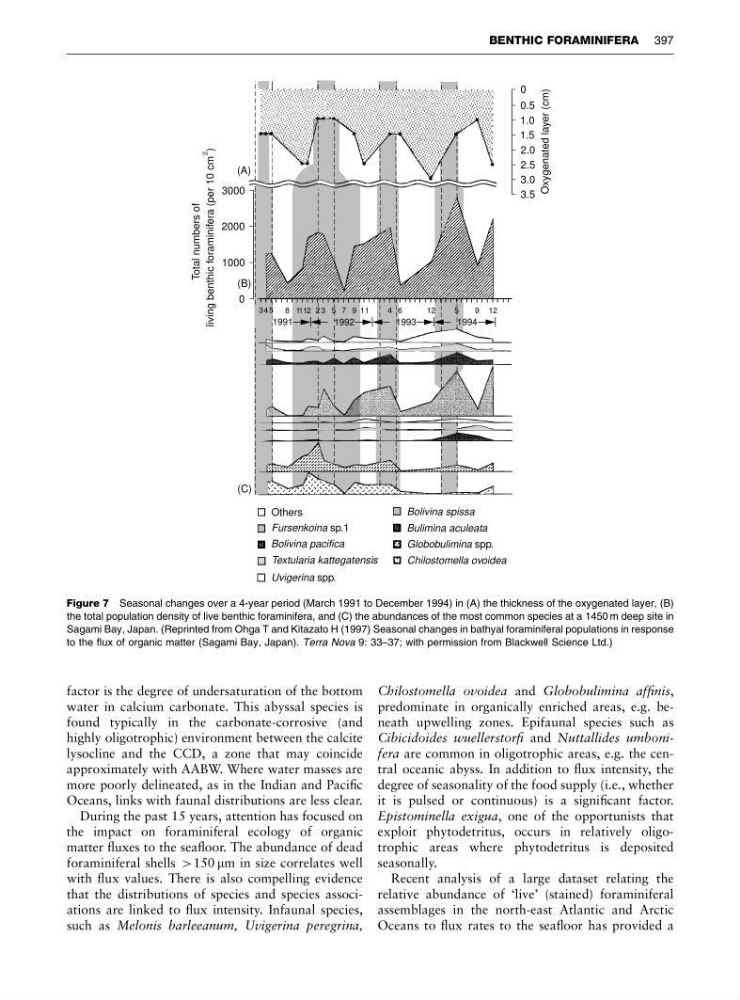
Figure 7 Seasonal changes over a 4-year period (March 1991 to December 1994) in (A) the thickness of the oxygenated layer, (B)
the total population density of live benthic foraminifera, and (C) the abundances of the most common species at a 1450 m deep site in
Sagami Bay, Japan. (Reprinted from Ohga T and Kitazato H (1997) Seasonal changes in bathyal foraminiferal populations in response
to the flux of organic matter (Sagami Bay, Japan). Terra Nova 9: 33–37; with permission from Blackwell Science Ltd.)
BENTHIC FORAMINIFERA 397
water in calcium carbonate. This abyssal species is
found typically in the carbonate-corrosive (and
highly oligotrophic) environment between the calcite
lysocline and the CCD, a zone that may coincide
approximately with AABW. Where water masses are
more poorly delineated, as in the Indian and Pacific
Oceans, links with faunal distributions are less clear.
During the past 15 years, attention has focused on
the impact on foraminiferal ecology of organic
matter fluxes to the seafloor. The abundance of dead
foraminiferal shells 4150 mm in size correlates well
with flux values. There is also compelling evidence
that the distributions of species and species associations are linked to flux intensity. Infaunal species,
such as Melonis barleeanum, Uvigerina peregrina,
Chilostomella ovoidea and Globobulimina affinis,
predominate in organically enriched areas, e.g. beneath upwelling zones. Epifaunal species such as
Cibicidoides wuellerstorfi and Nuttallides umbonifera are common in oligotrophic areas, e.g. the central oceanic abyss. In addition to flux intensity, the
degree of seasonality of the food supply (i.e., whether
it is pulsed or continuous) is a significant factor.
Epistominella exigua, one of the opportunists that
exploit phytodetritus, occurs in relatively oligotrophic areas where phytodetritus is deposited
seasonally.
Recent analysis of a large dataset relating the
relative abundance of ‘live’ (stained) foraminiferal
assemblages in the north-east Atlantic and Arctic
Oceans to flux rates to the seafloor has provided a
0
1000
2000
3000
Total numbers of
living benthic foraminifera (per 10 cm )
2
0
0.5
1.0
1.5
2.0
2.5
3.0
3.5
Oxygenated layer (cm)
34 5 8 1112 2 3 5 7 9 11
4 6
12
5
9 12
1991
1992
1993
1994
(A)
(B)
(C)
Others
Fursenkoina sp.1
Bolivina pacifica
Textularia kattegatensis
Uvigerina spp.
Bolivina spissa
Bulimina aculeata
Globobulimina spp.
Chilostomella ovoidea
Figure 7 Seasonal changes over a 4-year period (March 1991 to December 1994) in (A) the thickness of the oxygenated layer, (B)
the total population density of live benthic foraminifera, and (C) the abundances of the most common species at a 1450 m deep site in
Sagami Bay, Japan. (Reprinted from Ohga T and Kitazato H (1997) Seasonal changes in bathyal foraminiferal populations in response
to the flux of organic matter (Sagami Bay, Japan). Terra Nova 9: 33–37; with permission from Blackwell Science Ltd.)
BENTHIC FORAMINIFERA 397