

activities of these bacteria. These species move closer
to the sediment surface as redox zones shift upward
in the sediment under conditions of extreme oxygen
depletion. Although deep-infaunal foraminifera must
endure a harsh microenvironment, they are exposed
to less pressure from predators and competitors than
those occupying the more densely populated surface
sediments.
Deep-sea foraminifera may undergo temporal
fluctuations that reflect cycles of food and oxygen
availability. Changes over seasonal timescales in the
abundance of species and entire assemblages have
been described in continental slope settings (Figure 7). These changes are related to fluctuations in
pore water oxygen concentrations resulting from
episodic (seasonal) organic matter inputs to the seafloor. In some cases, the foraminifera migrate up and
down in the sediment, tracking critical oxygen levels
or redox fronts. Population fluctuations also occur in
abyssal settings where food is a limiting ecological
factor. In these cases, foraminiferal population dynamics reflect the seasonal availability of phytodetritus (‘food’). As a result of these temporal
processes, living foraminifera sampled during one
season often provide an incomplete view of the live
fauna as a whole.
Environmental Controls on Foraminiferal
Distributions
Our understanding of the factors that control the
distribution of foraminifera on the deep-ocean floor
is very incomplete, yet lack of knowledge has not
prevented the development of ideas. It is likely that
foraminiferal distribution patterns reflect a combination of influences. The most important first-order
factor is calcium carbonate dissolution. Above the
carbonate compensation depth (CCD), faunas include calcareous, agglutinated, and allogromiid taxa.
Below the CCD, calcareous species are almost entirely absent. At oceanwide or basinwide scales, the
organic carbon flux to the seafloor (and its seasonality) and bottom-water hydrography appear to be
particularly important, both above and below the
CCD.
Studies conducted in the 1950s and 1960s emphasized bathymetry (water depth) as an important
controlling factor. However, it soon became apparent
that the bathymetric distribution of foraminiferal
species beyond the shelf break is not consistent
geographically. Analyses of modern assemblages in
the North Atlantic, carried out in the 1970s, revealed
a much closer correlation between the distribution of
foraminiferal species and bottom-water masses. For
example, Cibicidoides wuellerstorfi was linked to
North Atlantic Deep Water (NADW) and Nuttallides
umbonifera to Antarctic Bottom Water (AABW). At
this time, it was difficult to explain how slight
physical and chemical differences between water
masses could influence foraminiferal distributions.
However, recent work in the south-east Atlantic,
where hydrographic contrasts are strongly developed, suggests that the distributions of certain
foraminiferal species are controlled in part by the
lateral advection of water masses. In the case of
N. umboniferus there is good evidence that the main
0
10 20 30 40 50
Intermediate and
deep infauna, number of specimens
0.25
1.25
2.25
3.25
4.25
5.25
6.25
7.25
8.25
9.25
0
100
200
150
50
250
Oxygen ( mol l )
μ
_ 1
0 20 40 60 80100120140160
0
1
2
3
4
5
6
7
8
9
10
Nitrate ( mol l )
μ
_ 1
(A)
(B)
(C)
0 100 200 300 400 500
Number of stained
foraminifera
0
1
2
3
4
5
6
7
8
9
10
Depth in sediment (cm)
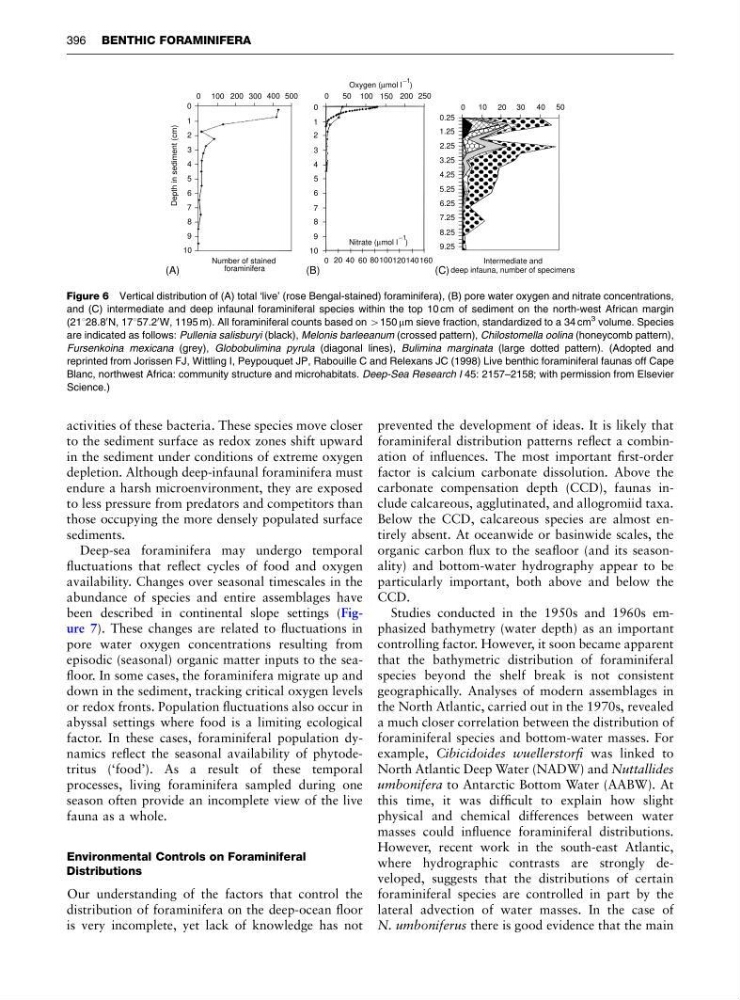
Figure 6 Vertical distribution of (A) total ‘live’ (rose Bengal-stained) foraminifera), (B) pore water oxygen and nitrate concentrations,
and (C) intermediate and deep infaunal foraminiferal species within the top 10 cm of sediment on the north-west African margin
(21128.8
0 N, 17157.2
0 W, 1195 m). All foraminiferal counts based on 4150 mm sieve fraction, standardized to a 34 cm
3 volume. Species
are indicated as follows: Pullenia salisburyi (black), Melonis barleeanum (crossed pattern), Chilostomella oolina (honeycomb pattern),
Fursenkoina mexicana (grey), Globobulimina pyrula (diagonal lines), Bulimina marginata (large dotted pattern). (Adopted and
reprinted from Jorissen FJ, Wittling I, Peypouquet JP, Rabouille C and Relexans JC (1998) Live benthic foraminiferal faunas off Cape
Blanc, northwest Africa: community structure and microhabitats. Deep-Sea Research I 45: 2157–2158; with permission from Elsevier
Science.)
396 BENTHIC FORAMINIFERA
to the sediment surface as redox zones shift upward
in the sediment under conditions of extreme oxygen
depletion. Although deep-infaunal foraminifera must
endure a harsh microenvironment, they are exposed
to less pressure from predators and competitors than
those occupying the more densely populated surface
sediments.
Deep-sea foraminifera may undergo temporal
fluctuations that reflect cycles of food and oxygen
availability. Changes over seasonal timescales in the
abundance of species and entire assemblages have
been described in continental slope settings (Figure 7). These changes are related to fluctuations in
pore water oxygen concentrations resulting from
episodic (seasonal) organic matter inputs to the seafloor. In some cases, the foraminifera migrate up and
down in the sediment, tracking critical oxygen levels
or redox fronts. Population fluctuations also occur in
abyssal settings where food is a limiting ecological
factor. In these cases, foraminiferal population dynamics reflect the seasonal availability of phytodetritus (‘food’). As a result of these temporal
processes, living foraminifera sampled during one
season often provide an incomplete view of the live
fauna as a whole.
Environmental Controls on Foraminiferal
Distributions
Our understanding of the factors that control the
distribution of foraminifera on the deep-ocean floor
is very incomplete, yet lack of knowledge has not
prevented the development of ideas. It is likely that
foraminiferal distribution patterns reflect a combination of influences. The most important first-order
factor is calcium carbonate dissolution. Above the
carbonate compensation depth (CCD), faunas include calcareous, agglutinated, and allogromiid taxa.
Below the CCD, calcareous species are almost entirely absent. At oceanwide or basinwide scales, the
organic carbon flux to the seafloor (and its seasonality) and bottom-water hydrography appear to be
particularly important, both above and below the
CCD.
Studies conducted in the 1950s and 1960s emphasized bathymetry (water depth) as an important
controlling factor. However, it soon became apparent
that the bathymetric distribution of foraminiferal
species beyond the shelf break is not consistent
geographically. Analyses of modern assemblages in
the North Atlantic, carried out in the 1970s, revealed
a much closer correlation between the distribution of
foraminiferal species and bottom-water masses. For
example, Cibicidoides wuellerstorfi was linked to
North Atlantic Deep Water (NADW) and Nuttallides
umbonifera to Antarctic Bottom Water (AABW). At
this time, it was difficult to explain how slight
physical and chemical differences between water
masses could influence foraminiferal distributions.
However, recent work in the south-east Atlantic,
where hydrographic contrasts are strongly developed, suggests that the distributions of certain
foraminiferal species are controlled in part by the
lateral advection of water masses. In the case of
N. umboniferus there is good evidence that the main
0
10 20 30 40 50
Intermediate and
deep infauna, number of specimens
0.25
1.25
2.25
3.25
4.25
5.25
6.25
7.25
8.25
9.25
0
100
200
150
50
250
Oxygen ( mol l )
μ
_ 1
0 20 40 60 80100120140160
0
1
2
3
4
5
6
7
8
9
10
Nitrate ( mol l )
μ
_ 1
(A)
(B)
(C)
0 100 200 300 400 500
Number of stained
foraminifera
0
1
2
3
4
5
6
7
8
9
10
Depth in sediment (cm)
Figure 6 Vertical distribution of (A) total ‘live’ (rose Bengal-stained) foraminifera), (B) pore water oxygen and nitrate concentrations,
and (C) intermediate and deep infaunal foraminiferal species within the top 10 cm of sediment on the north-west African margin
(21128.8
0 N, 17157.2
0 W, 1195 m). All foraminiferal counts based on 4150 mm sieve fraction, standardized to a 34 cm
3 volume. Species
are indicated as follows: Pullenia salisburyi (black), Melonis barleeanum (crossed pattern), Chilostomella oolina (honeycomb pattern),
Fursenkoina mexicana (grey), Globobulimina pyrula (diagonal lines), Bulimina marginata (large dotted pattern). (Adopted and
reprinted from Jorissen FJ, Wittling I, Peypouquet JP, Rabouille C and Relexans JC (1998) Live benthic foraminiferal faunas off Cape
Blanc, northwest Africa: community structure and microhabitats. Deep-Sea Research I 45: 2157–2158; with permission from Elsevier
Science.)
396 BENTHIC FORAMINIFERA