

foraminifera may help to bind together and stabilize
deep-sea sediments, although this has not yet been
clearly demonstrated.
Microhabitats and Temporal Variability
Like many smaller organisms, foraminifera reside
above, on and within deep-sea sediments. Various
factors influence their overall distribution pattern
within the sediment profile, but food availability and
geochemical (redox) gradients are probably the most
important. In oligotrophic regions, the flux of organic
matter (food) to the seafloor is low and most foraminifera live on or near the sediment surface where
food is concentrated. At the other extreme, in eutrophic regions, the high organic-matter flux causes
pore water oxygen concentrations to decrease rapidly
with depth into the sediment, restricting access to the
deeper layers to those species that can tolerate low
oxygen levels. Foraminifera penetrate most deeply
into the sediment where organic inputs are of intermediate intensity and the availability of food and
oxygen within the sediment is well balanced.
Underlying these patterns are the distributions of
individual species. Foraminifera occupy more or less
distinct zones or microenvironments (‘microhabitats’).
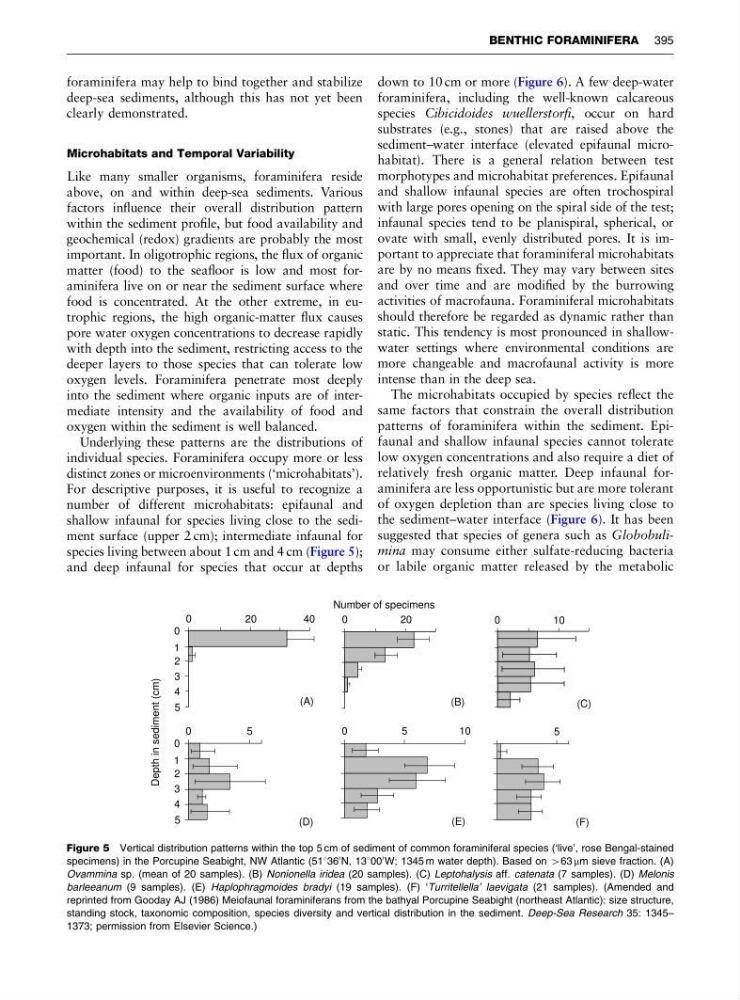
For descriptive purposes, it is useful to recognize a
number of different microhabitats: epifaunal and
shallow infaunal for species living close to the sediment surface (upper 2 cm); intermediate infaunal for
species living between about 1 cm and 4 cm (Figure 5);
and deep infaunal for species that occur at depths
down to 10 cm or more (Figure 6). A few deep-water
foraminifera, including the well-known calcareous
species Cibicidoides wuellerstorfi, occur on hard
substrates (e.g., stones) that are raised above the
sediment–water interface (elevated epifaunal microhabitat). There is a general relation between test
morphotypes and microhabitat preferences. Epifaunal
and shallow infaunal species are often trochospiral
with large pores opening on the spiral side of the test;
infaunal species tend to be planispiral, spherical, or
ovate with small, evenly distributed pores. It is important to appreciate that foraminiferal microhabitats
are by no means fixed. They may vary between sites
and over time and are modified by the burrowing
activities of macrofauna. Foraminiferal microhabitats
should therefore be regarded as dynamic rather than
static. This tendency is most pronounced in shallowwater settings where environmental conditions are
more changeable and macrofaunal activity is more
intense than in the deep sea.
The microhabitats occupied by species reflect the
same factors that constrain the overall distribution
patterns of foraminifera within the sediment. Epifaunal and shallow infaunal species cannot tolerate
low oxygen concentrations and also require a diet of
relatively fresh organic matter. Deep infaunal foraminifera are less opportunistic but are more tolerant
of oxygen depletion than are species living close to
the sediment–water interface (Figure 6). It has been
suggested that species of genera such as Globobulimina may consume either sulfate-reducing bacteria
or labile organic matter released by the metabolic
0
20
40
0
1
2
3
4
5
0
5
0
5
1 0
5
0
20
0
10
0
1
2
3
4
5
(A)
(B)
(C)
(F)
(E)
(D)
Number of specimens
Depth in sediment (cm)
Figure 5 Vertical distribution patterns within the top 5 cm of sediment of common foraminiferal species (‘live’, rose Bengal-stained
specimens) in the Porcupine Seabight, NW Atlantic (51136
0 N, 13100
0 W; 1345 m water depth). Based on 463 mm sieve fraction. (A)
Ovammina sp. (mean of 20 samples). (B) Nonionella iridea (20 samples). (C) Leptohalysis aff. catenata (7 samples). (D) Melonis
barleeanum (9 samples). (E) Haplophragmoides bradyi (19 samples). (F) ‘Turritellella’ laevigata (21 samples). (Amended and
reprinted from Gooday AJ (1986) Meiofaunal foraminiferans from the bathyal Porcupine Seabight (northeast Atlantic): size structure,
standing stock, taxonomic composition, species diversity and vertical distribution in the sediment. Deep-Sea Research 35: 1345–
1373; permission from Elsevier Science.)
BENTHIC FORAMINIFERA 395
deep-sea sediments, although this has not yet been
clearly demonstrated.
Microhabitats and Temporal Variability
Like many smaller organisms, foraminifera reside
above, on and within deep-sea sediments. Various
factors influence their overall distribution pattern
within the sediment profile, but food availability and
geochemical (redox) gradients are probably the most
important. In oligotrophic regions, the flux of organic
matter (food) to the seafloor is low and most foraminifera live on or near the sediment surface where
food is concentrated. At the other extreme, in eutrophic regions, the high organic-matter flux causes
pore water oxygen concentrations to decrease rapidly
with depth into the sediment, restricting access to the
deeper layers to those species that can tolerate low
oxygen levels. Foraminifera penetrate most deeply
into the sediment where organic inputs are of intermediate intensity and the availability of food and
oxygen within the sediment is well balanced.
Underlying these patterns are the distributions of
individual species. Foraminifera occupy more or less
distinct zones or microenvironments (‘microhabitats’).
For descriptive purposes, it is useful to recognize a
number of different microhabitats: epifaunal and
shallow infaunal for species living close to the sediment surface (upper 2 cm); intermediate infaunal for
species living between about 1 cm and 4 cm (Figure 5);
and deep infaunal for species that occur at depths
down to 10 cm or more (Figure 6). A few deep-water
foraminifera, including the well-known calcareous
species Cibicidoides wuellerstorfi, occur on hard
substrates (e.g., stones) that are raised above the
sediment–water interface (elevated epifaunal microhabitat). There is a general relation between test
morphotypes and microhabitat preferences. Epifaunal
and shallow infaunal species are often trochospiral
with large pores opening on the spiral side of the test;
infaunal species tend to be planispiral, spherical, or
ovate with small, evenly distributed pores. It is important to appreciate that foraminiferal microhabitats
are by no means fixed. They may vary between sites
and over time and are modified by the burrowing
activities of macrofauna. Foraminiferal microhabitats
should therefore be regarded as dynamic rather than
static. This tendency is most pronounced in shallowwater settings where environmental conditions are
more changeable and macrofaunal activity is more
intense than in the deep sea.
The microhabitats occupied by species reflect the
same factors that constrain the overall distribution
patterns of foraminifera within the sediment. Epifaunal and shallow infaunal species cannot tolerate
low oxygen concentrations and also require a diet of
relatively fresh organic matter. Deep infaunal foraminifera are less opportunistic but are more tolerant
of oxygen depletion than are species living close to
the sediment–water interface (Figure 6). It has been
suggested that species of genera such as Globobulimina may consume either sulfate-reducing bacteria
or labile organic matter released by the metabolic
0
20
40
0
1
2
3
4
5
0
5
0
5
1 0
5
0
20
0
10
0
1
2
3
4
5
(A)
(B)
(C)
(F)
(E)
(D)
Number of specimens
Depth in sediment (cm)
Figure 5 Vertical distribution patterns within the top 5 cm of sediment of common foraminiferal species (‘live’, rose Bengal-stained
specimens) in the Porcupine Seabight, NW Atlantic (51136
0 N, 13100
0 W; 1345 m water depth). Based on 463 mm sieve fraction. (A)
Ovammina sp. (mean of 20 samples). (B) Nonionella iridea (20 samples). (C) Leptohalysis aff. catenata (7 samples). (D) Melonis
barleeanum (9 samples). (E) Haplophragmoides bradyi (19 samples). (F) ‘Turritellella’ laevigata (21 samples). (Amended and
reprinted from Gooday AJ (1986) Meiofaunal foraminiferans from the bathyal Porcupine Seabight (northeast Atlantic): size structure,
standing stock, taxonomic composition, species diversity and vertical distribution in the sediment. Deep-Sea Research 35: 1345–
1373; permission from Elsevier Science.)
BENTHIC FORAMINIFERA 395