

the foraminiferal fauna. Deep-sea foraminiferal
assemblages are typically very diverse and therefore
faunal data are often condensed mathematically by
using multivariate approaches such as principal
components or factor analysis.
The mesh size of the sieve strongly influences the
species composition of the foraminiferal assemblage
retained. Most deep-sea studies have been based on
463 mm, 125 mm, 150 mm, 250 mm, or even 500 mm
meshes. In recent years, the use of a fine 63 mm mesh
has become more prevalent with the realization that
some small but important species are not adequately
retained by coarser sieves. However, the additional
information gained by examining fine fractions must
be weighed against the considerable time and effort
required to sort foraminifera from them.
Ecology
Abundance and Diversity
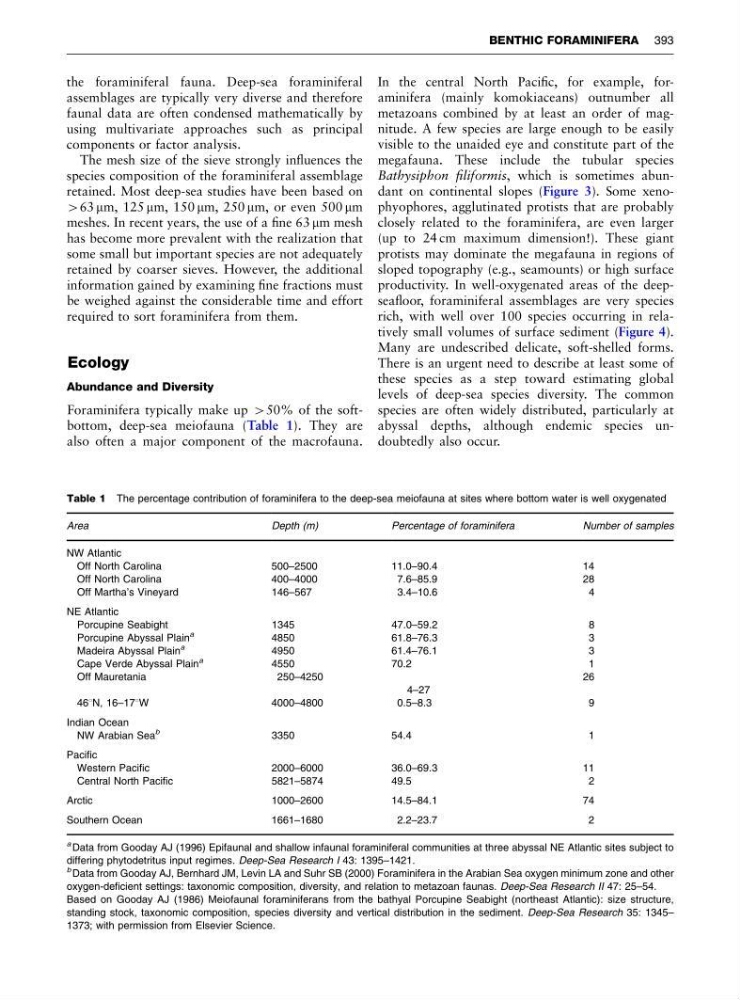
Foraminifera typically make up 450% of the softbottom, deep-sea meiofauna (Table 1). They are
also often a major component of the macrofauna.
In the central North Pacific, for example, foraminifera (mainly komokiaceans) outnumber all
metazoans combined by at least an order of magnitude. A few species are large enough to be easily
visible to the unaided eye and constitute part of the
megafauna. These include the tubular species
Bathysiphon filiformis, which is sometimes abundant on continental slopes (Figure 3). Some xenophyophores, agglutinated protists that are probably
closely related to the foraminifera, are even larger
(up to 24 cm maximum dimension!). These giant
protists may dominate the megafauna in regions of
sloped topography (e.g., seamounts) or high surface
productivity. In well-oxygenated areas of the deepseafloor, foraminiferal assemblages are very species
rich, with well over 100 species occurring in relatively small volumes of surface sediment (Figure 4).
Many are undescribed delicate, soft-shelled forms.
There is an urgent need to describe at least some of
these species as a step toward estimating global
levels of deep-sea species diversity. The common
species are often widely distributed, particularly at
abyssal depths, although endemic species undoubtedly also occur.
Table 1 The percentage contribution of foraminifera to the deep-sea meiofauna at sites where bottom water is well oxygenated
Area
Depth (m)
Percentage of foraminifera
Number of samples
NW Atlantic
Off North Carolina
500–2500
11.0–90.4
14
Off North Carolina
400–4000
7.6–85.9
28
Off Martha’s Vineyard
146–567
3.4–10.6
4
NE Atlantic
Porcupine Seabight
1345
47.0–59.2
8
Porcupine Abyssal Plain
a
4850
61.8–76.3
3
Madeira Abyssal Plain
a
4950
61.4–76.1
3
Cape Verde Abyssal Plain
a
4550
70.2
1
Off Mauretania
250–4250
4–27
26
461N, 16–171W
4000–4800
0.5–8.3
9
Indian Ocean
NW Arabian Sea
b
3350
54.4
1
Pacific
Western Pacific
2000–6000
36.0–69.3
11
Central North Pacific
5821–5874
49.5
2
Arctic
1000–2600
14.5–84.1
74
Southern Ocean
1661–1680
2.2–23.7
2
a Data from Gooday AJ (1996) Epifaunal and shallow infaunal foraminiferal communities at three abyssal NE Atlantic sites subject to
differing phytodetritus input regimes. Deep-Sea Research I 43: 1395–1421.
b Data from Gooday AJ, Bernhard JM, Levin LA and Suhr SB (2000) Foraminifera in the Arabian Sea oxygen minimum zone and other
oxygen-deficient settings: taxonomic composition, diversity, and relation to metazoan faunas. Deep-Sea Research II 47: 25–54.
Based on Gooday AJ (1986) Meiofaunal foraminiferans from the bathyal Porcupine Seabight (northeast Atlantic): size structure,
standing stock, taxonomic composition, species diversity and vertical distribution in the sediment. Deep-Sea Research 35: 1345–
1373; with permission from Elsevier Science.
BENTHIC FORAMINIFERA 393
assemblages are typically very diverse and therefore
faunal data are often condensed mathematically by
using multivariate approaches such as principal
components or factor analysis.
The mesh size of the sieve strongly influences the
species composition of the foraminiferal assemblage
retained. Most deep-sea studies have been based on
463 mm, 125 mm, 150 mm, 250 mm, or even 500 mm
meshes. In recent years, the use of a fine 63 mm mesh
has become more prevalent with the realization that
some small but important species are not adequately
retained by coarser sieves. However, the additional
information gained by examining fine fractions must
be weighed against the considerable time and effort
required to sort foraminifera from them.
Ecology
Abundance and Diversity
Foraminifera typically make up 450% of the softbottom, deep-sea meiofauna (Table 1). They are
also often a major component of the macrofauna.
In the central North Pacific, for example, foraminifera (mainly komokiaceans) outnumber all
metazoans combined by at least an order of magnitude. A few species are large enough to be easily
visible to the unaided eye and constitute part of the
megafauna. These include the tubular species
Bathysiphon filiformis, which is sometimes abundant on continental slopes (Figure 3). Some xenophyophores, agglutinated protists that are probably
closely related to the foraminifera, are even larger
(up to 24 cm maximum dimension!). These giant
protists may dominate the megafauna in regions of
sloped topography (e.g., seamounts) or high surface
productivity. In well-oxygenated areas of the deepseafloor, foraminiferal assemblages are very species
rich, with well over 100 species occurring in relatively small volumes of surface sediment (Figure 4).
Many are undescribed delicate, soft-shelled forms.
There is an urgent need to describe at least some of
these species as a step toward estimating global
levels of deep-sea species diversity. The common
species are often widely distributed, particularly at
abyssal depths, although endemic species undoubtedly also occur.
Table 1 The percentage contribution of foraminifera to the deep-sea meiofauna at sites where bottom water is well oxygenated
Area
Depth (m)
Percentage of foraminifera
Number of samples
NW Atlantic
Off North Carolina
500–2500
11.0–90.4
14
Off North Carolina
400–4000
7.6–85.9
28
Off Martha’s Vineyard
146–567
3.4–10.6
4
NE Atlantic
Porcupine Seabight
1345
47.0–59.2
8
Porcupine Abyssal Plain
a
4850
61.8–76.3
3
Madeira Abyssal Plain
a
4950
61.4–76.1
3
Cape Verde Abyssal Plain
a
4550
70.2
1
Off Mauretania
250–4250
4–27
26
461N, 16–171W
4000–4800
0.5–8.3
9
Indian Ocean
NW Arabian Sea
b
3350
54.4
1
Pacific
Western Pacific
2000–6000
36.0–69.3
11
Central North Pacific
5821–5874
49.5
2
Arctic
1000–2600
14.5–84.1
74
Southern Ocean
1661–1680
2.2–23.7
2
a Data from Gooday AJ (1996) Epifaunal and shallow infaunal foraminiferal communities at three abyssal NE Atlantic sites subject to
differing phytodetritus input regimes. Deep-Sea Research I 43: 1395–1421.
b Data from Gooday AJ, Bernhard JM, Levin LA and Suhr SB (2000) Foraminifera in the Arabian Sea oxygen minimum zone and other
oxygen-deficient settings: taxonomic composition, diversity, and relation to metazoan faunas. Deep-Sea Research II 47: 25–54.
Based on Gooday AJ (1986) Meiofaunal foraminiferans from the bathyal Porcupine Seabight (northeast Atlantic): size structure,
standing stock, taxonomic composition, species diversity and vertical distribution in the sediment. Deep-Sea Research 35: 1345–
1373; with permission from Elsevier Science.
BENTHIC FORAMINIFERA 393