

Foraminifera are extracted from sieved sediment
residues. Studies are often based on dried residues
and concern ‘total’ assemblages (i.e. including both
live and dead individuals). To distinguish individuals
that were living at the time of collection from dead
tests, it is necessary to preserve sediment samples in
either alcohol or formalin and then stain them with
rose Bengal solution. This colors the cytoplasm red
and is most obvious when residues are examined in
water. Stained assemblages provide a snapshot of the
foraminifera that were living when the samples were
collected. Since the live assemblage varies in both
time and space, it is also instructive to examine the
dead assemblage that provides an averaged view of
(
A
)
(B)
(C)
(D)
(E)
(F)
(G)
(H)
(I)
(J)
(K)
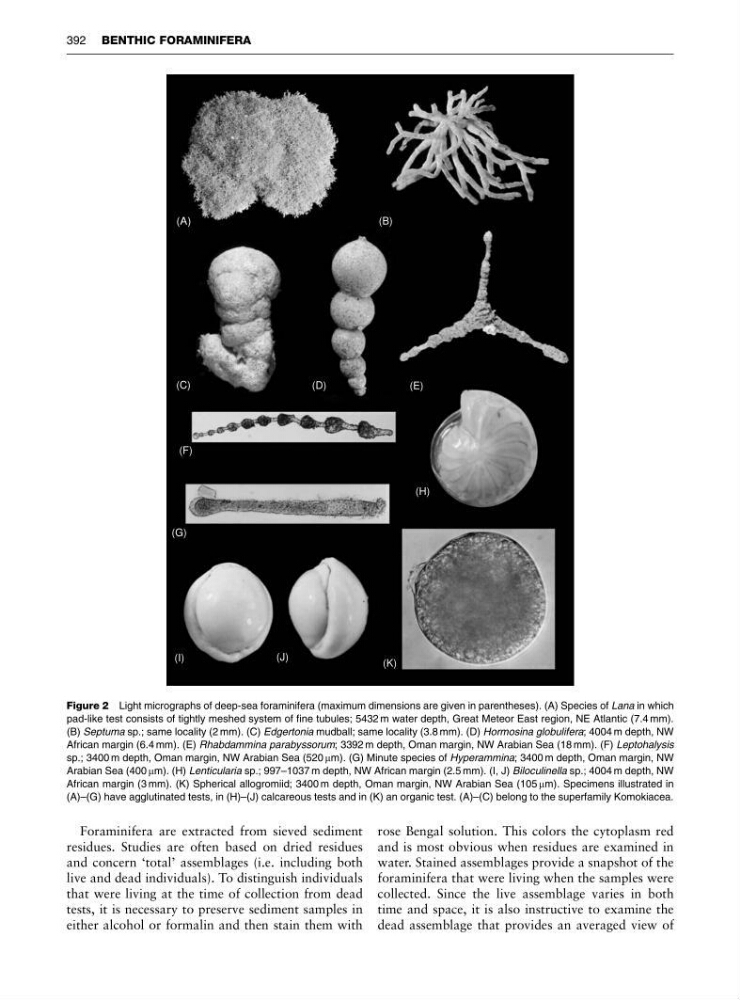
Figure 2 Light micrographs of deep-sea foraminifera (maximum dimensions are given in parentheses). (A) Species of Lana in which
pad-like test consists of tightly meshed system of fine tubules; 5432 m water depth, Great Meteor East region, NE Atlantic (7.4 mm).
(B) Septuma sp.; same locality (2 mm). (C) Edgertonia mudball; same locality (3.8 mm). (D) Hormosina globulifera; 4004 m depth, NW
African margin (6.4 mm). (E) Rhabdammina parabyssorum; 3392 m depth, Oman margin, NW Arabian Sea (18 mm). (F) Leptohalysis
sp.; 3400 m depth, Oman margin, NW Arabian Sea (520 mm). (G) Minute species of Hyperammina; 3400 m depth, Oman margin, NW
Arabian Sea (400 mm). (H) Lenticularia sp.; 997–1037 m depth, NW African margin (2.5 mm). (I, J) Biloculinella sp.; 4004 m depth, NW
African margin (3 mm). (K) Spherical allogromiid; 3400 m depth, Oman margin, NW Arabian Sea (105 mm). Specimens illustrated in
(A)–(G) have agglutinated tests, in (H)–(J) calcareous tests and in (K) an organic test. (A)–(C) belong to the superfamily Komokiacea.
392 BENTHIC FORAMINIFERA
residues. Studies are often based on dried residues
and concern ‘total’ assemblages (i.e. including both
live and dead individuals). To distinguish individuals
that were living at the time of collection from dead
tests, it is necessary to preserve sediment samples in
either alcohol or formalin and then stain them with
rose Bengal solution. This colors the cytoplasm red
and is most obvious when residues are examined in
water. Stained assemblages provide a snapshot of the
foraminifera that were living when the samples were
collected. Since the live assemblage varies in both
time and space, it is also instructive to examine the
dead assemblage that provides an averaged view of
(
A
)
(B)
(C)
(D)
(E)
(F)
(G)
(H)
(I)
(J)
(K)
Figure 2 Light micrographs of deep-sea foraminifera (maximum dimensions are given in parentheses). (A) Species of Lana in which
pad-like test consists of tightly meshed system of fine tubules; 5432 m water depth, Great Meteor East region, NE Atlantic (7.4 mm).
(B) Septuma sp.; same locality (2 mm). (C) Edgertonia mudball; same locality (3.8 mm). (D) Hormosina globulifera; 4004 m depth, NW
African margin (6.4 mm). (E) Rhabdammina parabyssorum; 3392 m depth, Oman margin, NW Arabian Sea (18 mm). (F) Leptohalysis
sp.; 3400 m depth, Oman margin, NW Arabian Sea (520 mm). (G) Minute species of Hyperammina; 3400 m depth, Oman margin, NW
Arabian Sea (400 mm). (H) Lenticularia sp.; 997–1037 m depth, NW African margin (2.5 mm). (I, J) Biloculinella sp.; 4004 m depth, NW
African margin (3 mm). (K) Spherical allogromiid; 3400 m depth, Oman margin, NW Arabian Sea (105 mm). Specimens illustrated in
(A)–(G) have agglutinated tests, in (H)–(J) calcareous tests and in (K) an organic test. (A)–(C) belong to the superfamily Komokiacea.
392 BENTHIC FORAMINIFERA