

Methodology
Qualitative deep-sea samples for foraminiferal studies are collected using nets (e.g., trawls) that are
dragged across the seafloor. Much of the Challenger
material studied by Brady was collected in this way.
Modern quantitative studies, however, require the
use of coring devices. The two most popular corers
used in the deep sea are the box corer, which obtains
a large (e.g., 0.25 m
2
) sample, and the multiple corer,
which collects simultaneously a battery of up to 12
smaller cores. The main advantage of the multiple
corer is that it obtains the sediment–water interface
in a virtually undisturbed condition.
(
A
)
(B)
(C)
(D)
(E)
(F)
(G)
(H)
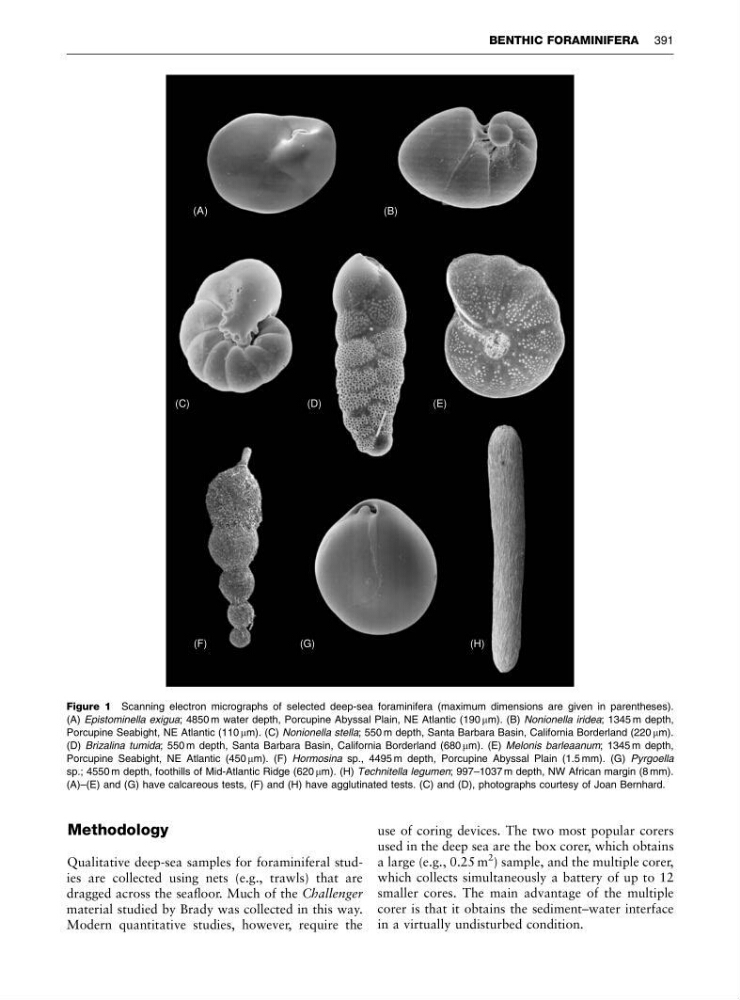
Figure 1 Scanning electron micrographs of selected deep-sea foraminifera (maximum dimensions are given in parentheses).
(A) Epistominella exigua; 4850 m water depth, Porcupine Abyssal Plain, NE Atlantic (190 mm). (B) Nonionella iridea; 1345 m depth,
Porcupine Seabight, NE Atlantic (110 mm). (C) Nonionella stella; 550 m depth, Santa Barbara Basin, California Borderland (220 mm).
(D) Brizalina tumida; 550 m depth, Santa Barbara Basin, California Borderland (680 mm). (E) Melonis barleaanum; 1345 m depth,
Porcupine Seabight, NE Atlantic (450 mm). (F) Hormosina sp., 4495 m depth, Porcupine Abyssal Plain (1.5 mm). (G) Pyrgoella
sp.; 4550 m depth, foothills of Mid-Atlantic Ridge (620 mm). (H) Technitella legumen; 997–1037 m depth, NW African margin (8 mm).
(A)–(E) and (G) have calcareous tests, (F) and (H) have agglutinated tests. (C) and (D), photographs courtesy of Joan Bernhard.
BENTHIC FORAMINIFERA 391
Qualitative deep-sea samples for foraminiferal studies are collected using nets (e.g., trawls) that are
dragged across the seafloor. Much of the Challenger
material studied by Brady was collected in this way.
Modern quantitative studies, however, require the
use of coring devices. The two most popular corers
used in the deep sea are the box corer, which obtains
a large (e.g., 0.25 m
2
) sample, and the multiple corer,
which collects simultaneously a battery of up to 12
smaller cores. The main advantage of the multiple
corer is that it obtains the sediment–water interface
in a virtually undisturbed condition.
(
A
)
(B)
(C)
(D)
(E)
(F)
(G)
(H)
Figure 1 Scanning electron micrographs of selected deep-sea foraminifera (maximum dimensions are given in parentheses).
(A) Epistominella exigua; 4850 m water depth, Porcupine Abyssal Plain, NE Atlantic (190 mm). (B) Nonionella iridea; 1345 m depth,
Porcupine Seabight, NE Atlantic (110 mm). (C) Nonionella stella; 550 m depth, Santa Barbara Basin, California Borderland (220 mm).
(D) Brizalina tumida; 550 m depth, Santa Barbara Basin, California Borderland (680 mm). (E) Melonis barleaanum; 1345 m depth,
Porcupine Seabight, NE Atlantic (450 mm). (F) Hormosina sp., 4495 m depth, Porcupine Abyssal Plain (1.5 mm). (G) Pyrgoella
sp.; 4550 m depth, foothills of Mid-Atlantic Ridge (620 mm). (H) Technitella legumen; 997–1037 m depth, NW African margin (8 mm).
(A)–(E) and (G) have calcareous tests, (F) and (H) have agglutinated tests. (C) and (D), photographs courtesy of Joan Bernhard.
BENTHIC FORAMINIFERA 391