

into the overlying water, but most of these reactions
result in production of carbon dioxide, which reacts
with water to form carbonic acid. A consistent pattern has been observed in the distribution of the
principal terminal electron acceptors with increasing
distance from an oxic water column. Oxygen, nitrate, manganese dioxide, ferric oxides, sulfate, and
finally carbon dioxide serve as the principal electron
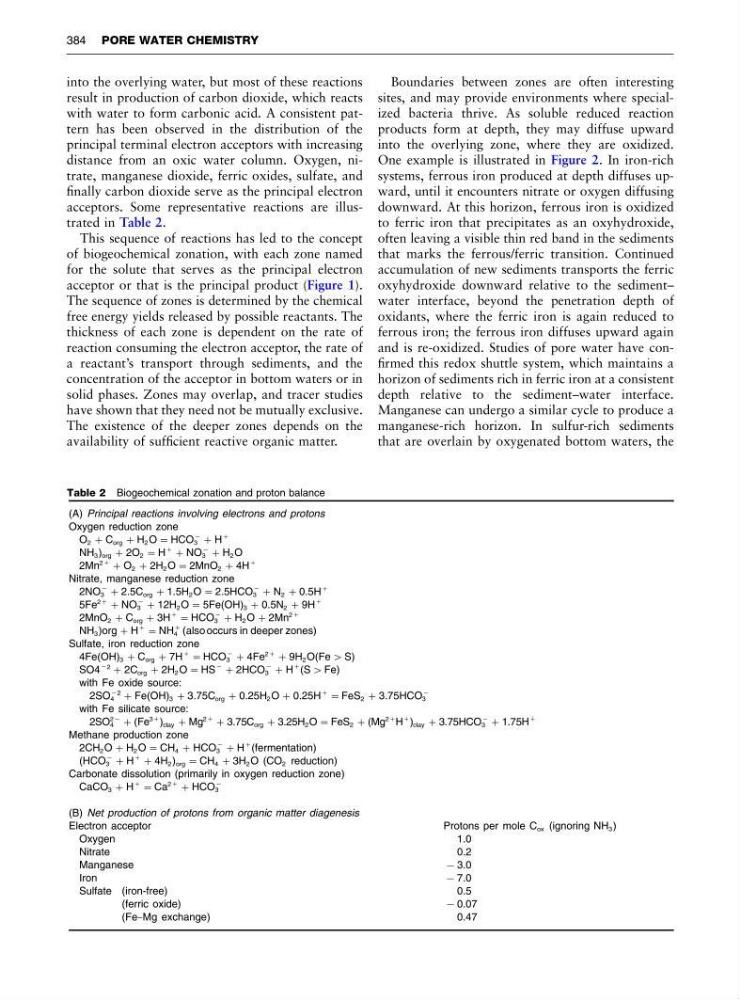
acceptors. Some representative reactions are illustrated in Table 2.
This sequence of reactions has led to the concept
of biogeochemical zonation, with each zone named
for the solute that serves as the principal electron
acceptor or that is the principal product (Figure 1).
The sequence of zones is determined by the chemical
free energy yields released by possible reactants. The
thickness of each zone is dependent on the rate of
reaction consuming the electron acceptor, the rate of
a reactant’s transport through sediments, and the
concentration of the acceptor in bottom waters or in
solid phases. Zones may overlap, and tracer studies
have shown that they need not be mutually exclusive.
The existence of the deeper zones depends on the
availability of sufficient reactive organic matter.
Boundaries between zones are often interesting
sites, and may provide environments where specialized bacteria thrive. As soluble reduced reaction
products form at depth, they may diffuse upward
into the overlying zone, where they are oxidized.
One example is illustrated in Figure 2. In iron-rich
systems, ferrous iron produced at depth diffuses upward, until it encounters nitrate or oxygen diffusing
downward. At this horizon, ferrous iron is oxidized
to ferric iron that precipitates as an oxyhydroxide,
often leaving a visible thin red band in the sediments
that marks the ferrous/ferric transition. Continued
accumulation of new sediments transports the ferric
oxyhydroxide downward relative to the sediment–
water interface, beyond the penetration depth of
oxidants, where the ferric iron is again reduced to
ferrous iron; the ferrous iron diffuses upward again
and is re-oxidized. Studies of pore water have confirmed this redox shuttle system, which maintains a
horizon of sediments rich in ferric iron at a consistent
depth relative to the sediment–water interface.
Manganese can undergo a similar cycle to produce a
manganese-rich horizon. In sulfur-rich sediments
that are overlain by oxygenated bottom waters, the
Table 2 Biogeochemical zonation and proton balance
384 PORE WATER CHEMISTRY
result in production of carbon dioxide, which reacts
with water to form carbonic acid. A consistent pattern has been observed in the distribution of the
principal terminal electron acceptors with increasing
distance from an oxic water column. Oxygen, nitrate, manganese dioxide, ferric oxides, sulfate, and
finally carbon dioxide serve as the principal electron
acceptors. Some representative reactions are illustrated in Table 2.
This sequence of reactions has led to the concept
of biogeochemical zonation, with each zone named
for the solute that serves as the principal electron
acceptor or that is the principal product (Figure 1).
The sequence of zones is determined by the chemical
free energy yields released by possible reactants. The
thickness of each zone is dependent on the rate of
reaction consuming the electron acceptor, the rate of
a reactant’s transport through sediments, and the
concentration of the acceptor in bottom waters or in
solid phases. Zones may overlap, and tracer studies
have shown that they need not be mutually exclusive.
The existence of the deeper zones depends on the
availability of sufficient reactive organic matter.
Boundaries between zones are often interesting
sites, and may provide environments where specialized bacteria thrive. As soluble reduced reaction
products form at depth, they may diffuse upward
into the overlying zone, where they are oxidized.
One example is illustrated in Figure 2. In iron-rich
systems, ferrous iron produced at depth diffuses upward, until it encounters nitrate or oxygen diffusing
downward. At this horizon, ferrous iron is oxidized
to ferric iron that precipitates as an oxyhydroxide,
often leaving a visible thin red band in the sediments
that marks the ferrous/ferric transition. Continued
accumulation of new sediments transports the ferric
oxyhydroxide downward relative to the sediment–
water interface, beyond the penetration depth of
oxidants, where the ferric iron is again reduced to
ferrous iron; the ferrous iron diffuses upward again
and is re-oxidized. Studies of pore water have confirmed this redox shuttle system, which maintains a
horizon of sediments rich in ferric iron at a consistent
depth relative to the sediment–water interface.
Manganese can undergo a similar cycle to produce a
manganese-rich horizon. In sulfur-rich sediments
that are overlain by oxygenated bottom waters, the
Table 2 Biogeochemical zonation and proton balance
384 PORE WATER CHEMISTRY