

Limitations of Pore Water Studies
Observation of the Net Process
Some solutes may be involved in more than one reaction. This limits the ability to uniquely define reaction stoichiometry.
Required Assumptions
Pore water profiles are usually assumed to be steadystate. If boundary conditions vary, pore waters respond, but there is a temporal lag in response that
increases with depth. The profile should exhibit concentrations that are roughly averaged over this response time. A second problem may be the existence
of unidentified transport processes, such as macrofaunal irrigation (see below). A third problem is that
patchiness of organisms on the seafloor may lead to
localized effects, such as caches of freshly deposited
organic matter in burrows. It is not always possible to
collect and process sufficient cores to evaluate the
spatial heterogeneity introduced by these effects, that
may occur on horizontal scales of centimeters to
meters. In the Equatorial Pacific, for example, benthic
fluxes of oxygen calculated from pore water profiles
collected with replicate cores at the same site have
been shown to vary by 30%, and inferences based on
a single core have an inherent uncertainty.
Sampling Resolution
Gradients may exist over very short vertical or
horizontal distances that cannot be easily resolved
during sampling. In organic-rich slope sediments, for
example, microelectrode measurements show that
the thickness of oxygenated sediments may be only
1–2 mm. Furthermore, if micro-environments are
present within burrows or inside shells, this can lead
to localized sites of reaction, but the pore water
measurement of sectioned cores defines an average
for the zone sampled. Most studies are designed to
evaluate vertical gradients, as it is usually difficult to
evaluate any horizontal gradients, if they are present.
Sampling Artifacts
These may be created by changes in temperature,
pressure, exposure to oxygen (or perhaps any gas
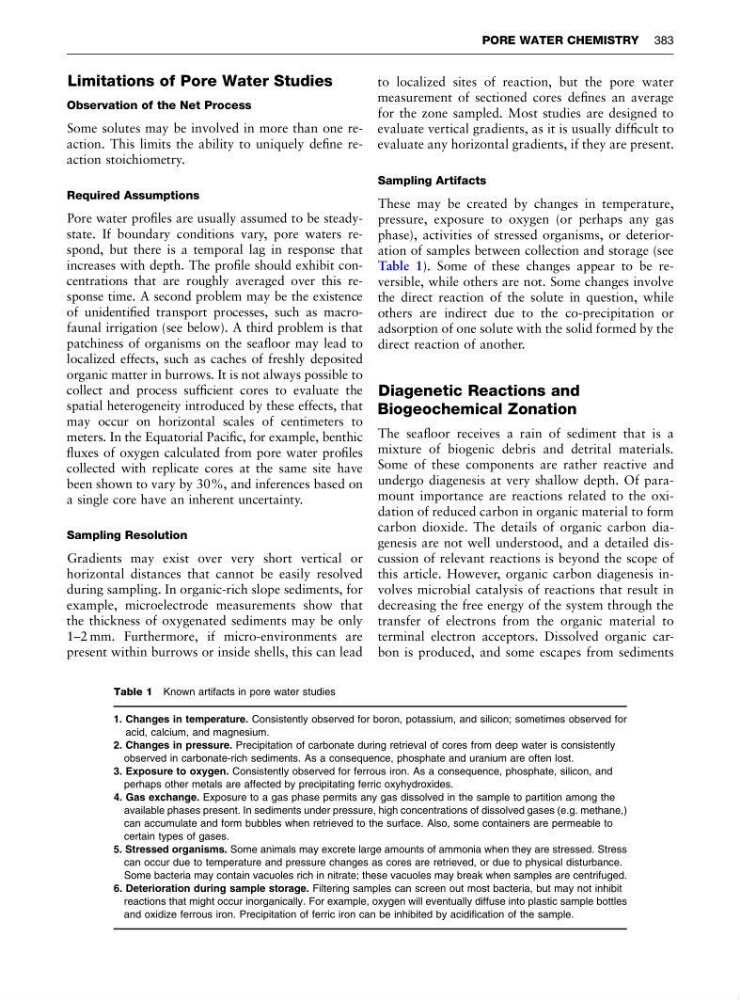
phase), activities of stressed organisms, or deterioration of samples between collection and storage (see
Table 1). Some of these changes appear to be reversible, while others are not. Some changes involve
the direct reaction of the solute in question, while
others are indirect due to the co-precipitation or
adsorption of one solute with the solid formed by the
direct reaction of another.
Diagenetic Reactions and
Biogeochemical Zonation
The seafloor receives a rain of sediment that is a
mixture of biogenic debris and detrital materials.
Some of these components are rather reactive and
undergo diagenesis at very shallow depth. Of paramount importance are reactions related to the oxidation of reduced carbon in organic material to form
carbon dioxide. The details of organic carbon diagenesis are not well understood, and a detailed discussion of relevant reactions is beyond the scope of
this article. However, organic carbon diagenesis involves microbial catalysis of reactions that result in
decreasing the free energy of the system through the
transfer of electrons from the organic material to
terminal electron acceptors. Dissolved organic carbon is produced, and some escapes from sediments
Table 1 Known artifacts in pore water studies
1. Changes in temperature. Consistently observed for boron, potassium, and silicon; sometimes observed for
acid, calcium, and magnesium.
2. Changes in pressure. Precipitation of carbonate during retrieval of cores from deep water is consistently
observed in carbonate-rich sediments. As a consequence, phosphate and uranium are often lost.
3. Exposure to oxygen. Consistently observed for ferrous iron. As a consequence, phosphate, silicon, and
perhaps other metals are affected by precipitating ferric oxyhydroxides.
4. Gas exchange. Exposure to a gas phase permits any gas dissolved in the sample to partition among the
available phases present. In sediments under pressure, high concentrations of dissolved gases (e.g. methane,)
can accumulate and form bubbles when retrieved to the surface. Also, some containers are permeable to
certain types of gases.
5. Stressed organisms. Some animals may excrete large amounts of ammonia when they are stressed. Stress
can occur due to temperature and pressure changes as cores are retrieved, or due to physical disturbance.
Some bacteria may contain vacuoles rich in nitrate; these vacuoles may break when samples are centrifuged.
6. Deterioration during sample storage. Filtering samples can screen out most bacteria, but may not inhibit
reactions that might occur inorganically. For example, oxygen will eventually diffuse into plastic sample bottles
and oxidize ferrous iron. Precipitation of ferric iron can be inhibited by acidification of the sample.
PORE WATER CHEMISTRY 383
Observation of the Net Process
Some solutes may be involved in more than one reaction. This limits the ability to uniquely define reaction stoichiometry.
Required Assumptions
Pore water profiles are usually assumed to be steadystate. If boundary conditions vary, pore waters respond, but there is a temporal lag in response that
increases with depth. The profile should exhibit concentrations that are roughly averaged over this response time. A second problem may be the existence
of unidentified transport processes, such as macrofaunal irrigation (see below). A third problem is that
patchiness of organisms on the seafloor may lead to
localized effects, such as caches of freshly deposited
organic matter in burrows. It is not always possible to
collect and process sufficient cores to evaluate the
spatial heterogeneity introduced by these effects, that
may occur on horizontal scales of centimeters to
meters. In the Equatorial Pacific, for example, benthic
fluxes of oxygen calculated from pore water profiles
collected with replicate cores at the same site have
been shown to vary by 30%, and inferences based on
a single core have an inherent uncertainty.
Sampling Resolution
Gradients may exist over very short vertical or
horizontal distances that cannot be easily resolved
during sampling. In organic-rich slope sediments, for
example, microelectrode measurements show that
the thickness of oxygenated sediments may be only
1–2 mm. Furthermore, if micro-environments are
present within burrows or inside shells, this can lead
to localized sites of reaction, but the pore water
measurement of sectioned cores defines an average
for the zone sampled. Most studies are designed to
evaluate vertical gradients, as it is usually difficult to
evaluate any horizontal gradients, if they are present.
Sampling Artifacts
These may be created by changes in temperature,
pressure, exposure to oxygen (or perhaps any gas
phase), activities of stressed organisms, or deterioration of samples between collection and storage (see
Table 1). Some of these changes appear to be reversible, while others are not. Some changes involve
the direct reaction of the solute in question, while
others are indirect due to the co-precipitation or
adsorption of one solute with the solid formed by the
direct reaction of another.
Diagenetic Reactions and
Biogeochemical Zonation
The seafloor receives a rain of sediment that is a
mixture of biogenic debris and detrital materials.
Some of these components are rather reactive and
undergo diagenesis at very shallow depth. Of paramount importance are reactions related to the oxidation of reduced carbon in organic material to form
carbon dioxide. The details of organic carbon diagenesis are not well understood, and a detailed discussion of relevant reactions is beyond the scope of
this article. However, organic carbon diagenesis involves microbial catalysis of reactions that result in
decreasing the free energy of the system through the
transfer of electrons from the organic material to
terminal electron acceptors. Dissolved organic carbon is produced, and some escapes from sediments
Table 1 Known artifacts in pore water studies
1. Changes in temperature. Consistently observed for boron, potassium, and silicon; sometimes observed for
acid, calcium, and magnesium.
2. Changes in pressure. Precipitation of carbonate during retrieval of cores from deep water is consistently
observed in carbonate-rich sediments. As a consequence, phosphate and uranium are often lost.
3. Exposure to oxygen. Consistently observed for ferrous iron. As a consequence, phosphate, silicon, and
perhaps other metals are affected by precipitating ferric oxyhydroxides.
4. Gas exchange. Exposure to a gas phase permits any gas dissolved in the sample to partition among the
available phases present. In sediments under pressure, high concentrations of dissolved gases (e.g. methane,)
can accumulate and form bubbles when retrieved to the surface. Also, some containers are permeable to
certain types of gases.
5. Stressed organisms. Some animals may excrete large amounts of ammonia when they are stressed. Stress
can occur due to temperature and pressure changes as cores are retrieved, or due to physical disturbance.
Some bacteria may contain vacuoles rich in nitrate; these vacuoles may break when samples are centrifuged.
6. Deterioration during sample storage. Filtering samples can screen out most bacteria, but may not inhibit
reactions that might occur inorganically. For example, oxygen will eventually diffuse into plastic sample bottles
and oxidize ferrous iron. Precipitation of ferric iron can be inhibited by acidification of the sample.
PORE WATER CHEMISTRY 383