

upward diffusion of sulfide through pore waters
brings it into contact with dissolved oxygen. This
provides a unique environment that may be exploited
by the sulfur-oxidizing bacteria Beggiatoa, an organism that utilizes the energy released by sulfide
oxidation and forms bacterial mats frequently found
where low oxygen bottom waters may exclude
predators.
Diagenetic Modeling
Substantial advances have been made in the development of mathematical models to quantify the
effects of the diagenetic processes that influence pore
water profiles. Important processes include those
mentioned below, but a full discussion of appropriate
formulations to describe these processes is beyond
the scope of this article (see the Further Reading
section for the mathematical development).
Chemical Reactions
Some solids dissolve and others precipitate. Many
reactions are driven by redox processes associated
with the oxidation of organic matter, largely
catalyzed by microbial activities as they extract
metabolic energy. Some of these are illustrated in
C org
C org
CO 2
Electron
acceptors
(O , NO , MeO, SO )
2
3
4
_
2 _
C +4e
4+
_
Burial of
metal sulfides
O reduction
2
NO reduction
3
_
SO reduction
4
2 _
CH production
4
Water
Sediment
Particle
rain
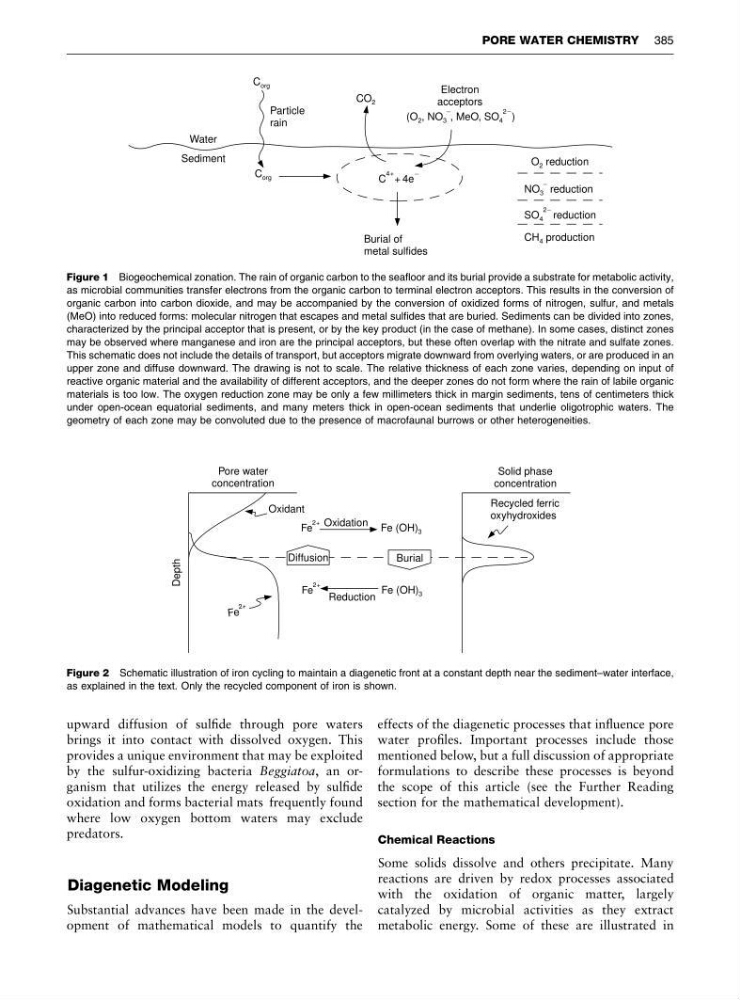
Figure 1 Biogeochemical zonation. The rain of organic carbon to the seafloor and its burial provide a substrate for metabolic activity,
as microbial communities transfer electrons from the organic carbon to terminal electron acceptors. This results in the conversion of
organic carbon into carbon dioxide, and may be accompanied by the conversion of oxidized forms of nitrogen, sulfur, and metals
(MeO) into reduced forms: molecular nitrogen that escapes and metal sulfides that are buried. Sediments can be divided into zones,
characterized by the principal acceptor that is present, or by the key product (in the case of methane). In some cases, distinct zones
may be observed where manganese and iron are the principal acceptors, but these often overlap with the nitrate and sulfate zones.
This schematic does not include the details of transport, but acceptors migrate downward from overlying waters, or are produced in an
upper zone and diffuse downward. The drawing is not to scale. The relative thickness of each zone varies, depending on input of
reactive organic material and the availability of different acceptors, and the deeper zones do not form where the rain of labile organic
materials is too low. The oxygen reduction zone may be only a few millimeters thick in margin sediments, tens of centimeters thick
under open-ocean equatorial sediments, and many meters thick in open-ocean sediments that underlie oligotrophic waters. The
geometry of each zone may be convoluted due to the presence of macrofaunal burrows or other heterogeneities.
Pore water
concentration
Solid phase
concentration
Depth
Oxidant
Fe
2+
Fe
2+
Recycled ferric
oxyhydroxides
Fe (OH) 3
Oxidation
Diffusion
Burial
Fe
2+
Fe (OH) 3
Reduction
Figure 2 Schematic illustration of iron cycling to maintain a diagenetic front at a constant depth near the sediment–water interface,
as explained in the text. Only the recycled component of iron is shown.
PORE WATER CHEMISTRY 385
brings it into contact with dissolved oxygen. This
provides a unique environment that may be exploited
by the sulfur-oxidizing bacteria Beggiatoa, an organism that utilizes the energy released by sulfide
oxidation and forms bacterial mats frequently found
where low oxygen bottom waters may exclude
predators.
Diagenetic Modeling
Substantial advances have been made in the development of mathematical models to quantify the
effects of the diagenetic processes that influence pore
water profiles. Important processes include those
mentioned below, but a full discussion of appropriate
formulations to describe these processes is beyond
the scope of this article (see the Further Reading
section for the mathematical development).
Chemical Reactions
Some solids dissolve and others precipitate. Many
reactions are driven by redox processes associated
with the oxidation of organic matter, largely
catalyzed by microbial activities as they extract
metabolic energy. Some of these are illustrated in
C org
C org
CO 2
Electron
acceptors
(O , NO , MeO, SO )
2
3
4
_
2 _
C +4e
4+
_
Burial of
metal sulfides
O reduction
2
NO reduction
3
_
SO reduction
4
2 _
CH production
4
Water
Sediment
Particle
rain
Figure 1 Biogeochemical zonation. The rain of organic carbon to the seafloor and its burial provide a substrate for metabolic activity,
as microbial communities transfer electrons from the organic carbon to terminal electron acceptors. This results in the conversion of
organic carbon into carbon dioxide, and may be accompanied by the conversion of oxidized forms of nitrogen, sulfur, and metals
(MeO) into reduced forms: molecular nitrogen that escapes and metal sulfides that are buried. Sediments can be divided into zones,
characterized by the principal acceptor that is present, or by the key product (in the case of methane). In some cases, distinct zones
may be observed where manganese and iron are the principal acceptors, but these often overlap with the nitrate and sulfate zones.
This schematic does not include the details of transport, but acceptors migrate downward from overlying waters, or are produced in an
upper zone and diffuse downward. The drawing is not to scale. The relative thickness of each zone varies, depending on input of
reactive organic material and the availability of different acceptors, and the deeper zones do not form where the rain of labile organic
materials is too low. The oxygen reduction zone may be only a few millimeters thick in margin sediments, tens of centimeters thick
under open-ocean equatorial sediments, and many meters thick in open-ocean sediments that underlie oligotrophic waters. The
geometry of each zone may be convoluted due to the presence of macrofaunal burrows or other heterogeneities.
Pore water
concentration
Solid phase
concentration
Depth
Oxidant
Fe
2+
Fe
2+
Recycled ferric
oxyhydroxides
Fe (OH) 3
Oxidation
Diffusion
Burial
Fe
2+
Fe (OH) 3
Reduction
Figure 2 Schematic illustration of iron cycling to maintain a diagenetic front at a constant depth near the sediment–water interface,
as explained in the text. Only the recycled component of iron is shown.
PORE WATER CHEMISTRY 385