

On a microscopic scale, a great variety of structures and textures are apparent in nodules, some of
them indicative of postdepositional alteration of
nodule interiors. One of the most commonly observed and most easily recognizable is that of collomorphic globular segregations of ferromanganese
oxides on a scale of tenths of a millimeter or less,
which often persist throughout much of the nodule
interior. Often the segregations become linked into
polygons or cusps elongated radially in the direction
of growth of the nodules. Several workers have also
recognized organic structures within manganese
nodules. Furthermore, cracks and fissures of various
sorts are a common feature of nodule interiors.
Fracturing of nodules is a process which can lead to
their breakup on the seafloor, in some cases as a result of the activity of benthic organisms, or of bottom currents. Fracturing is an important process in
limiting the overall size of nodules growing under
any particular set of conditions.
Growth Rates
It is possible to assess the rate of growth of nodules
either by dating their nuclei, which gives a minimum
rate of growth, or by measuring age differences between their different layers. Most radiometric dating
techniques indicate a slow growth rate for nodules,
from a few to a few tens of millimeters per million
years. Existing radiometric and other techniques for
nodule dating include uranium series disequilibrium
methods utilizing
230 Th
231 Pa, the
10 Be method, the
K-Ar method, fission track dating of nodule nuclei,
and hydration rind dating.
In spite of the overwhelming evidence for slow
growth, data have been accumulating from a number
of sources which indicate that the growth of nodules
may be variable with periods of rapid accumulation
being separated by periods of slower, or little or no
growth. In general, the most important factor influencing nodule growth rate is likely to be the rate at
which elements are supplied to the deposits, diagenetic sources generally supplying elements at a faster
rate than hydrogenous sources (Figure 1). Further, the
tops, bottoms and sides of nodules do not necessarily
accumulate elements at the same rate, leading to the
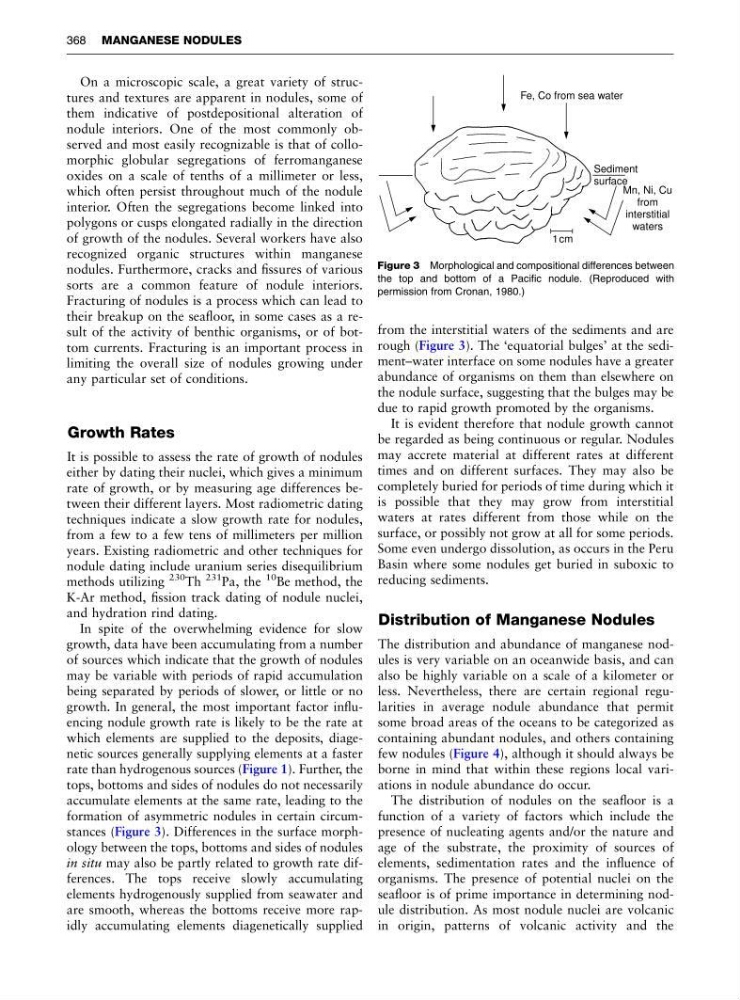
formation of asymmetric nodules in certain circumstances (Figure 3). Differences in the surface morphology between the tops, bottoms and sides of nodules
in situ may also be partly related to growth rate differences. The tops receive slowly accumulating
elements hydrogenously supplied from seawater and
are smooth, whereas the bottoms receive more rapidly accumulating elements diagenetically supplied
from the interstitial waters of the sediments and are
rough (Figure 3). The ‘equatorial bulges’ at the sediment–water interface on some nodules have a greater
abundance of organisms on them than elsewhere on
the nodule surface, suggesting that the bulges may be
due to rapid growth promoted by the organisms.
It is evident therefore that nodule growth cannot
be regarded as being continuous or regular. Nodules
may accrete material at different rates at different
times and on different surfaces. They may also be
completely buried for periods of time during which it
is possible that they may grow from interstitial
waters at rates different from those while on the
surface, or possibly not grow at all for some periods.
Some even undergo dissolution, as occurs in the Peru
Basin where some nodules get buried in suboxic to
reducing sediments.
Distribution of Manganese Nodules
The distribution and abundance of manganese nodules is very variable on an oceanwide basis, and can
also be highly variable on a scale of a kilometer or
less. Nevertheless, there are certain regional regularities in average nodule abundance that permit
some broad areas of the oceans to be categorized as
containing abundant nodules, and others containing
few nodules (Figure 4), although it should always be
borne in mind that within these regions local variations in nodule abundance do occur.
The distribution of nodules on the seafloor is a
function of a variety of factors which include the
presence of nucleating agents and/or the nature and
age of the substrate, the proximity of sources of
elements, sedimentation rates and the influence of
organisms. The presence of potential nuclei on the
seafloor is of prime importance in determining nodule distribution. As most nodule nuclei are volcanic
in origin, patterns of volcanic activity and the
Fe, Co from sea water
Sediment
surface
Mn, Ni, Cu
from
interstitial
waters
1cm
Figure 3 Morphological and compositional differences between
the top and bottom of a Pacific nodule. (Reproduced with
permission from Cronan, 1980.)
368 MANGANESE NODULES
them indicative of postdepositional alteration of
nodule interiors. One of the most commonly observed and most easily recognizable is that of collomorphic globular segregations of ferromanganese
oxides on a scale of tenths of a millimeter or less,
which often persist throughout much of the nodule
interior. Often the segregations become linked into
polygons or cusps elongated radially in the direction
of growth of the nodules. Several workers have also
recognized organic structures within manganese
nodules. Furthermore, cracks and fissures of various
sorts are a common feature of nodule interiors.
Fracturing of nodules is a process which can lead to
their breakup on the seafloor, in some cases as a result of the activity of benthic organisms, or of bottom currents. Fracturing is an important process in
limiting the overall size of nodules growing under
any particular set of conditions.
Growth Rates
It is possible to assess the rate of growth of nodules
either by dating their nuclei, which gives a minimum
rate of growth, or by measuring age differences between their different layers. Most radiometric dating
techniques indicate a slow growth rate for nodules,
from a few to a few tens of millimeters per million
years. Existing radiometric and other techniques for
nodule dating include uranium series disequilibrium
methods utilizing
230 Th
231 Pa, the
10 Be method, the
K-Ar method, fission track dating of nodule nuclei,
and hydration rind dating.
In spite of the overwhelming evidence for slow
growth, data have been accumulating from a number
of sources which indicate that the growth of nodules
may be variable with periods of rapid accumulation
being separated by periods of slower, or little or no
growth. In general, the most important factor influencing nodule growth rate is likely to be the rate at
which elements are supplied to the deposits, diagenetic sources generally supplying elements at a faster
rate than hydrogenous sources (Figure 1). Further, the
tops, bottoms and sides of nodules do not necessarily
accumulate elements at the same rate, leading to the
formation of asymmetric nodules in certain circumstances (Figure 3). Differences in the surface morphology between the tops, bottoms and sides of nodules
in situ may also be partly related to growth rate differences. The tops receive slowly accumulating
elements hydrogenously supplied from seawater and
are smooth, whereas the bottoms receive more rapidly accumulating elements diagenetically supplied
from the interstitial waters of the sediments and are
rough (Figure 3). The ‘equatorial bulges’ at the sediment–water interface on some nodules have a greater
abundance of organisms on them than elsewhere on
the nodule surface, suggesting that the bulges may be
due to rapid growth promoted by the organisms.
It is evident therefore that nodule growth cannot
be regarded as being continuous or regular. Nodules
may accrete material at different rates at different
times and on different surfaces. They may also be
completely buried for periods of time during which it
is possible that they may grow from interstitial
waters at rates different from those while on the
surface, or possibly not grow at all for some periods.
Some even undergo dissolution, as occurs in the Peru
Basin where some nodules get buried in suboxic to
reducing sediments.
Distribution of Manganese Nodules
The distribution and abundance of manganese nodules is very variable on an oceanwide basis, and can
also be highly variable on a scale of a kilometer or
less. Nevertheless, there are certain regional regularities in average nodule abundance that permit
some broad areas of the oceans to be categorized as
containing abundant nodules, and others containing
few nodules (Figure 4), although it should always be
borne in mind that within these regions local variations in nodule abundance do occur.
The distribution of nodules on the seafloor is a
function of a variety of factors which include the
presence of nucleating agents and/or the nature and
age of the substrate, the proximity of sources of
elements, sedimentation rates and the influence of
organisms. The presence of potential nuclei on the
seafloor is of prime importance in determining nodule distribution. As most nodule nuclei are volcanic
in origin, patterns of volcanic activity and the
Fe, Co from sea water
Sediment
surface
Mn, Ni, Cu
from
interstitial
waters
1cm
Figure 3 Morphological and compositional differences between
the top and bottom of a Pacific nodule. (Reproduced with
permission from Cronan, 1980.)
368 MANGANESE NODULES