

the first great manganese nodule controversy. Murray believed the deposits to have been formed by
submarine volcanic processes whereas Renard believed that they had precipitated from continental
runoff products in sea water. This controversy remained unresolved until it was realized that nodules
could obtain their metals from either or both sources.
The evidence for this included the finding of abundant nodules in the Baltic Sea where there are no
volcanic influences, and the finding of rapidly grown
ferromanganese oxide crusts associated with submarine hydrothermal activity of volcanic origin on
the Mid-Atlantic Ridge. Subsequently, a third source
of metals to the deposits was discovered, diagenetic
remobilization from underlying sediments. Thus
marine ferromanganese oxides can be represented on
a triangular diagram (Figure 1), the corners being
occupied by hydrothermal (volcanically derived),
hydrogenous (seawater derived) and diagenetic
(sediment interstitial water derived) constituents.
There appears to be a continuous compositional
transition between hydrogenous and diagenetic deposits, all of which are formed relatively slowly at
normal deep seafloor temperatures. By contrast, although theoretically possible, no continuous compositional gradation has been reported between
hydrogenous and hydrothermal deposits, although
mixtures of the two do occur. This may be partly
because (1) the growth rates of hydrogenous and
hydrothermal deposits are very different with the
latter accumulating much more rapidly than the
former leading to the incorporation of only limited
amounts of the more slowly accumulating hydrogenous material in them, and (2) the temperatures of
formation of the deposits are different leading to
mineralogical differences between them which can
affect their chemical composition. Similarly, a continuous compositional gradation between hydrothermal and diagenetic ferromanganese oxide
deposits has not been found, although again this is
theoretically possible. However, the depositional
conditions with which the respective deposits are
associated i.e., high temperature hydrothermal activity in mainly sediment-free elevated volcanic areas
on the one hand, and low-temperature accumulation
of organic rich sediments in basin areas on the other,
would preclude much mixing between the two.
Possibly they may occur in sedimented active submarine volcanic areas.
Internal Structure
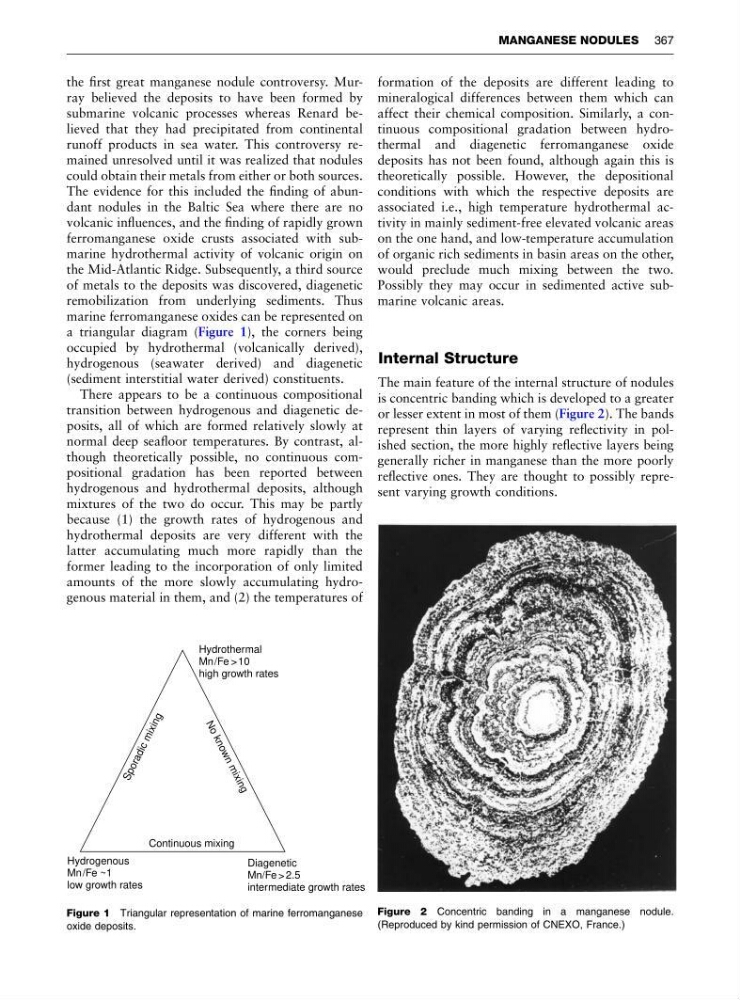
The main feature of the internal structure of nodules
is concentric banding which is developed to a greater
or lesser extent in most of them (Figure 2). The bands
represent thin layers of varying reflectivity in polished section, the more highly reflective layers being
generally richer in manganese than the more poorly
reflective ones. They are thought to possibly represent varying growth conditions.
Hydrothermal
Mn/Fe >10
high growth rates
Hydrogenous
Mn/Fe ~1
low growth rates
Diagenetic
Mn/Fe > 2.5
intermediate growth rates
S p o r a d ic m ix in g
N
o
k
n
o
w
n
m
ix
in
g
Continuous mixing
Figure 1 Triangular representation of marine ferromanganese
oxide deposits.
Figure 2 Concentric banding in a manganese nodule.
(Reproduced by kind permission of CNEXO, France.)
MANGANESE NODULES 367
submarine volcanic processes whereas Renard believed that they had precipitated from continental
runoff products in sea water. This controversy remained unresolved until it was realized that nodules
could obtain their metals from either or both sources.
The evidence for this included the finding of abundant nodules in the Baltic Sea where there are no
volcanic influences, and the finding of rapidly grown
ferromanganese oxide crusts associated with submarine hydrothermal activity of volcanic origin on
the Mid-Atlantic Ridge. Subsequently, a third source
of metals to the deposits was discovered, diagenetic
remobilization from underlying sediments. Thus
marine ferromanganese oxides can be represented on
a triangular diagram (Figure 1), the corners being
occupied by hydrothermal (volcanically derived),
hydrogenous (seawater derived) and diagenetic
(sediment interstitial water derived) constituents.
There appears to be a continuous compositional
transition between hydrogenous and diagenetic deposits, all of which are formed relatively slowly at
normal deep seafloor temperatures. By contrast, although theoretically possible, no continuous compositional gradation has been reported between
hydrogenous and hydrothermal deposits, although
mixtures of the two do occur. This may be partly
because (1) the growth rates of hydrogenous and
hydrothermal deposits are very different with the
latter accumulating much more rapidly than the
former leading to the incorporation of only limited
amounts of the more slowly accumulating hydrogenous material in them, and (2) the temperatures of
formation of the deposits are different leading to
mineralogical differences between them which can
affect their chemical composition. Similarly, a continuous compositional gradation between hydrothermal and diagenetic ferromanganese oxide
deposits has not been found, although again this is
theoretically possible. However, the depositional
conditions with which the respective deposits are
associated i.e., high temperature hydrothermal activity in mainly sediment-free elevated volcanic areas
on the one hand, and low-temperature accumulation
of organic rich sediments in basin areas on the other,
would preclude much mixing between the two.
Possibly they may occur in sedimented active submarine volcanic areas.
Internal Structure
The main feature of the internal structure of nodules
is concentric banding which is developed to a greater
or lesser extent in most of them (Figure 2). The bands
represent thin layers of varying reflectivity in polished section, the more highly reflective layers being
generally richer in manganese than the more poorly
reflective ones. They are thought to possibly represent varying growth conditions.
Hydrothermal
Mn/Fe >10
high growth rates
Hydrogenous
Mn/Fe ~1
low growth rates
Diagenetic
Mn/Fe > 2.5
intermediate growth rates
S p o r a d ic m ix in g
N
o
k
n
o
w
n
m
ix
in
g
Continuous mixing
Figure 1 Triangular representation of marine ferromanganese
oxide deposits.
Figure 2 Concentric banding in a manganese nodule.
(Reproduced by kind permission of CNEXO, France.)
MANGANESE NODULES 367