

subsequent dispersal of volcanic materials have an
important influence on where and in what amounts
nodules occur. Other materials can also be important
as nodule nuclei. Biogenic debris such as sharks’
teeth, can be locally abundant in areas of slow
sedimentation and their distribution will in time influence the abundance of nodules in such areas.
As most nuclei are subject to replacement with
time, old nodules have sometimes completely replaced their nuclei and have fractured, thus providing abundant nodule fragments to serve as fresh
nuclei for ferromanganese oxide deposition. In this
way, given sufficient time, areas which initially contained only limited nuclei may become covered with
nodules.
One of the most important factors affecting nodule abundance on the seafloor is the rate of accumulation of their associated sediments, low
sedimentation rates favoring high nodule abundances. Areas of the seafloor where sedimentation is
rapid are generally only sparsely covered with nodules. For example, most continental margin areas
have sedimentation rates that are too rapid for appreciable nodule development, as do turbiditefloored deep-sea abyssal plains. Low rates of sedimentation can result either from a minimal sediment
supply to the seafloor or currents inhibiting its
deposition. Large areas in the centers of ocean
basins receive minimal sediment input. Under these
conditions substantial accumulation of nodules at
the sediment surface is favored.
Worldwide Nodule Distribution Patterns
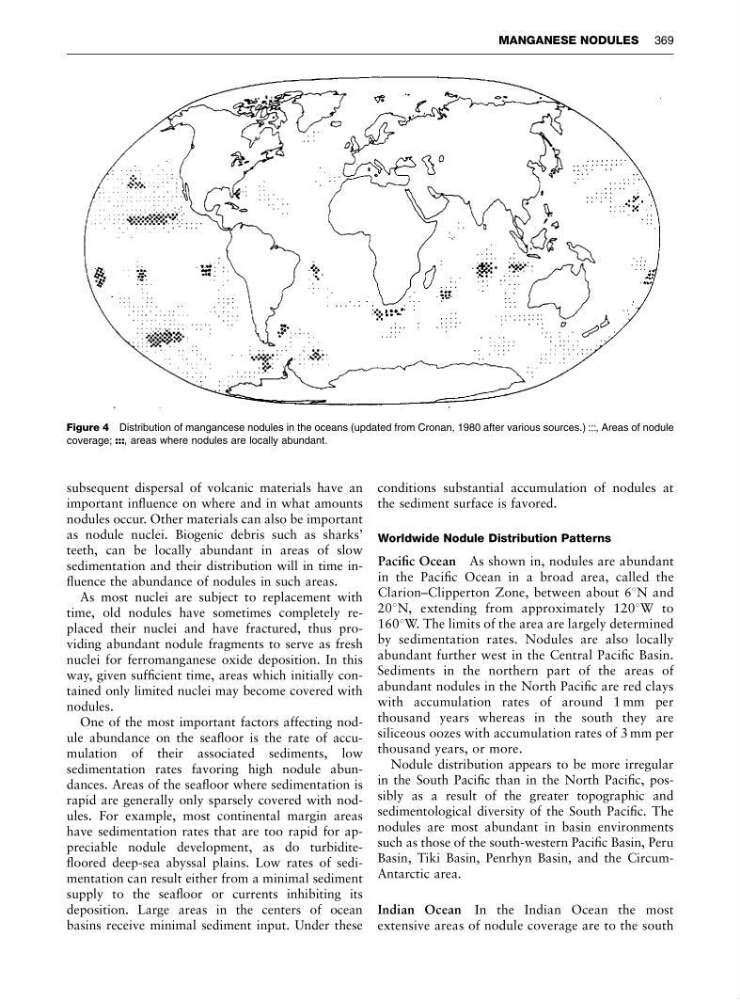
Pacific Ocean As shown in, nodules are abundant
in the Pacific Ocean in a broad area, called the
Clarion–Clipperton Zone, between about 61N and
201N, extending from approximately 1201W to
1601W. The limits of the area are largely determined
by sedimentation rates. Nodules are also locally
abundant further west in the Central Pacific Basin.
Sediments in the northern part of the areas of
abundant nodules in the North Pacific are red clays
with accumulation rates of around 1 mm per
thousand years whereas in the south they are
siliceous oozes with accumulation rates of 3 mm per
thousand years, or more.
Nodule distribution appears to be more irregular
in the South Pacific than in the North Pacific, possibly as a result of the greater topographic and
sedimentological diversity of the South Pacific. The
nodules are most abundant in basin environments
such as those of the south-western Pacific Basin, Peru
Basin, Tiki Basin, Penrhyn Basin, and the CircumAntarctic area.
Indian Ocean In the Indian Ocean the most
extensive areas of nodule coverage are to the south
Figure 4 Distribution of mangancese nodules in the oceans (updated from Cronan, 1980 after various sources.) , Areas of nodule
coverage; , areas where nodules are locally abundant.
MANGANESE NODULES 369
important influence on where and in what amounts
nodules occur. Other materials can also be important
as nodule nuclei. Biogenic debris such as sharks’
teeth, can be locally abundant in areas of slow
sedimentation and their distribution will in time influence the abundance of nodules in such areas.
As most nuclei are subject to replacement with
time, old nodules have sometimes completely replaced their nuclei and have fractured, thus providing abundant nodule fragments to serve as fresh
nuclei for ferromanganese oxide deposition. In this
way, given sufficient time, areas which initially contained only limited nuclei may become covered with
nodules.
One of the most important factors affecting nodule abundance on the seafloor is the rate of accumulation of their associated sediments, low
sedimentation rates favoring high nodule abundances. Areas of the seafloor where sedimentation is
rapid are generally only sparsely covered with nodules. For example, most continental margin areas
have sedimentation rates that are too rapid for appreciable nodule development, as do turbiditefloored deep-sea abyssal plains. Low rates of sedimentation can result either from a minimal sediment
supply to the seafloor or currents inhibiting its
deposition. Large areas in the centers of ocean
basins receive minimal sediment input. Under these
conditions substantial accumulation of nodules at
the sediment surface is favored.
Worldwide Nodule Distribution Patterns
Pacific Ocean As shown in, nodules are abundant
in the Pacific Ocean in a broad area, called the
Clarion–Clipperton Zone, between about 61N and
201N, extending from approximately 1201W to
1601W. The limits of the area are largely determined
by sedimentation rates. Nodules are also locally
abundant further west in the Central Pacific Basin.
Sediments in the northern part of the areas of
abundant nodules in the North Pacific are red clays
with accumulation rates of around 1 mm per
thousand years whereas in the south they are
siliceous oozes with accumulation rates of 3 mm per
thousand years, or more.
Nodule distribution appears to be more irregular
in the South Pacific than in the North Pacific, possibly as a result of the greater topographic and
sedimentological diversity of the South Pacific. The
nodules are most abundant in basin environments
such as those of the south-western Pacific Basin, Peru
Basin, Tiki Basin, Penrhyn Basin, and the CircumAntarctic area.
Indian Ocean In the Indian Ocean the most
extensive areas of nodule coverage are to the south
Figure 4 Distribution of mangancese nodules in the oceans (updated from Cronan, 1980 after various sources.) , Areas of nodule
coverage; , areas where nodules are locally abundant.
MANGANESE NODULES 369