

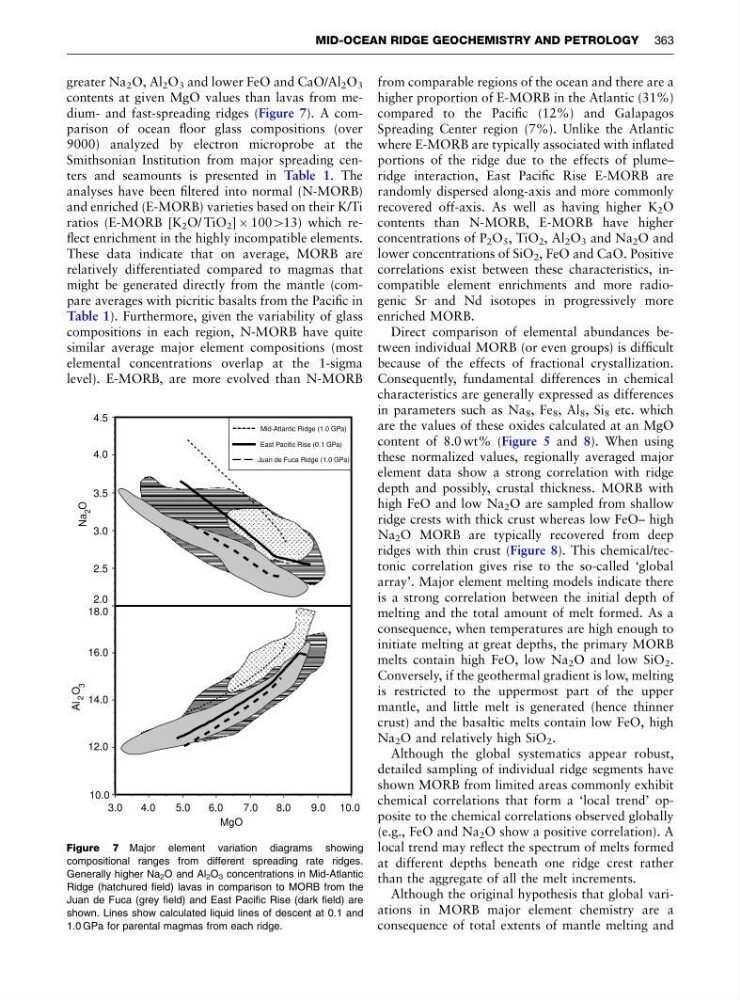
greater Na 2 O, Al 2 O 3 and lower FeO and CaO/Al 2 O 3
contents at given MgO values than lavas from medium- and fast-spreading ridges (Figure 7). A comparison of ocean floor glass compositions (over
9000) analyzed by electron microprobe at the
Smithsonian Institution from major spreading centers and seamounts is presented in Table 1. The
analyses have been filtered into normal (N-MORB)
and enriched (E-MORB) varieties based on their K/Ti
ratios (E-MORB [K 2 O/ TiO 2 ] Â 100413) which reflect enrichment in the highly incompatible elements.
These data indicate that on average, MORB are
relatively differentiated compared to magmas that
might be generated directly from the mantle (compare averages with picritic basalts from the Pacific in
Table 1). Furthermore, given the variability of glass
compositions in each region, N-MORB have quite
similar average major element compositions (most
elemental concentrations overlap at the 1-sigma
level). E-MORB, are more evolved than N-MORB
from comparable regions of the ocean and there are a
higher proportion of E-MORB in the Atlantic (31%)
compared to the Pacific (12%) and Galapagos
Spreading Center region (7%). Unlike the Atlantic
where E-MORB are typically associated with inflated
portions of the ridge due to the effects of plume–
ridge interaction, East Pacific Rise E-MORB are
randomly dispersed along-axis and more commonly
recovered off-axis. As well as having higher K 2 O
contents than N-MORB, E-MORB have higher
concentrations of P 2 O 5 , TiO 2 , Al 2 O 3 and Na 2 O and
lower concentrations of SiO 2 , FeO and CaO. Positive
correlations exist between these characteristics, incompatible element enrichments and more radiogenic Sr and Nd isotopes in progressively more
enriched MORB.
Direct comparison of elemental abundances between individual MORB (or even groups) is difficult
because of the effects of fractional crystallization.
Consequently, fundamental differences in chemical
characteristics are generally expressed as differences
in parameters such as Na 8 , Fe 8 , Al 8 , Si 8 etc. which
are the values of these oxides calculated at an MgO
content of 8.0 wt% (Figure 5 and 8). When using
these normalized values, regionally averaged major
element data show a strong correlation with ridge
depth and possibly, crustal thickness. MORB with
high FeO and low Na 2 O are sampled from shallow
ridge crests with thick crust whereas low FeO– high
Na 2 O MORB are typically recovered from deep
ridges with thin crust (Figure 8). This chemical/tectonic correlation gives rise to the so-called ‘global
array’. Major element melting models indicate there
is a strong correlation between the initial depth of
melting and the total amount of melt formed. As a
consequence, when temperatures are high enough to
initiate melting at great depths, the primary MORB
melts contain high FeO, low Na 2 O and low SiO 2 .
Conversely, if the geothermal gradient is low, melting
is restricted to the uppermost part of the upper
mantle, and little melt is generated (hence thinner
crust) and the basaltic melts contain low FeO, high
Na 2 O and relatively high SiO 2 .
Although the global systematics appear robust,
detailed sampling of individual ridge segments have
shown MORB from limited areas commonly exhibit
chemical correlations that form a ‘local trend’ opposite to the chemical correlations observed globally
(e.g., FeO and Na 2 O show a positive correlation). A
local trend may reflect the spectrum of melts formed
at different depths beneath one ridge crest rather
than the aggregate of all the melt increments.
Although the original hypothesis that global variations in MORB major element chemistry are a
consequence of total extents of mantle melting and
2.0
2.5
3.0
3.5
4.0
4.5
Na
2
O
Mid-Atlantic Ridge (1.0 GPa)
East Pacific Rise (0.1 GPa)
Juan de Fuca Ridge (1.0 GPa)
10.0
12.0
14.0
16.0
18.0
Al O
2
3
3.0
4.0
5.0
6.0
7.0
8.0
9.0 10.0
MgO
Figure 7 Major element variation diagrams showing
compositional ranges from different spreading rate ridges.
Generally higher Na 2 O and Al 2 O 3 concentrations in Mid-Atlantic
Ridge (hatchured field) lavas in comparison to MORB from the
Juan de Fuca (grey field) and East Pacific Rise (dark field) are
shown. Lines show calculated liquid lines of descent at 0.1 and
1.0 GPa for parental magmas from each ridge.
MID-OCEAN RIDGE GEOCHEMISTRY AND PETROLOGY 363
contents at given MgO values than lavas from medium- and fast-spreading ridges (Figure 7). A comparison of ocean floor glass compositions (over
9000) analyzed by electron microprobe at the
Smithsonian Institution from major spreading centers and seamounts is presented in Table 1. The
analyses have been filtered into normal (N-MORB)
and enriched (E-MORB) varieties based on their K/Ti
ratios (E-MORB [K 2 O/ TiO 2 ] Â 100413) which reflect enrichment in the highly incompatible elements.
These data indicate that on average, MORB are
relatively differentiated compared to magmas that
might be generated directly from the mantle (compare averages with picritic basalts from the Pacific in
Table 1). Furthermore, given the variability of glass
compositions in each region, N-MORB have quite
similar average major element compositions (most
elemental concentrations overlap at the 1-sigma
level). E-MORB, are more evolved than N-MORB
from comparable regions of the ocean and there are a
higher proportion of E-MORB in the Atlantic (31%)
compared to the Pacific (12%) and Galapagos
Spreading Center region (7%). Unlike the Atlantic
where E-MORB are typically associated with inflated
portions of the ridge due to the effects of plume–
ridge interaction, East Pacific Rise E-MORB are
randomly dispersed along-axis and more commonly
recovered off-axis. As well as having higher K 2 O
contents than N-MORB, E-MORB have higher
concentrations of P 2 O 5 , TiO 2 , Al 2 O 3 and Na 2 O and
lower concentrations of SiO 2 , FeO and CaO. Positive
correlations exist between these characteristics, incompatible element enrichments and more radiogenic Sr and Nd isotopes in progressively more
enriched MORB.
Direct comparison of elemental abundances between individual MORB (or even groups) is difficult
because of the effects of fractional crystallization.
Consequently, fundamental differences in chemical
characteristics are generally expressed as differences
in parameters such as Na 8 , Fe 8 , Al 8 , Si 8 etc. which
are the values of these oxides calculated at an MgO
content of 8.0 wt% (Figure 5 and 8). When using
these normalized values, regionally averaged major
element data show a strong correlation with ridge
depth and possibly, crustal thickness. MORB with
high FeO and low Na 2 O are sampled from shallow
ridge crests with thick crust whereas low FeO– high
Na 2 O MORB are typically recovered from deep
ridges with thin crust (Figure 8). This chemical/tectonic correlation gives rise to the so-called ‘global
array’. Major element melting models indicate there
is a strong correlation between the initial depth of
melting and the total amount of melt formed. As a
consequence, when temperatures are high enough to
initiate melting at great depths, the primary MORB
melts contain high FeO, low Na 2 O and low SiO 2 .
Conversely, if the geothermal gradient is low, melting
is restricted to the uppermost part of the upper
mantle, and little melt is generated (hence thinner
crust) and the basaltic melts contain low FeO, high
Na 2 O and relatively high SiO 2 .
Although the global systematics appear robust,
detailed sampling of individual ridge segments have
shown MORB from limited areas commonly exhibit
chemical correlations that form a ‘local trend’ opposite to the chemical correlations observed globally
(e.g., FeO and Na 2 O show a positive correlation). A
local trend may reflect the spectrum of melts formed
at different depths beneath one ridge crest rather
than the aggregate of all the melt increments.
Although the original hypothesis that global variations in MORB major element chemistry are a
consequence of total extents of mantle melting and
2.0
2.5
3.0
3.5
4.0
4.5
Na
2
O
Mid-Atlantic Ridge (1.0 GPa)
East Pacific Rise (0.1 GPa)
Juan de Fuca Ridge (1.0 GPa)
10.0
12.0
14.0
16.0
18.0
Al O
2
3
3.0
4.0
5.0
6.0
7.0
8.0
9.0 10.0
MgO
Figure 7 Major element variation diagrams showing
compositional ranges from different spreading rate ridges.
Generally higher Na 2 O and Al 2 O 3 concentrations in Mid-Atlantic
Ridge (hatchured field) lavas in comparison to MORB from the
Juan de Fuca (grey field) and East Pacific Rise (dark field) are
shown. Lines show calculated liquid lines of descent at 0.1 and
1.0 GPa for parental magmas from each ridge.
MID-OCEAN RIDGE GEOCHEMISTRY AND PETROLOGY 363