

pressures that correspond to depths of B1 to 10 km
within the oceanic crust and upper mantle. Much of
the major element data from fast-spreading ridges
like the East Pacific Rise are best explained by
low-pressure (B0.1 GPa) fractional crystallization
whereas at slow-spreading ridges like the Mid-Atlantic Ridge data require higher pressure crystallization (B0.5–1.0 GPa). This is consistent with
other evidence suggesting that magmas at fastspreading ridges evolve in a shallow magma lens or
chambers and that magmas at slow-spreading ridges
evolve at significantly greater depths; possibly in the
mantle lithosphere or at the crust–mantle boundary.
Estimated depths of crystallization correlate with
increased depths of magma lens or fault rupture
depth related to decreasing spreading rate.
Cogenetic lavas (those from the same or similar
primary melts) generated by fractional crystallization
exhibit up to 10-fold enrichments of incompatible
trace elements (e.g., Zr, Nb, Y, Ba, Rb, REE) that
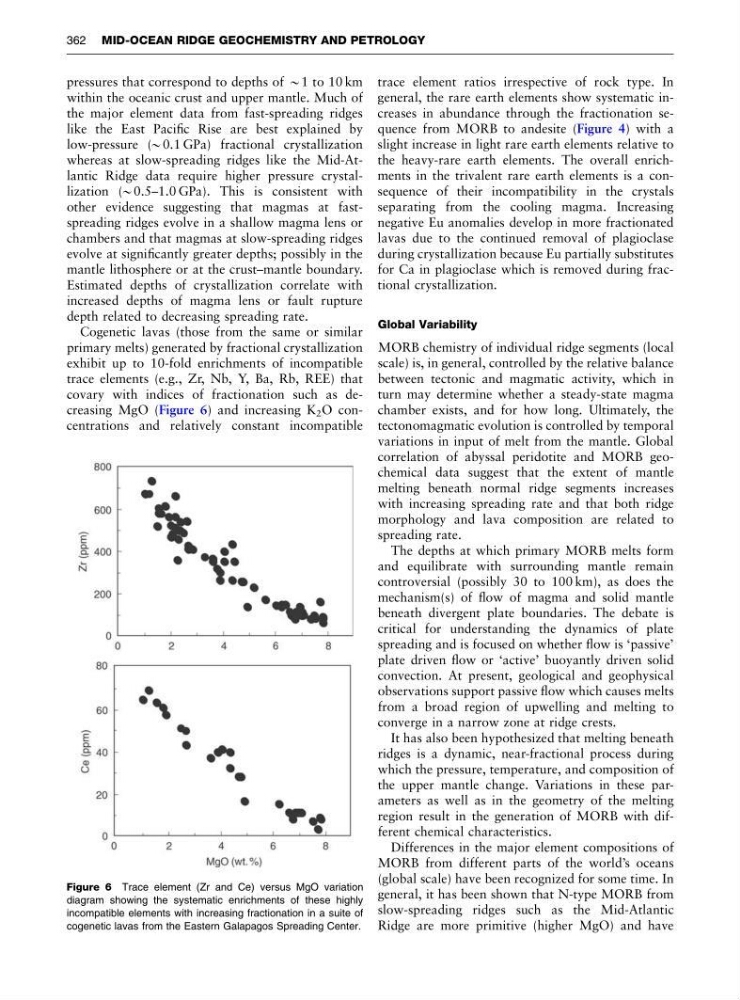
covary with indices of fractionation such as decreasing MgO (Figure 6) and increasing K 2 O concentrations and relatively constant incompatible
trace element ratios irrespective of rock type. In
general, the rare earth elements show systematic increases in abundance through the fractionation sequence from MORB to andesite (Figure 4) with a
slight increase in light rare earth elements relative to
the heavy-rare earth elements. The overall enrichments in the trivalent rare earth elements is a consequence of their incompatibility in the crystals
separating from the cooling magma. Increasing
negative Eu anomalies develop in more fractionated
lavas due to the continued removal of plagioclase
during crystallization because Eu partially substitutes
for Ca in plagioclase which is removed during fractional crystallization.
Global Variability
MORB chemistry of individual ridge segments (local
scale) is, in general, controlled by the relative balance
between tectonic and magmatic activity, which in
turn may determine whether a steady-state magma
chamber exists, and for how long. Ultimately, the
tectonomagmatic evolution is controlled by temporal
variations in input of melt from the mantle. Global
correlation of abyssal peridotite and MORB geochemical data suggest that the extent of mantle
melting beneath normal ridge segments increases
with increasing spreading rate and that both ridge
morphology and lava composition are related to
spreading rate.
The depths at which primary MORB melts form
and equilibrate with surrounding mantle remain
controversial (possibly 30 to 100 km), as does the
mechanism(s) of flow of magma and solid mantle
beneath divergent plate boundaries. The debate is
critical for understanding the dynamics of plate
spreading and is focused on whether flow is ‘passive’
plate driven flow or ‘active’ buoyantly driven solid
convection. At present, geological and geophysical
observations support passive flow which causes melts
from a broad region of upwelling and melting to
converge in a narrow zone at ridge crests.
It has also been hypothesized that melting beneath
ridges is a dynamic, near-fractional process during
which the pressure, temperature, and composition of
the upper mantle change. Variations in these parameters as well as in the geometry of the melting
region result in the generation of MORB with different chemical characteristics.
Differences in the major element compositions of
MORB from different parts of the world’s oceans
(global scale) have been recognized for some time. In
general, it has been shown that N-type MORB from
slow-spreading ridges such as the Mid-Atlantic
Ridge are more primitive (higher MgO) and have
Figure 6 Trace element (Zr and Ce) versus MgO variation
diagram showing the systematic enrichments of these highly
incompatible elements with increasing fractionation in a suite of
cogenetic lavas from the Eastern Galapagos Spreading Center.
362 MID-OCEAN RIDGE GEOCHEMISTRY AND PETROLOGY
within the oceanic crust and upper mantle. Much of
the major element data from fast-spreading ridges
like the East Pacific Rise are best explained by
low-pressure (B0.1 GPa) fractional crystallization
whereas at slow-spreading ridges like the Mid-Atlantic Ridge data require higher pressure crystallization (B0.5–1.0 GPa). This is consistent with
other evidence suggesting that magmas at fastspreading ridges evolve in a shallow magma lens or
chambers and that magmas at slow-spreading ridges
evolve at significantly greater depths; possibly in the
mantle lithosphere or at the crust–mantle boundary.
Estimated depths of crystallization correlate with
increased depths of magma lens or fault rupture
depth related to decreasing spreading rate.
Cogenetic lavas (those from the same or similar
primary melts) generated by fractional crystallization
exhibit up to 10-fold enrichments of incompatible
trace elements (e.g., Zr, Nb, Y, Ba, Rb, REE) that
covary with indices of fractionation such as decreasing MgO (Figure 6) and increasing K 2 O concentrations and relatively constant incompatible
trace element ratios irrespective of rock type. In
general, the rare earth elements show systematic increases in abundance through the fractionation sequence from MORB to andesite (Figure 4) with a
slight increase in light rare earth elements relative to
the heavy-rare earth elements. The overall enrichments in the trivalent rare earth elements is a consequence of their incompatibility in the crystals
separating from the cooling magma. Increasing
negative Eu anomalies develop in more fractionated
lavas due to the continued removal of plagioclase
during crystallization because Eu partially substitutes
for Ca in plagioclase which is removed during fractional crystallization.
Global Variability
MORB chemistry of individual ridge segments (local
scale) is, in general, controlled by the relative balance
between tectonic and magmatic activity, which in
turn may determine whether a steady-state magma
chamber exists, and for how long. Ultimately, the
tectonomagmatic evolution is controlled by temporal
variations in input of melt from the mantle. Global
correlation of abyssal peridotite and MORB geochemical data suggest that the extent of mantle
melting beneath normal ridge segments increases
with increasing spreading rate and that both ridge
morphology and lava composition are related to
spreading rate.
The depths at which primary MORB melts form
and equilibrate with surrounding mantle remain
controversial (possibly 30 to 100 km), as does the
mechanism(s) of flow of magma and solid mantle
beneath divergent plate boundaries. The debate is
critical for understanding the dynamics of plate
spreading and is focused on whether flow is ‘passive’
plate driven flow or ‘active’ buoyantly driven solid
convection. At present, geological and geophysical
observations support passive flow which causes melts
from a broad region of upwelling and melting to
converge in a narrow zone at ridge crests.
It has also been hypothesized that melting beneath
ridges is a dynamic, near-fractional process during
which the pressure, temperature, and composition of
the upper mantle change. Variations in these parameters as well as in the geometry of the melting
region result in the generation of MORB with different chemical characteristics.
Differences in the major element compositions of
MORB from different parts of the world’s oceans
(global scale) have been recognized for some time. In
general, it has been shown that N-type MORB from
slow-spreading ridges such as the Mid-Atlantic
Ridge are more primitive (higher MgO) and have
Figure 6 Trace element (Zr and Ce) versus MgO variation
diagram showing the systematic enrichments of these highly
incompatible elements with increasing fractionation in a suite of
cogenetic lavas from the Eastern Galapagos Spreading Center.
362 MID-OCEAN RIDGE GEOCHEMISTRY AND PETROLOGY