

to be chemically altered and metamorphosed. When
this occurs, the primary minerals are recrystallized or
replaced by a variety of secondary minerals such as
smectite, albite, chlorite, epidote, and amphibole
that are more stable under lower temperature and
more hydrous conditions. MOR basalts, diabases
and gabbros are commonly metamorphosed to
greenschists and amphibolites. Plutonic rocks and
portions of the upper mantle rich in olivine and
pyroxene are transformed into serpentinites. Oceanic
metamorphic rocks are commonly recovered from
transform faults, fracture zones and slowly spreading
segments of the MOR where tectonism and faulting
facilitate deep penetration of sea water into the crust
and upper mantle.
Chemical Variability
Although MORB form a relatively homogeneous
population of rock types when compared to lavas
erupted at other tectonic localities, there are subtle,
yet significant, chemical differences in their chemistry due to variability in source composition, depth
and extent of melting, magma mixing, and processes
that modify primary magmas in the shallow lithosphere. Chemical differences between MORB exist
on all scales, from individual flows erupted along the
same ridge segment (e.g., CoAxial Segment of the
Juan de Fuca Ridge) to the average composition of
basalts from the global ridge system (e.g. Mid-Atlantic Ridge vs. East Pacific Rise). High-density
sampling along several MOR segments has shown
that quite a diversity of lava compositions can be
erupted over short time (10s–100 years) and length
scales (100 m to a few kilometers). Slow spreading
ridges, which do not have steady-state magma bodies, generally erupt more mafic lavas compared to
fast spreading ridges where magmas are more heavily
influenced by fractional crystallization in shallow
magma bodies. Intermediate rate-spreading centers,
where magma lenses may be small and intermittent,
show characteristics of both slow- and-fast spreading
centers. In environments where magma supply is low
or mixing is inhibited, such as proximal to transform
faults, propagating rift tips and overlapping spreading centers, compositionally diverse and highly differentiated lavas are commonly found (such as
the Eastern Galapagos Spreading Center, Figures 3, 4
and 6). In these environments, extensive fractional
crystallization is a consequence of relatively cooler
thermal regimes and the magmatic processes associated with rift propagation.
Local variability in MORB can be divided into
two categories: (1) those due to processes that affect
an individual parental magma (e.g., fractional crystallization, assimilation) and (2) those created via
partial melting and transport in a single melting regime (e.g., melting in a rising diapir). In contrast,
global variations reflect regional variations in mantle
source chemistry and temperature, as well as the
averaging of melts derived from diverse melting regimes (e.g. accumulative polybaric fractional melting). At any given segment of MOR, variations may
be due to various combinations of these processes.
Local Variability
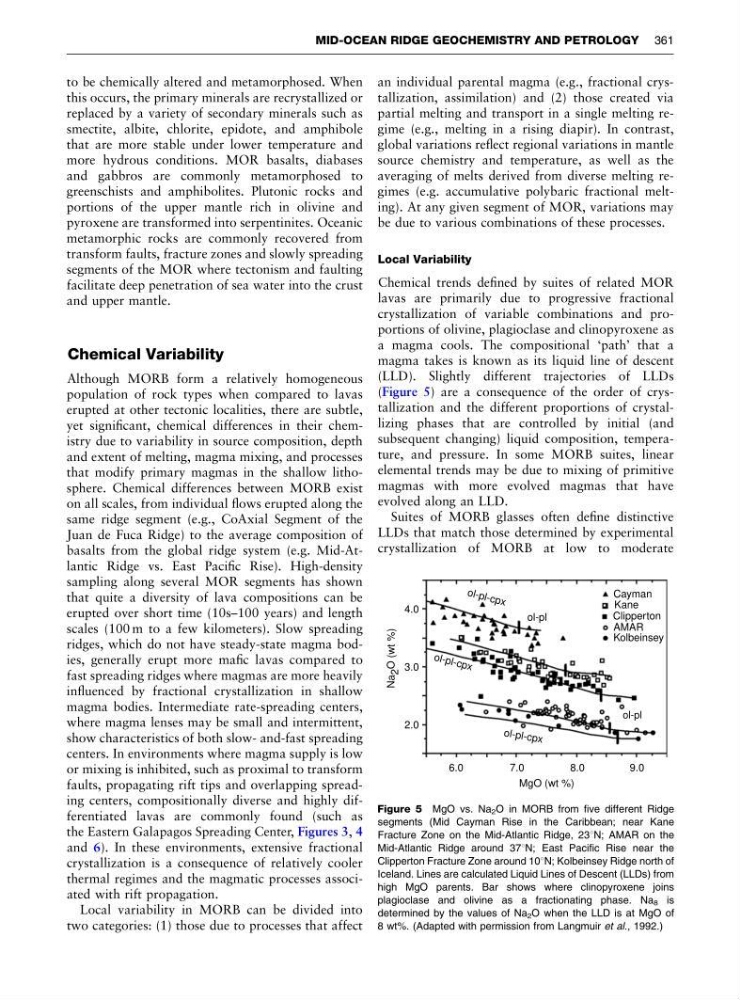
Chemical trends defined by suites of related MOR
lavas are primarily due to progressive fractional
crystallization of variable combinations and proportions of olivine, plagioclase and clinopyroxene as
a magma cools. The compositional ‘path’ that a
magma takes is known as its liquid line of descent
(LLD). Slightly different trajectories of LLDs
(Figure 5) are a consequence of the order of crystallization and the different proportions of crystallizing phases that are controlled by initial (and
subsequent changing) liquid composition, temperature, and pressure. In some MORB suites, linear
elemental trends may be due to mixing of primitive
magmas with more evolved magmas that have
evolved along an LLD.
Suites of MORB glasses often define distinctive
LLDs that match those determined by experimental
crystallization of MORB at low to moderate
Cayman
Kane
Clipperton
AMAR
Kolbeinsey
9.0
8.0
7.0
6.0
2.0
3.0
4.0
MgO (wt %)
ol-pl
Na
2 O (wt %)
o l- p l- c p x
ol-pl
o l- p l- c p x
ol -p l-c px
Figure 5 MgO vs. Na 2 O in MORB from five different Ridge
segments (Mid Cayman Rise in the Caribbean; near Kane
Fracture Zone on the Mid-Atlantic Ridge, 231N; AMAR on the
Mid-Atlantic Ridge around 371N; East Pacific Rise near the
Clipperton Fracture Zone around 101N; Kolbeinsey Ridge north of
Iceland. Lines are calculated Liquid Lines of Descent (LLDs) from
high MgO parents. Bar shows where clinopyroxene joins
plagioclase and olivine as a fractionating phase. Na 8 is
determined by the values of Na 2 O when the LLD is at MgO of
8 wt%. (Adapted with permission from Langmuir et al., 1992.)
MID-OCEAN RIDGE GEOCHEMISTRY AND PETROLOGY 361
this occurs, the primary minerals are recrystallized or
replaced by a variety of secondary minerals such as
smectite, albite, chlorite, epidote, and amphibole
that are more stable under lower temperature and
more hydrous conditions. MOR basalts, diabases
and gabbros are commonly metamorphosed to
greenschists and amphibolites. Plutonic rocks and
portions of the upper mantle rich in olivine and
pyroxene are transformed into serpentinites. Oceanic
metamorphic rocks are commonly recovered from
transform faults, fracture zones and slowly spreading
segments of the MOR where tectonism and faulting
facilitate deep penetration of sea water into the crust
and upper mantle.
Chemical Variability
Although MORB form a relatively homogeneous
population of rock types when compared to lavas
erupted at other tectonic localities, there are subtle,
yet significant, chemical differences in their chemistry due to variability in source composition, depth
and extent of melting, magma mixing, and processes
that modify primary magmas in the shallow lithosphere. Chemical differences between MORB exist
on all scales, from individual flows erupted along the
same ridge segment (e.g., CoAxial Segment of the
Juan de Fuca Ridge) to the average composition of
basalts from the global ridge system (e.g. Mid-Atlantic Ridge vs. East Pacific Rise). High-density
sampling along several MOR segments has shown
that quite a diversity of lava compositions can be
erupted over short time (10s–100 years) and length
scales (100 m to a few kilometers). Slow spreading
ridges, which do not have steady-state magma bodies, generally erupt more mafic lavas compared to
fast spreading ridges where magmas are more heavily
influenced by fractional crystallization in shallow
magma bodies. Intermediate rate-spreading centers,
where magma lenses may be small and intermittent,
show characteristics of both slow- and-fast spreading
centers. In environments where magma supply is low
or mixing is inhibited, such as proximal to transform
faults, propagating rift tips and overlapping spreading centers, compositionally diverse and highly differentiated lavas are commonly found (such as
the Eastern Galapagos Spreading Center, Figures 3, 4
and 6). In these environments, extensive fractional
crystallization is a consequence of relatively cooler
thermal regimes and the magmatic processes associated with rift propagation.
Local variability in MORB can be divided into
two categories: (1) those due to processes that affect
an individual parental magma (e.g., fractional crystallization, assimilation) and (2) those created via
partial melting and transport in a single melting regime (e.g., melting in a rising diapir). In contrast,
global variations reflect regional variations in mantle
source chemistry and temperature, as well as the
averaging of melts derived from diverse melting regimes (e.g. accumulative polybaric fractional melting). At any given segment of MOR, variations may
be due to various combinations of these processes.
Local Variability
Chemical trends defined by suites of related MOR
lavas are primarily due to progressive fractional
crystallization of variable combinations and proportions of olivine, plagioclase and clinopyroxene as
a magma cools. The compositional ‘path’ that a
magma takes is known as its liquid line of descent
(LLD). Slightly different trajectories of LLDs
(Figure 5) are a consequence of the order of crystallization and the different proportions of crystallizing phases that are controlled by initial (and
subsequent changing) liquid composition, temperature, and pressure. In some MORB suites, linear
elemental trends may be due to mixing of primitive
magmas with more evolved magmas that have
evolved along an LLD.
Suites of MORB glasses often define distinctive
LLDs that match those determined by experimental
crystallization of MORB at low to moderate
Cayman
Kane
Clipperton
AMAR
Kolbeinsey
9.0
8.0
7.0
6.0
2.0
3.0
4.0
MgO (wt %)
ol-pl
Na
2 O (wt %)
o l- p l- c p x
ol-pl
o l- p l- c p x
ol -p l-c px
Figure 5 MgO vs. Na 2 O in MORB from five different Ridge
segments (Mid Cayman Rise in the Caribbean; near Kane
Fracture Zone on the Mid-Atlantic Ridge, 231N; AMAR on the
Mid-Atlantic Ridge around 371N; East Pacific Rise near the
Clipperton Fracture Zone around 101N; Kolbeinsey Ridge north of
Iceland. Lines are calculated Liquid Lines of Descent (LLDs) from
high MgO parents. Bar shows where clinopyroxene joins
plagioclase and olivine as a fractionating phase. Na 8 is
determined by the values of Na 2 O when the LLD is at MgO of
8 wt%. (Adapted with permission from Langmuir et al., 1992.)
MID-OCEAN RIDGE GEOCHEMISTRY AND PETROLOGY 361