

environments nor associated with noticeable increase
of smectite proportion or specific change in the clay
chemical or isotopic composition. The intrusion of
basalt sills in soft marine sediments may determine
some metamorphic effects and the very local formation of ordered mixed layers (corrensite), chlorite,
and associated non-clay minerals.
The hydrothermal impact on deep-sea sedimentation is fundamentally characterized by in situ
precipitation of Fe-Mn oxyhydroxides relatively depleted in accessory transition elements (Co, Cu, Ni),
and locally by the deposition of massive sulfides near
the vents where hot and chemically concentrated
water merges. The autochthonous clay minerals in
such environments are marked by various species
depending on fluid temperature, oxidation-reduction
processes, and fluid/rock ratio. For instance, drilling
holes in Pacific hydrothermal systems show different
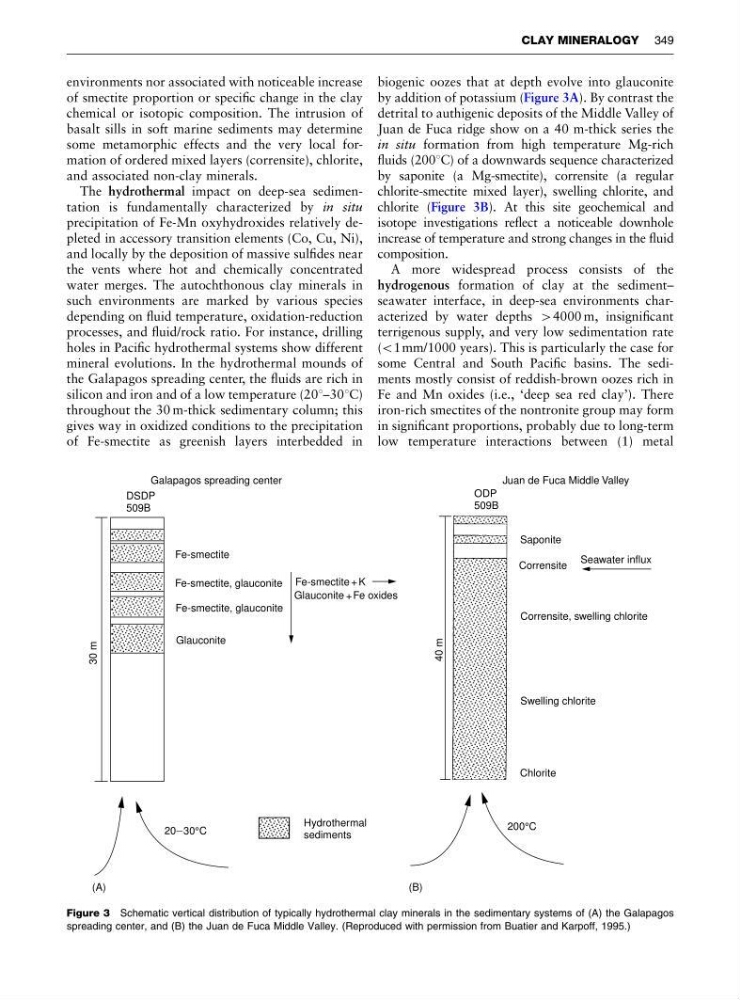
mineral evolutions. In the hydrothermal mounds of
the Galapagos spreading center, the fluids are rich in
silicon and iron and of a low temperature (201–301C)
throughout the 30 m-thick sedimentary column; this
gives way in oxidized conditions to the precipitation
of Fe-smectite as greenish layers interbedded in
biogenic oozes that at depth evolve into glauconite
by addition of potassium (Figure 3A). By contrast the
detrital to authigenic deposits of the Middle Valley of
Juan de Fuca ridge show on a 40 m-thick series the
in situ formation from high temperature Mg-rich
fluids (2001C) of a downwards sequence characterized
by saponite (a Mg-smectite), corrensite (a regular
chlorite-smectite mixed layer), swelling chlorite, and
chlorite (Figure 3B). At this site geochemical and
isotope investigations reflect a noticeable downhole
increase of temperature and strong changes in the fluid
composition.
A more widespread process consists of the
hydrogenous formation of clay at the sediment–
seawater interface, in deep-sea environments characterized by water depths 44000 m, insignificant
terrigenous supply, and very low sedimentation rate
(o1mm/1000 years). This is particularly the case for
some Central and South Pacific basins. The sediments mostly consist of reddish-brown oozes rich in
Fe and Mn oxides (i.e., ‘deep sea red clay’). There
iron-rich smectites of the nontronite group may form
in significant proportions, probably due to long-term
low temperature interactions between (1) metal
ODP
509B
Chlorite
Swelling chlorite
Corrensite, swelling chlorite
Saponite
Corrensite
20 _ 30°C
30 m
Hydrothermal
sediments
DSDP
509B
Fe-smectite
Fe-smectite + K
Glauconite +Fe oxides
Fe-smectite, glauconite
Fe-smectite, glauconite
Glauconite
Galapagos spreading center
200°C
40 m
Seawater influx
Juan de Fuca Middle Valley
(A)
(B)
Figure 3 Schematic vertical distribution of typically hydrothermal clay minerals in the sedimentary systems of (A) the Galapagos
spreading center, and (B) the Juan de Fuca Middle Valley. (Reproduced with permission from Buatier and Karpoff, 1995.)
CLAY MINERALOGY 349
of smectite proportion or specific change in the clay
chemical or isotopic composition. The intrusion of
basalt sills in soft marine sediments may determine
some metamorphic effects and the very local formation of ordered mixed layers (corrensite), chlorite,
and associated non-clay minerals.
The hydrothermal impact on deep-sea sedimentation is fundamentally characterized by in situ
precipitation of Fe-Mn oxyhydroxides relatively depleted in accessory transition elements (Co, Cu, Ni),
and locally by the deposition of massive sulfides near
the vents where hot and chemically concentrated
water merges. The autochthonous clay minerals in
such environments are marked by various species
depending on fluid temperature, oxidation-reduction
processes, and fluid/rock ratio. For instance, drilling
holes in Pacific hydrothermal systems show different
mineral evolutions. In the hydrothermal mounds of
the Galapagos spreading center, the fluids are rich in
silicon and iron and of a low temperature (201–301C)
throughout the 30 m-thick sedimentary column; this
gives way in oxidized conditions to the precipitation
of Fe-smectite as greenish layers interbedded in
biogenic oozes that at depth evolve into glauconite
by addition of potassium (Figure 3A). By contrast the
detrital to authigenic deposits of the Middle Valley of
Juan de Fuca ridge show on a 40 m-thick series the
in situ formation from high temperature Mg-rich
fluids (2001C) of a downwards sequence characterized
by saponite (a Mg-smectite), corrensite (a regular
chlorite-smectite mixed layer), swelling chlorite, and
chlorite (Figure 3B). At this site geochemical and
isotope investigations reflect a noticeable downhole
increase of temperature and strong changes in the fluid
composition.
A more widespread process consists of the
hydrogenous formation of clay at the sediment–
seawater interface, in deep-sea environments characterized by water depths 44000 m, insignificant
terrigenous supply, and very low sedimentation rate
(o1mm/1000 years). This is particularly the case for
some Central and South Pacific basins. The sediments mostly consist of reddish-brown oozes rich in
Fe and Mn oxides (i.e., ‘deep sea red clay’). There
iron-rich smectites of the nontronite group may form
in significant proportions, probably due to long-term
low temperature interactions between (1) metal
ODP
509B
Chlorite
Swelling chlorite
Corrensite, swelling chlorite
Saponite
Corrensite
20 _ 30°C
30 m
Hydrothermal
sediments
DSDP
509B
Fe-smectite
Fe-smectite + K
Glauconite +Fe oxides
Fe-smectite, glauconite
Fe-smectite, glauconite
Glauconite
Galapagos spreading center
200°C
40 m
Seawater influx
Juan de Fuca Middle Valley
(A)
(B)
Figure 3 Schematic vertical distribution of typically hydrothermal clay minerals in the sedimentary systems of (A) the Galapagos
spreading center, and (B) the Juan de Fuca Middle Valley. (Reproduced with permission from Buatier and Karpoff, 1995.)
CLAY MINERALOGY 349