

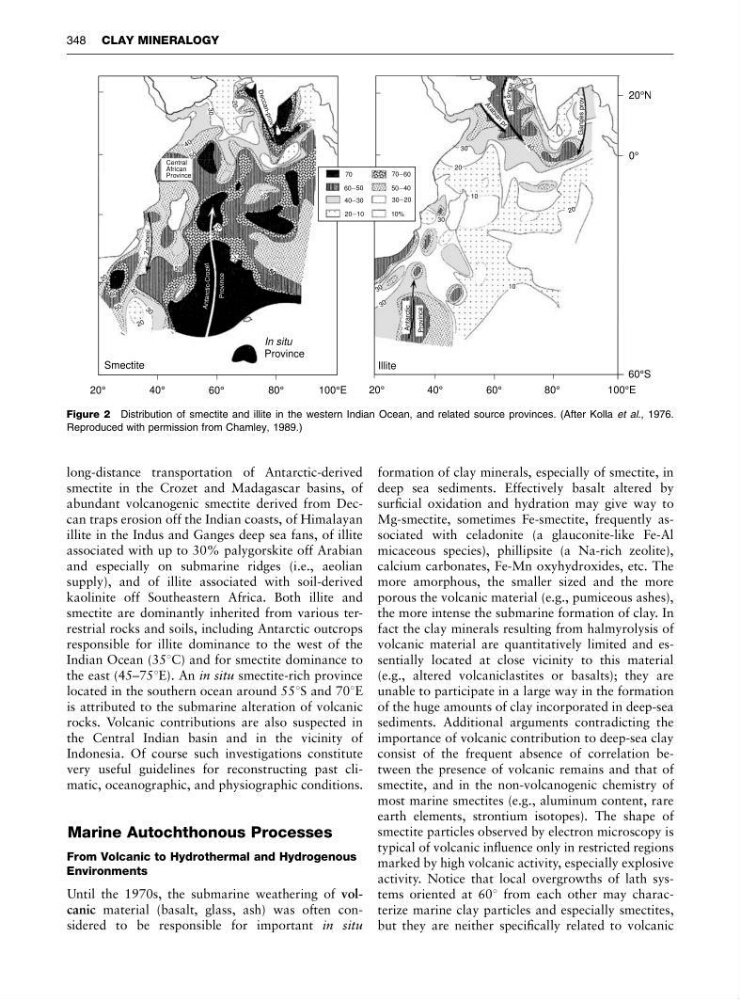
long-distance transportation of Antarctic-derived
smectite in the Crozet and Madagascar basins, of
abundant volcanogenic smectite derived from Deccan traps erosion off the Indian coasts, of Himalayan
illite in the Indus and Ganges deep sea fans, of illite
associated with up to 30% palygorskite off Arabian
and especially on submarine ridges (i.e., aeolian
supply), and of illite associated with soil-derived
kaolinite off Southeastern Africa. Both illite and
smectite are dominantly inherited from various terrestrial rocks and soils, including Antarctic outcrops
responsible for illite dominance to the west of the
Indian Ocean (351C) and for smectite dominance to
the east (45–751E). An in situ smectite-rich province
located in the southern ocean around 551S and 701E
is attributed to the submarine alteration of volcanic
rocks. Volcanic contributions are also suspected in
the Central Indian basin and in the vicinity of
Indonesia. Of course such investigations constitute
very useful guidelines for reconstructing past climatic, oceanographic, and physiographic conditions.
Marine Autochthonous Processes
From Volcanic to Hydrothermal and Hydrogenous
Environments
Until the 1970s, the submarine weathering of volcanic material (basalt, glass, ash) was often considered to be responsible for important in situ
formation of clay minerals, especially of smectite, in
deep sea sediments. Effectively basalt altered by
surficial oxidation and hydration may give way to
Mg-smectite, sometimes Fe-smectite, frequently associated with celadonite (a glauconite-like Fe-Al
micaceous species), phillipsite (a Na-rich zeolite),
calcium carbonates, Fe-Mn oxyhydroxides, etc. The
more amorphous, the smaller sized and the more
porous the volcanic material (e.g., pumiceous ashes),
the more intense the submarine formation of clay. In
fact the clay minerals resulting from halmyrolysis of
volcanic material are quantitatively limited and essentially located at close vicinity to this material
(e.g., altered volcaniclastites or basalts); they are
unable to participate in a large way in the formation
of the huge amounts of clay incorporated in deep-sea
sediments. Additional arguments contradicting the
importance of volcanic contribution to deep-sea clay
consist of the frequent absence of correlation between the presence of volcanic remains and that of
smectite, and in the non-volcanogenic chemistry of
most marine smectites (e.g., aluminum content, rare
earth elements, strontium isotopes). The shape of
smectite particles observed by electron microscopy is
typical of volcanic influence only in restricted regions
marked by high volcanic activity, especially explosive
activity. Notice that local overgrowths of lath systems oriented at 601 from each other may characterize marine clay particles and especially smectites,
but they are neither specifically related to volcanic
20°
20°
40°
40°
60°
60°
80°
80°
100°E
100°E
60°S
70
70 _ 60
60 _ 50
40 _ 30
20 _ 10
30 _ 20
50 _ 40
Illite
Smectite
In situ
Province
2 0
5 0
60
3 0
4 0
2 0
50
Zambesi
Central
African
Province
10%
5 0
4 0
30
20
D ec ca n- pr ov
Antarctic
Province
5 0
7 0
7 0
3 0
3 0
30
10
20
30
10
20
4 0
A r a b ia
n
p r Ind
us
pro v
Ganges prov
20°N
0°
5 0
Province
Figure 2 Distribution of smectite and illite in the western Indian Ocean, and related source provinces. (After Kolla et al., 1976.
Reproduced with permission from Chamley, 1989.)
348 CLAY MINERALOGY
smectite in the Crozet and Madagascar basins, of
abundant volcanogenic smectite derived from Deccan traps erosion off the Indian coasts, of Himalayan
illite in the Indus and Ganges deep sea fans, of illite
associated with up to 30% palygorskite off Arabian
and especially on submarine ridges (i.e., aeolian
supply), and of illite associated with soil-derived
kaolinite off Southeastern Africa. Both illite and
smectite are dominantly inherited from various terrestrial rocks and soils, including Antarctic outcrops
responsible for illite dominance to the west of the
Indian Ocean (351C) and for smectite dominance to
the east (45–751E). An in situ smectite-rich province
located in the southern ocean around 551S and 701E
is attributed to the submarine alteration of volcanic
rocks. Volcanic contributions are also suspected in
the Central Indian basin and in the vicinity of
Indonesia. Of course such investigations constitute
very useful guidelines for reconstructing past climatic, oceanographic, and physiographic conditions.
Marine Autochthonous Processes
From Volcanic to Hydrothermal and Hydrogenous
Environments
Until the 1970s, the submarine weathering of volcanic material (basalt, glass, ash) was often considered to be responsible for important in situ
formation of clay minerals, especially of smectite, in
deep sea sediments. Effectively basalt altered by
surficial oxidation and hydration may give way to
Mg-smectite, sometimes Fe-smectite, frequently associated with celadonite (a glauconite-like Fe-Al
micaceous species), phillipsite (a Na-rich zeolite),
calcium carbonates, Fe-Mn oxyhydroxides, etc. The
more amorphous, the smaller sized and the more
porous the volcanic material (e.g., pumiceous ashes),
the more intense the submarine formation of clay. In
fact the clay minerals resulting from halmyrolysis of
volcanic material are quantitatively limited and essentially located at close vicinity to this material
(e.g., altered volcaniclastites or basalts); they are
unable to participate in a large way in the formation
of the huge amounts of clay incorporated in deep-sea
sediments. Additional arguments contradicting the
importance of volcanic contribution to deep-sea clay
consist of the frequent absence of correlation between the presence of volcanic remains and that of
smectite, and in the non-volcanogenic chemistry of
most marine smectites (e.g., aluminum content, rare
earth elements, strontium isotopes). The shape of
smectite particles observed by electron microscopy is
typical of volcanic influence only in restricted regions
marked by high volcanic activity, especially explosive
activity. Notice that local overgrowths of lath systems oriented at 601 from each other may characterize marine clay particles and especially smectites,
but they are neither specifically related to volcanic
20°
20°
40°
40°
60°
60°
80°
80°
100°E
100°E
60°S
70
70 _ 60
60 _ 50
40 _ 30
20 _ 10
30 _ 20
50 _ 40
Illite
Smectite
In situ
Province
2 0
5 0
60
3 0
4 0
2 0
50
Zambesi
Central
African
Province
10%
5 0
4 0
30
20
D ec ca n- pr ov
Antarctic
Province
5 0
7 0
7 0
3 0
3 0
30
10
20
30
10
20
4 0
A r a b ia
n
p r Ind
us
pro v
Ganges prov
20°N
0°
5 0
Province
Figure 2 Distribution of smectite and illite in the western Indian Ocean, and related source provinces. (After Kolla et al., 1976.
Reproduced with permission from Chamley, 1989.)
348 CLAY MINERALOGY