

weathering, but also in a few low latitude regions
depending on active erosion of tectonically rejuvenated, high altitude domains (e.g., supply by Indus
and Ganges river drainage systems of Himalayan
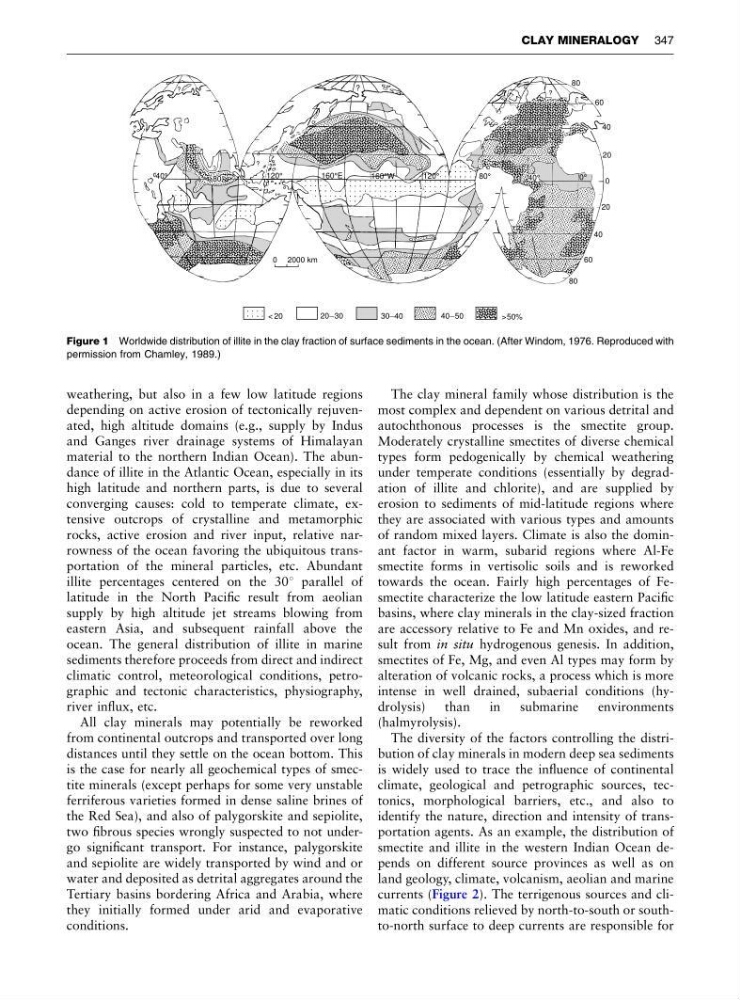
material to the northern Indian Ocean). The abundance of illite in the Atlantic Ocean, especially in its
high latitude and northern parts, is due to several
converging causes: cold to temperate climate, extensive outcrops of crystalline and metamorphic
rocks, active erosion and river input, relative narrowness of the ocean favoring the ubiquitous transportation of the mineral particles, etc. Abundant
illite percentages centered on the 301 parallel of
latitude in the North Pacific result from aeolian
supply by high altitude jet streams blowing from
eastern Asia, and subsequent rainfall above the
ocean. The general distribution of illite in marine
sediments therefore proceeds from direct and indirect
climatic control, meteorological conditions, petrographic and tectonic characteristics, physiography,
river influx, etc.
All clay minerals may potentially be reworked
from continental outcrops and transported over long
distances until they settle on the ocean bottom. This
is the case for nearly all geochemical types of smectite minerals (except perhaps for some very unstable
ferriferous varieties formed in dense saline brines of
the Red Sea), and also of palygorskite and sepiolite,
two fibrous species wrongly suspected to not undergo significant transport. For instance, palygorskite
and sepiolite are widely transported by wind and or
water and deposited as detrital aggregates around the
Tertiary basins bordering Africa and Arabia, where
they initially formed under arid and evaporative
conditions.
The clay mineral family whose distribution is the
most complex and dependent on various detrital and
autochthonous processes is the smectite group.
Moderately crystalline smectites of diverse chemical
types form pedogenically by chemical weathering
under temperate conditions (essentially by degradation of illite and chlorite), and are supplied by
erosion to sediments of mid-latitude regions where
they are associated with various types and amounts
of random mixed layers. Climate is also the dominant factor in warm, subarid regions where Al-Fe
smectite forms in vertisolic soils and is reworked
towards the ocean. Fairly high percentages of Fesmectite characterize the low latitude eastern Pacific
basins, where clay minerals in the clay-sized fraction
are accessory relative to Fe and Mn oxides, and result from in situ hydrogenous genesis. In addition,
smectites of Fe, Mg, and even Al types may form by
alteration of volcanic rocks, a process which is more
intense in well drained, subaerial conditions (hydrolysis) than in submarine
environments
(halmyrolysis).
The diversity of the factors controlling the distribution of clay minerals in modern deep sea sediments
is widely used to trace the influence of continental
climate, geological and petrographic sources, tectonics, morphological barriers, etc., and also to
identify the nature, direction and intensity of transportation agents. As an example, the distribution of
smectite and illite in the western Indian Ocean depends on different source provinces as well as on
land geology, climate, volcanism, aeolian and marine
currents (Figure 2). The terrigenous sources and climatic conditions relieved by north-to-south or southto-north surface to deep currents are responsible for
< 20
30 _ 40
40 _ 50
>50%
80°
40°
0°
160°E
160°W
120°
120°
80°
40°
80
60
40
20
0
20
40
60
80
?
?
?
?
0 2000 km
20 _ 30
Figure 1 Worldwide distribution of illite in the clay fraction of surface sediments in the ocean. (After Windom, 1976. Reproduced with
permission from Chamley, 1989.)
CLAY MINERALOGY 347
depending on active erosion of tectonically rejuvenated, high altitude domains (e.g., supply by Indus
and Ganges river drainage systems of Himalayan
material to the northern Indian Ocean). The abundance of illite in the Atlantic Ocean, especially in its
high latitude and northern parts, is due to several
converging causes: cold to temperate climate, extensive outcrops of crystalline and metamorphic
rocks, active erosion and river input, relative narrowness of the ocean favoring the ubiquitous transportation of the mineral particles, etc. Abundant
illite percentages centered on the 301 parallel of
latitude in the North Pacific result from aeolian
supply by high altitude jet streams blowing from
eastern Asia, and subsequent rainfall above the
ocean. The general distribution of illite in marine
sediments therefore proceeds from direct and indirect
climatic control, meteorological conditions, petrographic and tectonic characteristics, physiography,
river influx, etc.
All clay minerals may potentially be reworked
from continental outcrops and transported over long
distances until they settle on the ocean bottom. This
is the case for nearly all geochemical types of smectite minerals (except perhaps for some very unstable
ferriferous varieties formed in dense saline brines of
the Red Sea), and also of palygorskite and sepiolite,
two fibrous species wrongly suspected to not undergo significant transport. For instance, palygorskite
and sepiolite are widely transported by wind and or
water and deposited as detrital aggregates around the
Tertiary basins bordering Africa and Arabia, where
they initially formed under arid and evaporative
conditions.
The clay mineral family whose distribution is the
most complex and dependent on various detrital and
autochthonous processes is the smectite group.
Moderately crystalline smectites of diverse chemical
types form pedogenically by chemical weathering
under temperate conditions (essentially by degradation of illite and chlorite), and are supplied by
erosion to sediments of mid-latitude regions where
they are associated with various types and amounts
of random mixed layers. Climate is also the dominant factor in warm, subarid regions where Al-Fe
smectite forms in vertisolic soils and is reworked
towards the ocean. Fairly high percentages of Fesmectite characterize the low latitude eastern Pacific
basins, where clay minerals in the clay-sized fraction
are accessory relative to Fe and Mn oxides, and result from in situ hydrogenous genesis. In addition,
smectites of Fe, Mg, and even Al types may form by
alteration of volcanic rocks, a process which is more
intense in well drained, subaerial conditions (hydrolysis) than in submarine
environments
(halmyrolysis).
The diversity of the factors controlling the distribution of clay minerals in modern deep sea sediments
is widely used to trace the influence of continental
climate, geological and petrographic sources, tectonics, morphological barriers, etc., and also to
identify the nature, direction and intensity of transportation agents. As an example, the distribution of
smectite and illite in the western Indian Ocean depends on different source provinces as well as on
land geology, climate, volcanism, aeolian and marine
currents (Figure 2). The terrigenous sources and climatic conditions relieved by north-to-south or southto-north surface to deep currents are responsible for
< 20
30 _ 40
40 _ 50
>50%
80°
40°
0°
160°E
160°W
120°
120°
80°
40°
80
60
40
20
0
20
40
60
80
?
?
?
?
0 2000 km
20 _ 30
Figure 1 Worldwide distribution of illite in the clay fraction of surface sediments in the ocean. (After Windom, 1976. Reproduced with
permission from Chamley, 1989.)
CLAY MINERALOGY 347