

fraction coming from the continents is more
geologically recycled than that from the ocean crust,
and diagenesis in this regard is clearly not an
ultimate source but a process of further recycling of
these metals within the sediment column. The
relative importance of continental weathering
versus seafloor hydrothermal activity as a source of
iron and manganese to pelagic sediments and
marine ferromanganese deposits has been debated
since the 1890s. Early work by able geochemists on
both sides of this issue was hampered by a lack of
convincing evidence. For example, on the basis of
early distribution maps of manganese and other
trace metals in surface Atlantic sediments and
evidence for iron and manganese enrichments in
atmospheric dust, it was suggested that continental
weathering and atmospheric transport was an
important pathway of these metals to the ocean.
However, the manganese distribution in Atlantic
sediments can more readily be explained by
hydrothermal enrichments from hot springs along
the Mid-Atlantic Ridge, unknown at that time but
well-known today. Likewise, early arguments for
extensive hydrothermal iron and manganese
enrichments from volcanic hot springs located along
the mid-ocean ridges were compelling, but were not
confirmed until the discovery of hot springs there in
1977. Water column trace-metal analytical
techniques have improved to the point that a very
convincing argument can be made for continental
weathering and atmospheric transport as a path for
at least some fraction of the iron and manganese in
marine
ferromanganese
deposits.
Another
approach, which additionally answers the old
question of the relative contributions of these two
sources to ferromanganese deposits at any given
location of the seafloor, was made for the Pacific
(Figure 3) using a ‘Co-chronometer’. This dating
method is based upon the inverse relationship to
growth rate of some minor metals’ concentrations
in hydrogenetic ferromanganese crust deposits,
more painstakingly measured by radiometric
techniques such as U-series (excess
230 Th) or
10 Be
dating. Using the relatively easy Co-chronometer,
hundreds of ferromanganese deposits were
measured to construct the detailed map of
ferromanganese crust growth rates for the Pacific in
Figure 3. The highest growth rates are associated
with active spreading along the East Pacific Rise,
Juan de Fuca Ridge, and Galapagos Rift, and with
submarine arc volcanism in the Mariana Island arc.
The deposits in these areas therefore receive most of
their iron and manganese from hydrothermal
sources. The slowest crust growth rates and highest
cobalt enrichments are located near the Mid-Pacific
Mountains seamount province west of Hawaii, far
from active hot springs and the continents.
Source of minor metals Relative to sea water and
the Earth’s crust, ferromanganese nodules are
enriched in nickel, copper, cobalt, and a host of other
minor metals such as the platinum-group elements
(PGE) and the rare-earth elements (REE).
Concentrations of nickel and copper reach up to 2
wt% in ‘high-grade’ nodules from fields between the
Clarion and Clipperton fracture zones, with cobalt
concentrations approaching 0.5 wt%. Broadly,
nodules from the Pacific appear to be more enriched
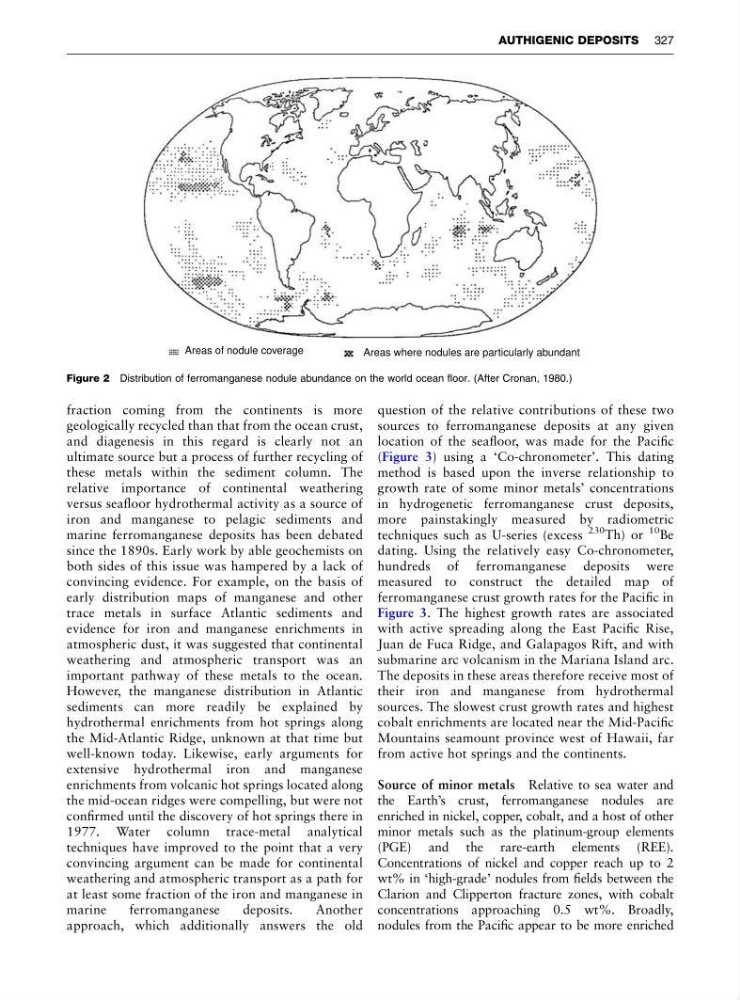
Areas of nodule coverage
Areas where nodules are particularly abundant
Figure 2 Distribution of ferromanganese nodule abundance on the world ocean floor. (After Cronan, 1980.)
AUTHIGENIC DEPOSITS 327
geologically recycled than that from the ocean crust,
and diagenesis in this regard is clearly not an
ultimate source but a process of further recycling of
these metals within the sediment column. The
relative importance of continental weathering
versus seafloor hydrothermal activity as a source of
iron and manganese to pelagic sediments and
marine ferromanganese deposits has been debated
since the 1890s. Early work by able geochemists on
both sides of this issue was hampered by a lack of
convincing evidence. For example, on the basis of
early distribution maps of manganese and other
trace metals in surface Atlantic sediments and
evidence for iron and manganese enrichments in
atmospheric dust, it was suggested that continental
weathering and atmospheric transport was an
important pathway of these metals to the ocean.
However, the manganese distribution in Atlantic
sediments can more readily be explained by
hydrothermal enrichments from hot springs along
the Mid-Atlantic Ridge, unknown at that time but
well-known today. Likewise, early arguments for
extensive hydrothermal iron and manganese
enrichments from volcanic hot springs located along
the mid-ocean ridges were compelling, but were not
confirmed until the discovery of hot springs there in
1977. Water column trace-metal analytical
techniques have improved to the point that a very
convincing argument can be made for continental
weathering and atmospheric transport as a path for
at least some fraction of the iron and manganese in
marine
ferromanganese
deposits.
Another
approach, which additionally answers the old
question of the relative contributions of these two
sources to ferromanganese deposits at any given
location of the seafloor, was made for the Pacific
(Figure 3) using a ‘Co-chronometer’. This dating
method is based upon the inverse relationship to
growth rate of some minor metals’ concentrations
in hydrogenetic ferromanganese crust deposits,
more painstakingly measured by radiometric
techniques such as U-series (excess
230 Th) or
10 Be
dating. Using the relatively easy Co-chronometer,
hundreds of ferromanganese deposits were
measured to construct the detailed map of
ferromanganese crust growth rates for the Pacific in
Figure 3. The highest growth rates are associated
with active spreading along the East Pacific Rise,
Juan de Fuca Ridge, and Galapagos Rift, and with
submarine arc volcanism in the Mariana Island arc.
The deposits in these areas therefore receive most of
their iron and manganese from hydrothermal
sources. The slowest crust growth rates and highest
cobalt enrichments are located near the Mid-Pacific
Mountains seamount province west of Hawaii, far
from active hot springs and the continents.
Source of minor metals Relative to sea water and
the Earth’s crust, ferromanganese nodules are
enriched in nickel, copper, cobalt, and a host of other
minor metals such as the platinum-group elements
(PGE) and the rare-earth elements (REE).
Concentrations of nickel and copper reach up to 2
wt% in ‘high-grade’ nodules from fields between the
Clarion and Clipperton fracture zones, with cobalt
concentrations approaching 0.5 wt%. Broadly,
nodules from the Pacific appear to be more enriched
Areas of nodule coverage
Areas where nodules are particularly abundant
Figure 2 Distribution of ferromanganese nodule abundance on the world ocean floor. (After Cronan, 1980.)
AUTHIGENIC DEPOSITS 327