

minerals are listed in order of decreasing E h or oxidation potential of the formation environment, and
increasing crystal order. In vernadite, all manganese
occurs as Mn
4þ
, which allows for crystal lattice substitution of metals such as Co
3þ and Pb
4þ . Todorokite
contains some manganese as Mn
2þ , which allows for
crystal lattice substitution of metals such as Cu
2þ and
Ni
2þ
. Birnessite is an intermediate form. Iron oxides
are primarily found as closely intermingled X-rayamorphous FeOOH and occasionally as goethite or
lepidocrocite. Other minerals include detrital quartz,
plagioclase feldspar, clay minerals such as smectites,
authigenic zeolites, apatite, barite, and calcite.
The global distribution of ferromanganese nodules
on the seafloor (Figure 2) largely reflects the inverse
distribution of thickest sediment cover. Nodules,
which accumulate at rates of several millimeters per
million years, cannot grow where sediments are accumulating at rates that are greater than 10
3 times
faster (several centimeters per thousand years).
Otherwise, rapid burial and dissolution would be
their fate. Paradoxically, nodules are found to lie
atop sediments that are accumulating at rates up to
10
3 times faster; this phenomenon has been explained by bottom current winnowing and gentle
bumping or tilting of nodules during the burrowing
activities of benthic organisms. Nodules are truly
pelagic deposits and are rarely found near the continents or near islands where rapid hemipelagic
sedimentation occurs. Exceptions are found on the
Blake Plateau off eastern Florida, within the Drake
Passage off South America, and near the Cape of
Good Hope off Southern Africa, where bottom currents are strong and sweep sediments from these
areas (Figure 2). Highly concentrated nodule fields
occur between the Clarion and Clipperton fracture
zones just north of the equatorial high productivity
zone in the Eastern Pacific, just south of this zone in
the Indian Ocean, and near the Antarctic Convergence in the Southeast Pacific.
Source of major metals The sources of the major
metals in ferromanganese nodules and crusts – iron
and manganese – are commonly described as
products of the weathering of the continents,
seafloor hydrothermal activity, and sediment
diagenesis. Other than a small but distinct
cosmogenic component (see Ferromanganese Crusts
below), the iron and manganese must ultimately
come from the Earth’s crust and mantle. The
Precipitation of colloidal
particles from near-bottom
sea water
Upward migration of dissolved
metals such as Mn , Cu ,
Ni , Zn , Mg under
pore water conditions
2+
2+
2+
2+
2+
Basaltic
substrate
rocks
Hydrogenetic
crusts
Hydrogenetic
nodules
Range of calcite compensation depth
Mixed-type nodules
Early diagenetic
nodules
Peneliquid
sediment layer
Consolidated
pelagic sediment
Ocean water
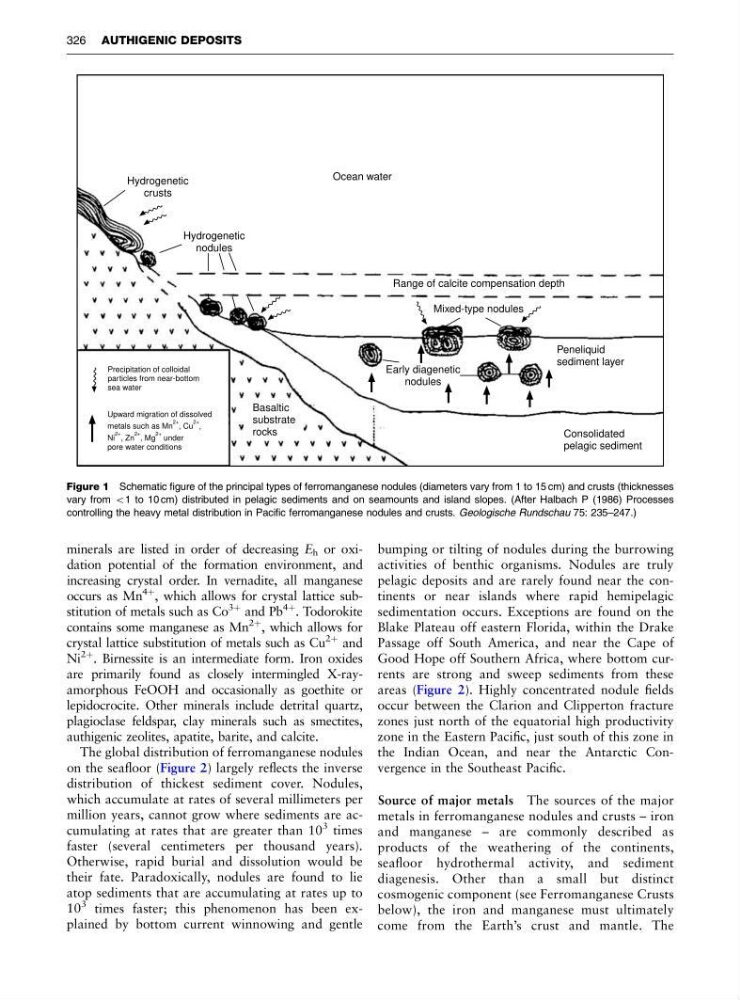
Figure 1 Schematic figure of the principal types of ferromanganese nodules (diameters vary from 1 to 15 cm) and crusts (thicknesses
vary from o1 to 10 cm) distributed in pelagic sediments and on seamounts and island slopes. (After Halbach P (1986) Processes
controlling the heavy metal distribution in Pacific ferromanganese nodules and crusts. Geologische Rundschau 75: 235–247.)
326 AUTHIGENIC DEPOSITS
increasing crystal order. In vernadite, all manganese
occurs as Mn
4þ
, which allows for crystal lattice substitution of metals such as Co
3þ and Pb
4þ . Todorokite
contains some manganese as Mn
2þ , which allows for
crystal lattice substitution of metals such as Cu
2þ and
Ni
2þ
. Birnessite is an intermediate form. Iron oxides
are primarily found as closely intermingled X-rayamorphous FeOOH and occasionally as goethite or
lepidocrocite. Other minerals include detrital quartz,
plagioclase feldspar, clay minerals such as smectites,
authigenic zeolites, apatite, barite, and calcite.
The global distribution of ferromanganese nodules
on the seafloor (Figure 2) largely reflects the inverse
distribution of thickest sediment cover. Nodules,
which accumulate at rates of several millimeters per
million years, cannot grow where sediments are accumulating at rates that are greater than 10
3 times
faster (several centimeters per thousand years).
Otherwise, rapid burial and dissolution would be
their fate. Paradoxically, nodules are found to lie
atop sediments that are accumulating at rates up to
10
3 times faster; this phenomenon has been explained by bottom current winnowing and gentle
bumping or tilting of nodules during the burrowing
activities of benthic organisms. Nodules are truly
pelagic deposits and are rarely found near the continents or near islands where rapid hemipelagic
sedimentation occurs. Exceptions are found on the
Blake Plateau off eastern Florida, within the Drake
Passage off South America, and near the Cape of
Good Hope off Southern Africa, where bottom currents are strong and sweep sediments from these
areas (Figure 2). Highly concentrated nodule fields
occur between the Clarion and Clipperton fracture
zones just north of the equatorial high productivity
zone in the Eastern Pacific, just south of this zone in
the Indian Ocean, and near the Antarctic Convergence in the Southeast Pacific.
Source of major metals The sources of the major
metals in ferromanganese nodules and crusts – iron
and manganese – are commonly described as
products of the weathering of the continents,
seafloor hydrothermal activity, and sediment
diagenesis. Other than a small but distinct
cosmogenic component (see Ferromanganese Crusts
below), the iron and manganese must ultimately
come from the Earth’s crust and mantle. The
Precipitation of colloidal
particles from near-bottom
sea water
Upward migration of dissolved
metals such as Mn , Cu ,
Ni , Zn , Mg under
pore water conditions
2+
2+
2+
2+
2+
Basaltic
substrate
rocks
Hydrogenetic
crusts
Hydrogenetic
nodules
Range of calcite compensation depth
Mixed-type nodules
Early diagenetic
nodules
Peneliquid
sediment layer
Consolidated
pelagic sediment
Ocean water
Figure 1 Schematic figure of the principal types of ferromanganese nodules (diameters vary from 1 to 15 cm) and crusts (thicknesses
vary from o1 to 10 cm) distributed in pelagic sediments and on seamounts and island slopes. (After Halbach P (1986) Processes
controlling the heavy metal distribution in Pacific ferromanganese nodules and crusts. Geologische Rundschau 75: 235–247.)
326 AUTHIGENIC DEPOSITS