

would not be possible to produce a sudden release
that could lead to harmful CO 2 concentrations at the
ocean or land surface.
Injection Methods
The first injection concept was proposed by the
Italian physicist Cesare Marchetti, who thought to
introduce CO 2 into the outflow of the Mediterranean
Sea, where the relatively dense seawater would cause
the CO 2 to sink as it entered the Atlantic Ocean. As
illustrated in Figure 3, a number of options have
been considered since then.
Understanding these methods requires some
background information on the CO 2 –seawater system. Referring to Figure 4, at typical ocean pressures
and temperatures, pure CO 2 would be a gas above a
depth of 400–500 m and a liquid below that depth.
Liquid CO 2 is more compressible than seawater, and
would be positively buoyant (i.e., it will rise) down
to about 3000 m, but negatively buoyant (i.e., it will
sink) below that depth. At about 3700 m, the liquid
becomes negatively buoyant compared to seawater
saturated with CO 2 . In seawater–CO 2 systems, CO 2
hydrate (CO 2 Á nH 2 O, n B5.75) can form below
c. 400 m depth depending on the relative compositions of CO 2 and H 2 O. CO 2 hydrate is a solid with a
density about 10% greater than that of seawater.
The rising droplet plume has been the most studied
and is probably the easiest scheme to implement. It
would rely on commercially available technology to
inject the CO 2 as a stream of buoyant droplets from a
bottom manifold. Effective sequestration can be
achieved by locating the manifold below the thermocline, and dilution can be increased by increasing
the manifold length. Even better dilution can be
achieved by releasing the CO 2 droplets from a moving
ship whose motion provides additional dispersal. Although the means of delivery are different, the plumes
resulting from these two options would be similar,
each creating a vertical band of CO 2 -enriched seawater over a prescribed horizontal region.
Another promising option is to inject liquid CO 2
into a reactor where it can react at a controlled rate
with seawater to form hydrates. While it is difficult
to achieve 100% reaction efficiency, laboratory and
field experiments indicate that negative buoyancy,
and hence sinking, can be achieved with as little as
about 25% reaction efficiency. The hydrate reactor
could be towed from a moving ship to encourage
dilution, or attached to a fixed platform, where the
large concentration of dense particles, and the increased seawater density caused by hydrate dissolution, would induce a negatively buoyant plume.
The concept of a CO 2 lake is based on a desire to
minimize leakage to the atmosphere and exposure to
biota. This would require more advanced technology
and perhaps higher costs, as the depth of the lake
should be at least 3000 m, which exceeds the depths
at which the offshore oil industry currently works.
The CO 2 in the lake would be partly in the form of
solid hydrates. This would limit the CO 2 dissolution
into the water column, further slowing leakage to the
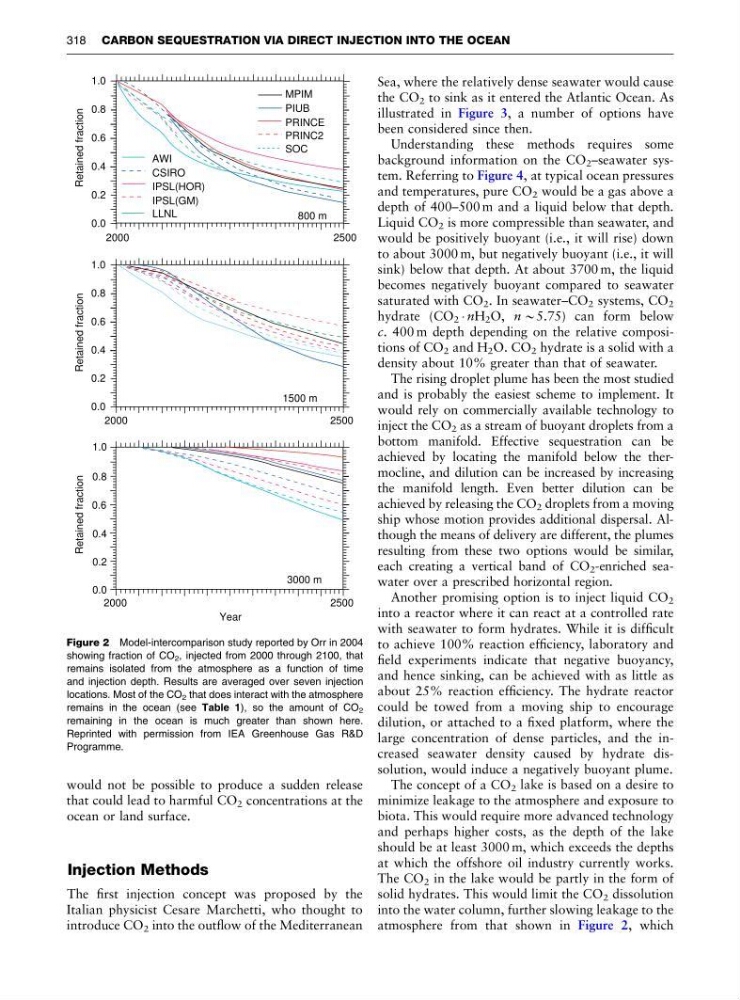
atmosphere from that shown in Figure 2, which
1.0
0.8
0.6
0.4
0.2
0.0
2000
2500
2000
2500
2000
2500
800 m
1500 m
3000 m
Retained fraction
1.0
0.8
0.6
0.4
0.2
0.0
Retained fraction
1.0
0.8
0.6
0.4
0.2
0.0
Retained fraction
MPIM
PIUB
PRINCE
PRINC2
SOC
AWI
CSIRO
IPSL(HOR)
IPSL(GM)
LLNL
Year
Figure 2 Model-intercomparison study reported by Orr in 2004
showing fraction of CO 2 , injected from 2000 through 2100, that
remains isolated from the atmosphere as a function of time
and injection depth. Results are averaged over seven injection
locations. Most of the CO 2 that does interact with the atmosphere
remains in the ocean (see Table 1), so the amount of CO 2
remaining in the ocean is much greater than shown here.
Reprinted with permission from IEA Greenhouse Gas R&D
Programme.
318 CARBON SEQUESTRATION VIA DIRECT INJECTION INTO THE OCEAN
that could lead to harmful CO 2 concentrations at the
ocean or land surface.
Injection Methods
The first injection concept was proposed by the
Italian physicist Cesare Marchetti, who thought to
introduce CO 2 into the outflow of the Mediterranean
Sea, where the relatively dense seawater would cause
the CO 2 to sink as it entered the Atlantic Ocean. As
illustrated in Figure 3, a number of options have
been considered since then.
Understanding these methods requires some
background information on the CO 2 –seawater system. Referring to Figure 4, at typical ocean pressures
and temperatures, pure CO 2 would be a gas above a
depth of 400–500 m and a liquid below that depth.
Liquid CO 2 is more compressible than seawater, and
would be positively buoyant (i.e., it will rise) down
to about 3000 m, but negatively buoyant (i.e., it will
sink) below that depth. At about 3700 m, the liquid
becomes negatively buoyant compared to seawater
saturated with CO 2 . In seawater–CO 2 systems, CO 2
hydrate (CO 2 Á nH 2 O, n B5.75) can form below
c. 400 m depth depending on the relative compositions of CO 2 and H 2 O. CO 2 hydrate is a solid with a
density about 10% greater than that of seawater.
The rising droplet plume has been the most studied
and is probably the easiest scheme to implement. It
would rely on commercially available technology to
inject the CO 2 as a stream of buoyant droplets from a
bottom manifold. Effective sequestration can be
achieved by locating the manifold below the thermocline, and dilution can be increased by increasing
the manifold length. Even better dilution can be
achieved by releasing the CO 2 droplets from a moving
ship whose motion provides additional dispersal. Although the means of delivery are different, the plumes
resulting from these two options would be similar,
each creating a vertical band of CO 2 -enriched seawater over a prescribed horizontal region.
Another promising option is to inject liquid CO 2
into a reactor where it can react at a controlled rate
with seawater to form hydrates. While it is difficult
to achieve 100% reaction efficiency, laboratory and
field experiments indicate that negative buoyancy,
and hence sinking, can be achieved with as little as
about 25% reaction efficiency. The hydrate reactor
could be towed from a moving ship to encourage
dilution, or attached to a fixed platform, where the
large concentration of dense particles, and the increased seawater density caused by hydrate dissolution, would induce a negatively buoyant plume.
The concept of a CO 2 lake is based on a desire to
minimize leakage to the atmosphere and exposure to
biota. This would require more advanced technology
and perhaps higher costs, as the depth of the lake
should be at least 3000 m, which exceeds the depths
at which the offshore oil industry currently works.
The CO 2 in the lake would be partly in the form of
solid hydrates. This would limit the CO 2 dissolution
into the water column, further slowing leakage to the
atmosphere from that shown in Figure 2, which
1.0
0.8
0.6
0.4
0.2
0.0
2000
2500
2000
2500
2000
2500
800 m
1500 m
3000 m
Retained fraction
1.0
0.8
0.6
0.4
0.2
0.0
Retained fraction
1.0
0.8
0.6
0.4
0.2
0.0
Retained fraction
MPIM
PIUB
PRINCE
PRINC2
SOC
AWI
CSIRO
IPSL(HOR)
IPSL(GM)
LLNL
Year
Figure 2 Model-intercomparison study reported by Orr in 2004
showing fraction of CO 2 , injected from 2000 through 2100, that
remains isolated from the atmosphere as a function of time
and injection depth. Results are averaged over seven injection
locations. Most of the CO 2 that does interact with the atmosphere
remains in the ocean (see Table 1), so the amount of CO 2
remaining in the ocean is much greater than shown here.
Reprinted with permission from IEA Greenhouse Gas R&D
Programme.
318 CARBON SEQUESTRATION VIA DIRECT INJECTION INTO THE OCEAN