

assumes that CO 2 is injected into the water column.
It is also possible that various approaches could be
engineered to physically contain CO 2 on the seafloor
and isolate the CO 2 from the overlying water column
(and perhaps the sediments); however, this would
entail an additional cost.
Another method that has received attention is injecting a dense CO 2 –seawater mixture at a depth of
500–1000 m, forming a sinking bottom gravity current. CO 2 -enriched seawater is less than 1% heavier
than seawater, but this is sufficient to promote a
sinking density current, especially if the current were
formed along a submarine canyon. However, the
environmental impacts would be greater with this
option due to the concentrated nature of the plume,
and its contact with the seafloor.
As discussed earlier, the deep ocean equilibrates
with the surface ocean on the scale of 300–1000
years, and by injecting anthropogenic CO 2 into the
deep ocean, the surface-to-deep mixing timescale is
effectively bypassed. Anthropogenic CO 2 also
Dispersal of CO 2 by ship
Dispersal of
CO 2 /CaCO 3
mixture
CO 2 /CaCO 3
reactor
Flue gas
Refilling ship
Rising CO 2 plume
Sinking CO 2 plume
Captured and
compressed CO 2
CO 2 lake
CO 2 lake
3 k m
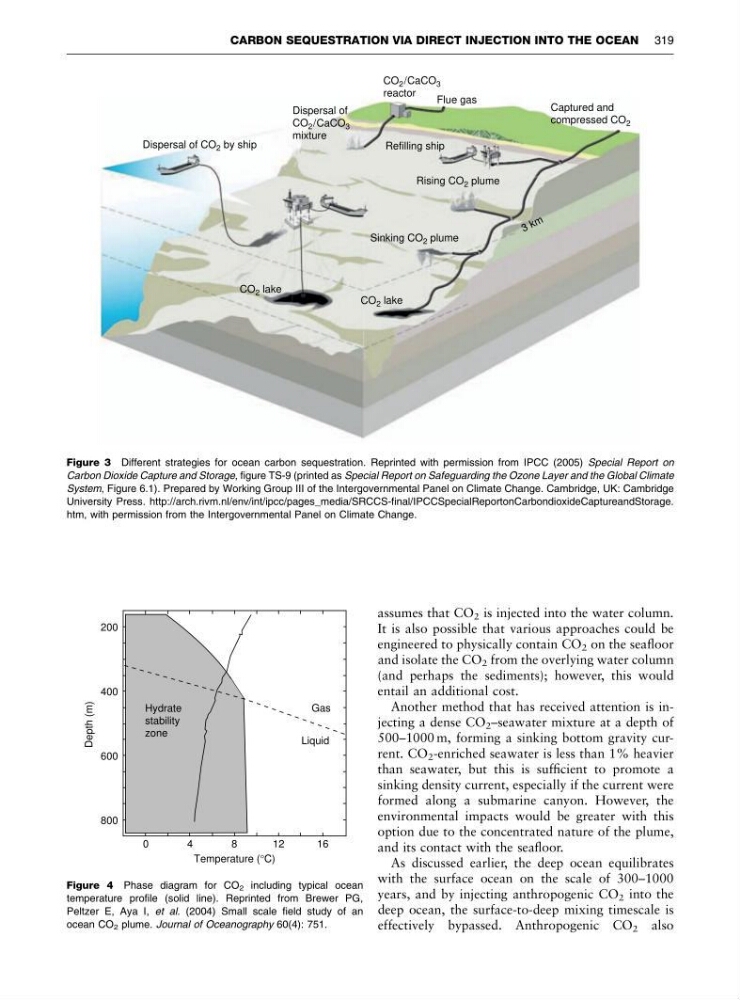
Figure 3 Different strategies for ocean carbon sequestration. Reprinted with permission from IPCC (2005) Special Report on
Carbon Dioxide Capture and Storage, figure TS-9 (printed as Special Report on Safeguarding the Ozone Layer and the Global Climate
System, Figure 6.1). Prepared by Working Group III of the Intergovernmental Panel on Climate Change. Cambridge, UK: Cambridge
University Press. http://arch.rivm.nl/env/int/ipcc/pages_media/SRCCS-final/IPCCSpecialReportonCarbondioxideCaptureandStorage.
htm, with permission from the Intergovernmental Panel on Climate Change.
200
400
600
800
0
4
8
1 2
1 6
Temperature (°C)
Hydrate
stability
zone
Gas
Liquid
Depth (m)
Figure 4 Phase diagram for CO 2 including typical ocean
temperature profile (solid line). Reprinted from Brewer PG,
Peltzer E, Aya I, et al. (2004) Small scale field study of an
ocean CO 2 plume. Journal of Oceanography 60(4): 751.
CARBON SEQUESTRATION VIA DIRECT INJECTION INTO THE OCEAN 319
It is also possible that various approaches could be
engineered to physically contain CO 2 on the seafloor
and isolate the CO 2 from the overlying water column
(and perhaps the sediments); however, this would
entail an additional cost.
Another method that has received attention is injecting a dense CO 2 –seawater mixture at a depth of
500–1000 m, forming a sinking bottom gravity current. CO 2 -enriched seawater is less than 1% heavier
than seawater, but this is sufficient to promote a
sinking density current, especially if the current were
formed along a submarine canyon. However, the
environmental impacts would be greater with this
option due to the concentrated nature of the plume,
and its contact with the seafloor.
As discussed earlier, the deep ocean equilibrates
with the surface ocean on the scale of 300–1000
years, and by injecting anthropogenic CO 2 into the
deep ocean, the surface-to-deep mixing timescale is
effectively bypassed. Anthropogenic CO 2 also
Dispersal of CO 2 by ship
Dispersal of
CO 2 /CaCO 3
mixture
CO 2 /CaCO 3
reactor
Flue gas
Refilling ship
Rising CO 2 plume
Sinking CO 2 plume
Captured and
compressed CO 2
CO 2 lake
CO 2 lake
3 k m
Figure 3 Different strategies for ocean carbon sequestration. Reprinted with permission from IPCC (2005) Special Report on
Carbon Dioxide Capture and Storage, figure TS-9 (printed as Special Report on Safeguarding the Ozone Layer and the Global Climate
System, Figure 6.1). Prepared by Working Group III of the Intergovernmental Panel on Climate Change. Cambridge, UK: Cambridge
University Press. http://arch.rivm.nl/env/int/ipcc/pages_media/SRCCS-final/IPCCSpecialReportonCarbondioxideCaptureandStorage.
htm, with permission from the Intergovernmental Panel on Climate Change.
200
400
600
800
0
4
8
1 2
1 6
Temperature (°C)
Hydrate
stability
zone
Gas
Liquid
Depth (m)
Figure 4 Phase diagram for CO 2 including typical ocean
temperature profile (solid line). Reprinted from Brewer PG,
Peltzer E, Aya I, et al. (2004) Small scale field study of an
ocean CO 2 plume. Journal of Oceanography 60(4): 751.
CARBON SEQUESTRATION VIA DIRECT INJECTION INTO THE OCEAN 319