

whether the CO 2 is released into the atmosphere or
the deep ocean. However, in the shorter term, releasing the CO 2 in the deep ocean will diminish the
pH change in the near-surface ocean, where marine
biota are most plentiful. Thus, direct injection of
CO 2 into the deep ocean could reduce adverse impacts presently occurring in the surface ocean. In the
long run, however, a sustainable solution to the
problem of climate change must ultimately entail a
drastic reduction of total CO 2 emissions.
Effectiveness
Carbon dioxide is constantly exchanged between the
ocean and atmosphere. Each year the ocean and atmosphere exchange about 350 Gt CO 2 , with a net
ocean uptake currently of about 8 Gt CO 2 . Because
of this exchange, questions arise as to how effective
ocean sequestration will be at keeping the CO 2 out of
the atmosphere. Specifically, is the sequestration
permanent, and if not, how fast does the CO 2 leak
back to the atmosphere. Because there has been no
long-term CO 2 direct-injection experiment in the
ocean, the long-term effectiveness of direct CO 2 injection must be predicted based on observations of
other oceanic tracers (e.g., radiocarbon) and on
computer models of ocean circulation and chemistry.
As implied earlier, because the atmosphere and
ocean are currently out of equilibrium, most CO 2
emitted to either media will ultimately enter the
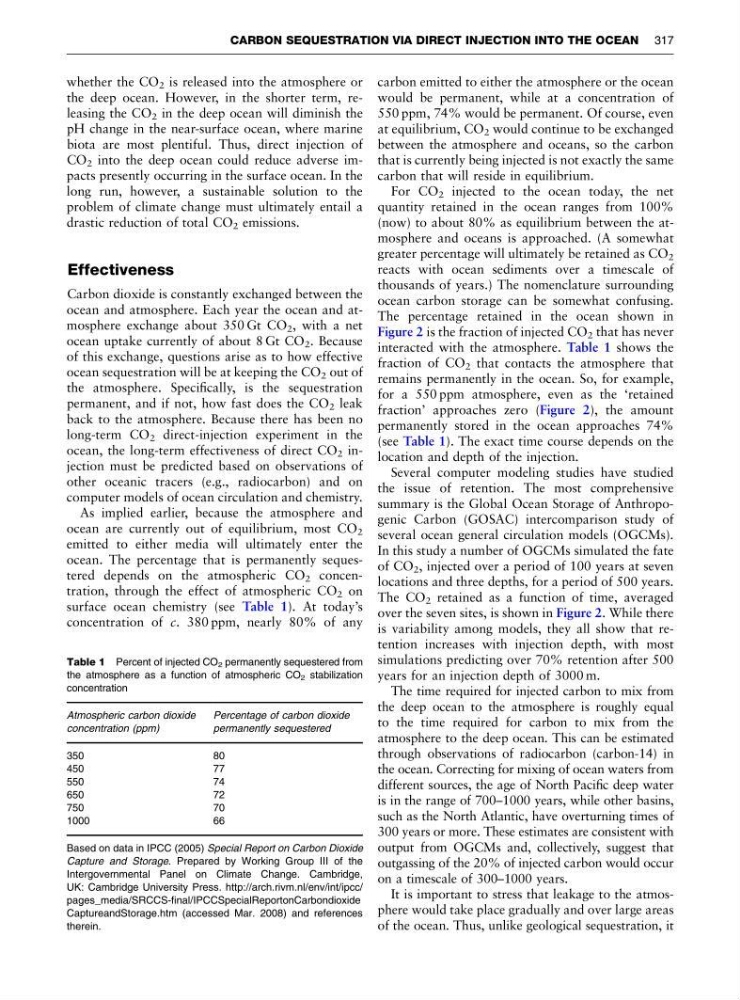
ocean. The percentage that is permanently sequestered depends on the atmospheric CO 2 concentration, through the effect of atmospheric CO 2 on
surface ocean chemistry (see Table 1). At today’s
concentration of c. 380 ppm, nearly 80% of any
carbon emitted to either the atmosphere or the ocean
would be permanent, while at a concentration of
550 ppm, 74% would be permanent. Of course, even
at equilibrium, CO 2 would continue to be exchanged
between the atmosphere and oceans, so the carbon
that is currently being injected is not exactly the same
carbon that will reside in equilibrium.
For CO 2 injected to the ocean today, the net
quantity retained in the ocean ranges from 100%
(now) to about 80% as equilibrium between the atmosphere and oceans is approached. (A somewhat
greater percentage will ultimately be retained as CO 2
reacts with ocean sediments over a timescale of
thousands of years.) The nomenclature surrounding
ocean carbon storage can be somewhat confusing.
The percentage retained in the ocean shown in
Figure 2 is the fraction of injected CO 2 that has never
interacted with the atmosphere. Table 1 shows the
fraction of CO 2 that contacts the atmosphere that
remains permanently in the ocean. So, for example,
for a 550 ppm atmosphere, even as the ‘retained
fraction’ approaches zero (Figure 2), the amount
permanently stored in the ocean approaches 74%
(see Table 1). The exact time course depends on the
location and depth of the injection.
Several computer modeling studies have studied
the issue of retention. The most comprehensive
summary is the Global Ocean Storage of Anthropogenic Carbon (GOSAC) intercomparison study of
several ocean general circulation models (OGCMs).
In this study a number of OGCMs simulated the fate
of CO 2 , injected over a period of 100 years at seven
locations and three depths, for a period of 500 years.
The CO 2 retained as a function of time, averaged
over the seven sites, is shown in Figure 2. While there
is variability among models, they all show that retention increases with injection depth, with most
simulations predicting over 70% retention after 500
years for an injection depth of 3000 m.
The time required for injected carbon to mix from
the deep ocean to the atmosphere is roughly equal
to the time required for carbon to mix from the
atmosphere to the deep ocean. This can be estimated
through observations of radiocarbon (carbon-14) in
the ocean. Correcting for mixing of ocean waters from
different sources, the age of North Pacific deep water
is in the range of 700–1000 years, while other basins,
such as the North Atlantic, have overturning times of
300 years or more. These estimates are consistent with
output from OGCMs and, collectively, suggest that
outgassing of the 20% of injected carbon would occur
on a timescale of 300–1000 years.
It is important to stress that leakage to the atmosphere would take place gradually and over large areas
of the ocean. Thus, unlike geological sequestration, it
Table 1 Percent of injected CO 2 permanently sequestered from
the atmosphere as a function of atmospheric CO 2 stabilization
concentration
Atmospheric carbon dioxide
concentration (ppm)
Percentage of carbon dioxide
permanently sequestered
350
80
450
77
550
74
650
72
750
70
1000
66
Based on data in IPCC (2005) Special Report on Carbon Dioxide
Capture and Storage. Prepared by Working Group III of the
Intergovernmental Panel on Climate Change. Cambridge,
UK: Cambridge University Press. http://arch.rivm.nl/env/int/ipcc/
pages_media/SRCCS-final/IPCCSpecialReportonCarbondioxide
CaptureandStorage.htm (accessed Mar. 2008) and references
therein.
CARBON SEQUESTRATION VIA DIRECT INJECTION INTO THE OCEAN 317
the deep ocean. However, in the shorter term, releasing the CO 2 in the deep ocean will diminish the
pH change in the near-surface ocean, where marine
biota are most plentiful. Thus, direct injection of
CO 2 into the deep ocean could reduce adverse impacts presently occurring in the surface ocean. In the
long run, however, a sustainable solution to the
problem of climate change must ultimately entail a
drastic reduction of total CO 2 emissions.
Effectiveness
Carbon dioxide is constantly exchanged between the
ocean and atmosphere. Each year the ocean and atmosphere exchange about 350 Gt CO 2 , with a net
ocean uptake currently of about 8 Gt CO 2 . Because
of this exchange, questions arise as to how effective
ocean sequestration will be at keeping the CO 2 out of
the atmosphere. Specifically, is the sequestration
permanent, and if not, how fast does the CO 2 leak
back to the atmosphere. Because there has been no
long-term CO 2 direct-injection experiment in the
ocean, the long-term effectiveness of direct CO 2 injection must be predicted based on observations of
other oceanic tracers (e.g., radiocarbon) and on
computer models of ocean circulation and chemistry.
As implied earlier, because the atmosphere and
ocean are currently out of equilibrium, most CO 2
emitted to either media will ultimately enter the
ocean. The percentage that is permanently sequestered depends on the atmospheric CO 2 concentration, through the effect of atmospheric CO 2 on
surface ocean chemistry (see Table 1). At today’s
concentration of c. 380 ppm, nearly 80% of any
carbon emitted to either the atmosphere or the ocean
would be permanent, while at a concentration of
550 ppm, 74% would be permanent. Of course, even
at equilibrium, CO 2 would continue to be exchanged
between the atmosphere and oceans, so the carbon
that is currently being injected is not exactly the same
carbon that will reside in equilibrium.
For CO 2 injected to the ocean today, the net
quantity retained in the ocean ranges from 100%
(now) to about 80% as equilibrium between the atmosphere and oceans is approached. (A somewhat
greater percentage will ultimately be retained as CO 2
reacts with ocean sediments over a timescale of
thousands of years.) The nomenclature surrounding
ocean carbon storage can be somewhat confusing.
The percentage retained in the ocean shown in
Figure 2 is the fraction of injected CO 2 that has never
interacted with the atmosphere. Table 1 shows the
fraction of CO 2 that contacts the atmosphere that
remains permanently in the ocean. So, for example,
for a 550 ppm atmosphere, even as the ‘retained
fraction’ approaches zero (Figure 2), the amount
permanently stored in the ocean approaches 74%
(see Table 1). The exact time course depends on the
location and depth of the injection.
Several computer modeling studies have studied
the issue of retention. The most comprehensive
summary is the Global Ocean Storage of Anthropogenic Carbon (GOSAC) intercomparison study of
several ocean general circulation models (OGCMs).
In this study a number of OGCMs simulated the fate
of CO 2 , injected over a period of 100 years at seven
locations and three depths, for a period of 500 years.
The CO 2 retained as a function of time, averaged
over the seven sites, is shown in Figure 2. While there
is variability among models, they all show that retention increases with injection depth, with most
simulations predicting over 70% retention after 500
years for an injection depth of 3000 m.
The time required for injected carbon to mix from
the deep ocean to the atmosphere is roughly equal
to the time required for carbon to mix from the
atmosphere to the deep ocean. This can be estimated
through observations of radiocarbon (carbon-14) in
the ocean. Correcting for mixing of ocean waters from
different sources, the age of North Pacific deep water
is in the range of 700–1000 years, while other basins,
such as the North Atlantic, have overturning times of
300 years or more. These estimates are consistent with
output from OGCMs and, collectively, suggest that
outgassing of the 20% of injected carbon would occur
on a timescale of 300–1000 years.
It is important to stress that leakage to the atmosphere would take place gradually and over large areas
of the ocean. Thus, unlike geological sequestration, it
Table 1 Percent of injected CO 2 permanently sequestered from
the atmosphere as a function of atmospheric CO 2 stabilization
concentration
Atmospheric carbon dioxide
concentration (ppm)
Percentage of carbon dioxide
permanently sequestered
350
80
450
77
550
74
650
72
750
70
1000
66
Based on data in IPCC (2005) Special Report on Carbon Dioxide
Capture and Storage. Prepared by Working Group III of the
Intergovernmental Panel on Climate Change. Cambridge,
UK: Cambridge University Press. http://arch.rivm.nl/env/int/ipcc/
pages_media/SRCCS-final/IPCCSpecialReportonCarbondioxide
CaptureandStorage.htm (accessed Mar. 2008) and references
therein.
CARBON SEQUESTRATION VIA DIRECT INJECTION INTO THE OCEAN 317