

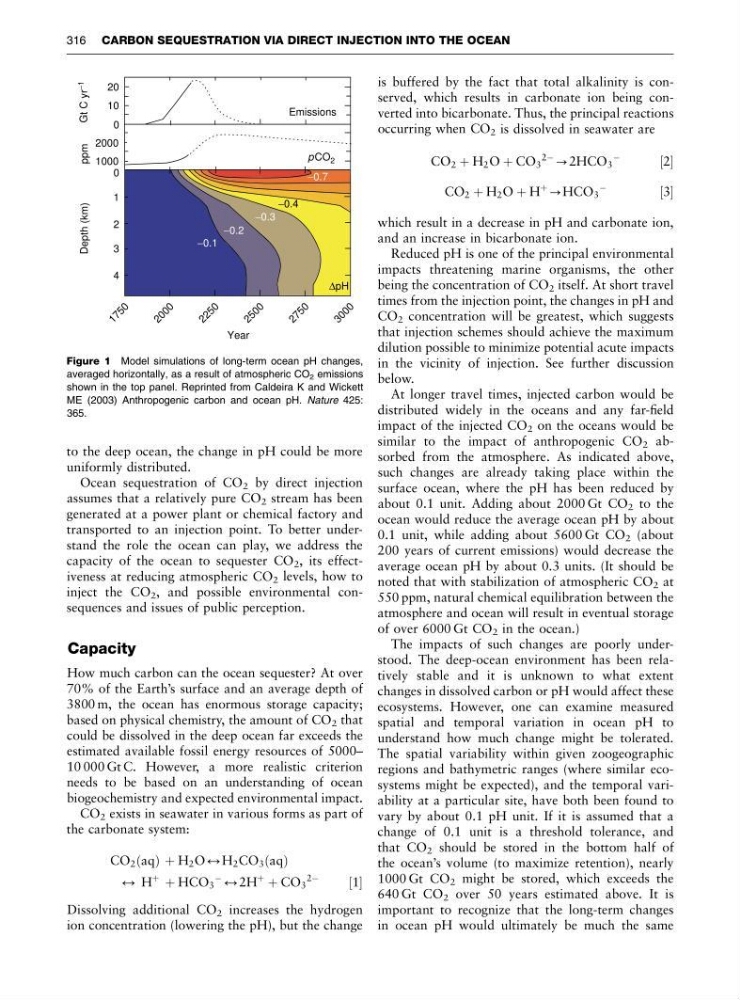
to the deep ocean, the change in pH could be more
uniformly distributed.
Ocean sequestration of CO 2 by direct injection
assumes that a relatively pure CO 2 stream has been
generated at a power plant or chemical factory and
transported to an injection point. To better understand the role the ocean can play, we address the
capacity of the ocean to sequester CO 2 , its effectiveness at reducing atmospheric CO 2 levels, how to
inject the CO 2 , and possible environmental consequences and issues of public perception.
Capacity
How much carbon can the ocean sequester? At over
70% of the Earth’s surface and an average depth of
3800 m, the ocean has enormous storage capacity;
based on physical chemistry, the amount of CO 2 that
could be dissolved in the deep ocean far exceeds the
estimated available fossil energy resources of 5000–
10 000 Gt C. However, a more realistic criterion
needs to be based on an understanding of ocean
biogeochemistry and expected environmental impact.
CO 2 exists in seawater in various forms as part of
the carbonate system:
CO 2 ðaqÞ þ H 2 O2H 2 CO 3 ðaqÞ
2 H
þ þ HCO 3
À
22H
þ þ CO 3
2À
½1
Dissolving additional CO 2 increases the hydrogen
ion concentration (lowering the pH), but the change
is buffered by the fact that total alkalinity is conserved, which results in carbonate ion being converted into bicarbonate. Thus, the principal reactions
occurring when CO 2 is dissolved in seawater are
CO 2 þ H 2 O þ CO 3
2À
-2HCO 3
À
½2
CO 2 þ H 2 O þ H
þ
-HCO 3
À
½3
which result in a decrease in pH and carbonate ion,
and an increase in bicarbonate ion.
Reduced pH is one of the principal environmental
impacts threatening marine organisms, the other
being the concentration of CO 2 itself. At short travel
times from the injection point, the changes in pH and
CO 2 concentration will be greatest, which suggests
that injection schemes should achieve the maximum
dilution possible to minimize potential acute impacts
in the vicinity of injection. See further discussion
below.
At longer travel times, injected carbon would be
distributed widely in the oceans and any far-field
impact of the injected CO 2 on the oceans would be
similar to the impact of anthropogenic CO 2 absorbed from the atmosphere. As indicated above,
such changes are already taking place within the
surface ocean, where the pH has been reduced by
about 0.1 unit. Adding about 2000 Gt CO 2 to the
ocean would reduce the average ocean pH by about
0.1 unit, while adding about 5600 Gt CO 2 (about
200 years of current emissions) would decrease the
average ocean pH by about 0.3 units. (It should be
noted that with stabilization of atmospheric CO 2 at
550 ppm, natural chemical equilibration between the
atmosphere and ocean will result in eventual storage
of over 6000 Gt CO 2 in the ocean.)
The impacts of such changes are poorly understood. The deep-ocean environment has been relatively stable and it is unknown to what extent
changes in dissolved carbon or pH would affect these
ecosystems. However, one can examine measured
spatial and temporal variation in ocean pH to
understand how much change might be tolerated.
The spatial variability within given zoogeographic
regions and bathymetric ranges (where similar ecosystems might be expected), and the temporal variability at a particular site, have both been found to
vary by about 0.1 pH unit. If it is assumed that a
change of 0.1 unit is a threshold tolerance, and
that CO 2 should be stored in the bottom half of
the ocean’s volume (to maximize retention), nearly
1000 Gt CO 2 might be stored, which exceeds the
640 Gt CO 2 over 50 years estimated above. It is
important to recognize that the long-term changes
in ocean pH would ultimately be much the same
20
10
0
0
1
2
3
4
1 7 5 0
2 0 0 0
2 2 5 0
2 5 0 0
2 7 5 0
3 0 0 0
2000
1000
Emissions
pCO 2
−0.7
−0.4
−0.3
−0.2
−0.1
Year
Depth (km)
ppm
Gt C yr −1
ΔpH
Figure 1 Model simulations of long-term ocean pH changes,
averaged horizontally, as a result of atmospheric CO 2 emissions
shown in the top panel. Reprinted from Caldeira K and Wickett
ME (2003) Anthropogenic carbon and ocean pH. Nature 425:
365.
316 CARBON SEQUESTRATION VIA DIRECT INJECTION INTO THE OCEAN
uniformly distributed.
Ocean sequestration of CO 2 by direct injection
assumes that a relatively pure CO 2 stream has been
generated at a power plant or chemical factory and
transported to an injection point. To better understand the role the ocean can play, we address the
capacity of the ocean to sequester CO 2 , its effectiveness at reducing atmospheric CO 2 levels, how to
inject the CO 2 , and possible environmental consequences and issues of public perception.
Capacity
How much carbon can the ocean sequester? At over
70% of the Earth’s surface and an average depth of
3800 m, the ocean has enormous storage capacity;
based on physical chemistry, the amount of CO 2 that
could be dissolved in the deep ocean far exceeds the
estimated available fossil energy resources of 5000–
10 000 Gt C. However, a more realistic criterion
needs to be based on an understanding of ocean
biogeochemistry and expected environmental impact.
CO 2 exists in seawater in various forms as part of
the carbonate system:
CO 2 ðaqÞ þ H 2 O2H 2 CO 3 ðaqÞ
2 H
þ þ HCO 3
À
22H
þ þ CO 3
2À
½1
Dissolving additional CO 2 increases the hydrogen
ion concentration (lowering the pH), but the change
is buffered by the fact that total alkalinity is conserved, which results in carbonate ion being converted into bicarbonate. Thus, the principal reactions
occurring when CO 2 is dissolved in seawater are
CO 2 þ H 2 O þ CO 3
2À
-2HCO 3
À
½2
CO 2 þ H 2 O þ H
þ
-HCO 3
À
½3
which result in a decrease in pH and carbonate ion,
and an increase in bicarbonate ion.
Reduced pH is one of the principal environmental
impacts threatening marine organisms, the other
being the concentration of CO 2 itself. At short travel
times from the injection point, the changes in pH and
CO 2 concentration will be greatest, which suggests
that injection schemes should achieve the maximum
dilution possible to minimize potential acute impacts
in the vicinity of injection. See further discussion
below.
At longer travel times, injected carbon would be
distributed widely in the oceans and any far-field
impact of the injected CO 2 on the oceans would be
similar to the impact of anthropogenic CO 2 absorbed from the atmosphere. As indicated above,
such changes are already taking place within the
surface ocean, where the pH has been reduced by
about 0.1 unit. Adding about 2000 Gt CO 2 to the
ocean would reduce the average ocean pH by about
0.1 unit, while adding about 5600 Gt CO 2 (about
200 years of current emissions) would decrease the
average ocean pH by about 0.3 units. (It should be
noted that with stabilization of atmospheric CO 2 at
550 ppm, natural chemical equilibration between the
atmosphere and ocean will result in eventual storage
of over 6000 Gt CO 2 in the ocean.)
The impacts of such changes are poorly understood. The deep-ocean environment has been relatively stable and it is unknown to what extent
changes in dissolved carbon or pH would affect these
ecosystems. However, one can examine measured
spatial and temporal variation in ocean pH to
understand how much change might be tolerated.
The spatial variability within given zoogeographic
regions and bathymetric ranges (where similar ecosystems might be expected), and the temporal variability at a particular site, have both been found to
vary by about 0.1 pH unit. If it is assumed that a
change of 0.1 unit is a threshold tolerance, and
that CO 2 should be stored in the bottom half of
the ocean’s volume (to maximize retention), nearly
1000 Gt CO 2 might be stored, which exceeds the
640 Gt CO 2 over 50 years estimated above. It is
important to recognize that the long-term changes
in ocean pH would ultimately be much the same
20
10
0
0
1
2
3
4
1 7 5 0
2 0 0 0
2 2 5 0
2 5 0 0
2 7 5 0
3 0 0 0
2000
1000
Emissions
pCO 2
−0.7
−0.4
−0.3
−0.2
−0.1
Year
Depth (km)
ppm
Gt C yr −1
ΔpH
Figure 1 Model simulations of long-term ocean pH changes,
averaged horizontally, as a result of atmospheric CO 2 emissions
shown in the top panel. Reprinted from Caldeira K and Wickett
ME (2003) Anthropogenic carbon and ocean pH. Nature 425:
365.
316 CARBON SEQUESTRATION VIA DIRECT INJECTION INTO THE OCEAN