

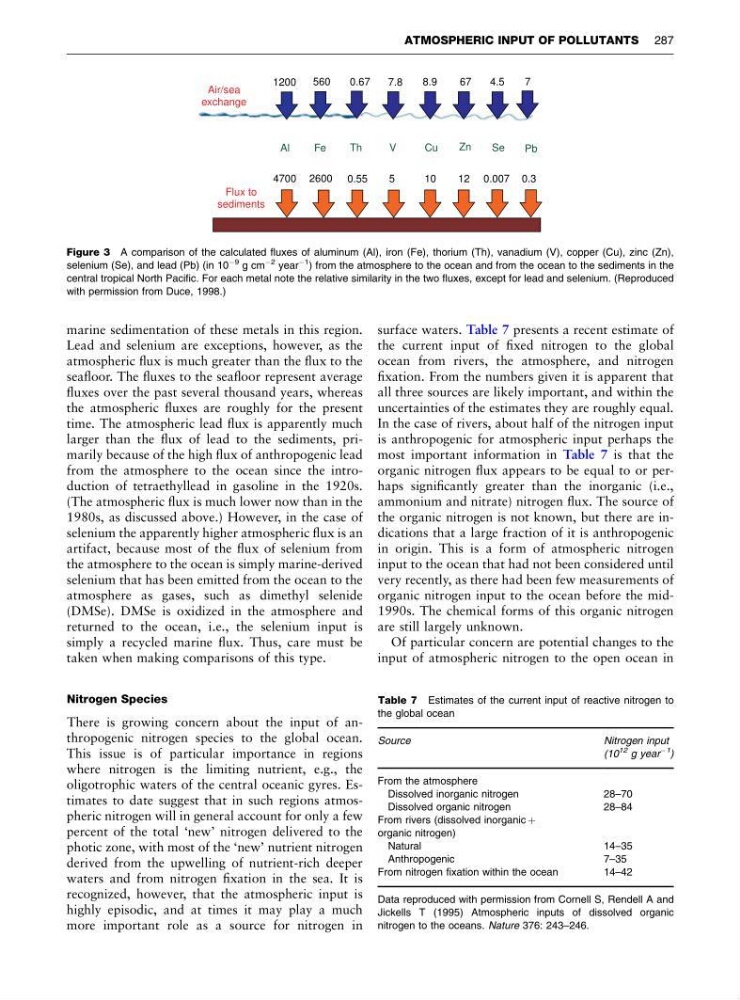
marine sedimentation of these metals in this region.
Lead and selenium are exceptions, however, as the
atmospheric flux is much greater than the flux to the
seafloor. The fluxes to the seafloor represent average
fluxes over the past several thousand years, whereas
the atmospheric fluxes are roughly for the present
time. The atmospheric lead flux is apparently much
larger than the flux of lead to the sediments, primarily because of the high flux of anthropogenic lead
from the atmosphere to the ocean since the introduction of tetraethyllead in gasoline in the 1920s.
(The atmospheric flux is much lower now than in the
1980s, as discussed above.) However, in the case of
selenium the apparently higher atmospheric flux is an
artifact, because most of the flux of selenium from
the atmosphere to the ocean is simply marine-derived
selenium that has been emitted from the ocean to the
atmosphere as gases, such as dimethyl selenide
(DMSe). DMSe is oxidized in the atmosphere and
returned to the ocean, i.e., the selenium input is
simply a recycled marine flux. Thus, care must be
taken when making comparisons of this type.
Nitrogen Species
There is growing concern about the input of anthropogenic nitrogen species to the global ocean.
This issue is of particular importance in regions
where nitrogen is the limiting nutrient, e.g., the
oligotrophic waters of the central oceanic gyres. Estimates to date suggest that in such regions atmospheric nitrogen will in general account for only a few
percent of the total ‘new’ nitrogen delivered to the
photic zone, with most of the ‘new’ nutrient nitrogen
derived from the upwelling of nutrient-rich deeper
waters and from nitrogen fixation in the sea. It is
recognized, however, that the atmospheric input is
highly episodic, and at times it may play a much
more important role as a source for nitrogen in
surface waters. Table 7 presents a recent estimate of
the current input of fixed nitrogen to the global
ocean from rivers, the atmosphere, and nitrogen
fixation. From the numbers given it is apparent that
all three sources are likely important, and within the
uncertainties of the estimates they are roughly equal.
In the case of rivers, about half of the nitrogen input
is anthropogenic for atmospheric input perhaps the
most important information in Table 7 is that the
organic nitrogen flux appears to be equal to or perhaps significantly greater than the inorganic (i.e.,
ammonium and nitrate) nitrogen flux. The source of
the organic nitrogen is not known, but there are indications that a large fraction of it is anthropogenic
in origin. This is a form of atmospheric nitrogen
input to the ocean that had not been considered until
very recently, as there had been few measurements of
organic nitrogen input to the ocean before the mid1990s. The chemical forms of this organic nitrogen
are still largely unknown.
Of particular concern are potential changes to the
input of atmospheric nitrogen to the open ocean in
Air/sea
exchange
Flux to
sediments
Al
Fe
Th
V
Cu
Zn
Se
Pb
1200
560
0.67
7.8
8.9
67
4.5
7
4700 2600 0.55
5
10
12 0.007 0.3
Figure 3 A comparison of the calculated fluxes of aluminum (Al), iron (Fe), thorium (Th), vanadium (V), copper (Cu), zinc (Zn),
selenium (Se), and lead (Pb) (in 10
À9 g cm
À2 year
À1 ) from the atmosphere to the ocean and from the ocean to the sediments in the
central tropical North Pacific. For each metal note the relative similarity in the two fluxes, except for lead and selenium. (Reproduced
with permission from Duce, 1998.)
Table 7 Estimates of the current input of reactive nitrogen to
the global ocean
Source
Nitrogen input
(10
12 g year
À1
)
From the atmosphere
Dissolved inorganic nitrogen
28–70
Dissolved organic nitrogen
28–84
From rivers (dissolved inorganic þ
organic nitrogen)
Natural
14–35
Anthropogenic
7–35
From nitrogen fixation within the ocean
14–42
Data reproduced with permission from Cornell S, Rendell A and
Jickells T (1995) Atmospheric inputs of dissolved organic
nitrogen to the oceans. Nature 376: 243–246.
ATMOSPHERIC INPUT OF POLLUTANTS 287
Lead and selenium are exceptions, however, as the
atmospheric flux is much greater than the flux to the
seafloor. The fluxes to the seafloor represent average
fluxes over the past several thousand years, whereas
the atmospheric fluxes are roughly for the present
time. The atmospheric lead flux is apparently much
larger than the flux of lead to the sediments, primarily because of the high flux of anthropogenic lead
from the atmosphere to the ocean since the introduction of tetraethyllead in gasoline in the 1920s.
(The atmospheric flux is much lower now than in the
1980s, as discussed above.) However, in the case of
selenium the apparently higher atmospheric flux is an
artifact, because most of the flux of selenium from
the atmosphere to the ocean is simply marine-derived
selenium that has been emitted from the ocean to the
atmosphere as gases, such as dimethyl selenide
(DMSe). DMSe is oxidized in the atmosphere and
returned to the ocean, i.e., the selenium input is
simply a recycled marine flux. Thus, care must be
taken when making comparisons of this type.
Nitrogen Species
There is growing concern about the input of anthropogenic nitrogen species to the global ocean.
This issue is of particular importance in regions
where nitrogen is the limiting nutrient, e.g., the
oligotrophic waters of the central oceanic gyres. Estimates to date suggest that in such regions atmospheric nitrogen will in general account for only a few
percent of the total ‘new’ nitrogen delivered to the
photic zone, with most of the ‘new’ nutrient nitrogen
derived from the upwelling of nutrient-rich deeper
waters and from nitrogen fixation in the sea. It is
recognized, however, that the atmospheric input is
highly episodic, and at times it may play a much
more important role as a source for nitrogen in
surface waters. Table 7 presents a recent estimate of
the current input of fixed nitrogen to the global
ocean from rivers, the atmosphere, and nitrogen
fixation. From the numbers given it is apparent that
all three sources are likely important, and within the
uncertainties of the estimates they are roughly equal.
In the case of rivers, about half of the nitrogen input
is anthropogenic for atmospheric input perhaps the
most important information in Table 7 is that the
organic nitrogen flux appears to be equal to or perhaps significantly greater than the inorganic (i.e.,
ammonium and nitrate) nitrogen flux. The source of
the organic nitrogen is not known, but there are indications that a large fraction of it is anthropogenic
in origin. This is a form of atmospheric nitrogen
input to the ocean that had not been considered until
very recently, as there had been few measurements of
organic nitrogen input to the ocean before the mid1990s. The chemical forms of this organic nitrogen
are still largely unknown.
Of particular concern are potential changes to the
input of atmospheric nitrogen to the open ocean in
Air/sea
exchange
Flux to
sediments
Al
Fe
Th
V
Cu
Zn
Se
Pb
1200
560
0.67
7.8
8.9
67
4.5
7
4700 2600 0.55
5
10
12 0.007 0.3
Figure 3 A comparison of the calculated fluxes of aluminum (Al), iron (Fe), thorium (Th), vanadium (V), copper (Cu), zinc (Zn),
selenium (Se), and lead (Pb) (in 10
À9 g cm
À2 year
À1 ) from the atmosphere to the ocean and from the ocean to the sediments in the
central tropical North Pacific. For each metal note the relative similarity in the two fluxes, except for lead and selenium. (Reproduced
with permission from Duce, 1998.)
Table 7 Estimates of the current input of reactive nitrogen to
the global ocean
Source
Nitrogen input
(10
12 g year
À1
)
From the atmosphere
Dissolved inorganic nitrogen
28–70
Dissolved organic nitrogen
28–84
From rivers (dissolved inorganic þ
organic nitrogen)
Natural
14–35
Anthropogenic
7–35
From nitrogen fixation within the ocean
14–42
Data reproduced with permission from Cornell S, Rendell A and
Jickells T (1995) Atmospheric inputs of dissolved organic
nitrogen to the oceans. Nature 376: 243–246.
ATMOSPHERIC INPUT OF POLLUTANTS 287