

ecosystem); and (4) the role of planktonic communities in regulating the chemistry and cycling of
these nutrient elements in seawater.
Distribution in Seawater
Knowledge of the distributions of trace element nutrients is essential to understanding the influence of
these micronutrients on the productivity and species
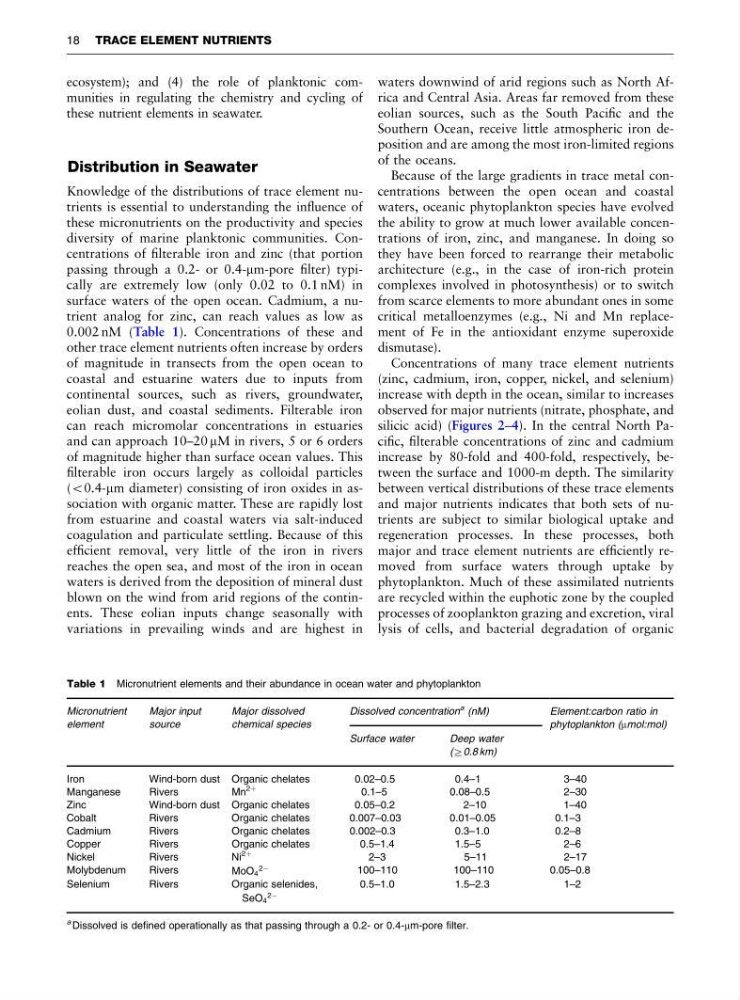
diversity of marine planktonic communities. Concentrations of filterable iron and zinc (that portion
passing through a 0.2- or 0.4-mm-pore filter) typically are extremely low (only 0.02 to 0.1 nM) in
surface waters of the open ocean. Cadmium, a nutrient analog for zinc, can reach values as low as
0.002 nM (Table 1). Concentrations of these and
other trace element nutrients often increase by orders
of magnitude in transects from the open ocean to
coastal and estuarine waters due to inputs from
continental sources, such as rivers, groundwater,
eolian dust, and coastal sediments. Filterable iron
can reach micromolar concentrations in estuaries
and can approach 10–20 mM in rivers, 5 or 6 orders
of magnitude higher than surface ocean values. This
filterable iron occurs largely as colloidal particles
(o0.4-mm diameter) consisting of iron oxides in association with organic matter. These are rapidly lost
from estuarine and coastal waters via salt-induced
coagulation and particulate settling. Because of this
efficient removal, very little of the iron in rivers
reaches the open sea, and most of the iron in ocean
waters is derived from the deposition of mineral dust
blown on the wind from arid regions of the continents. These eolian inputs change seasonally with
variations in prevailing winds and are highest in
waters downwind of arid regions such as North Africa and Central Asia. Areas far removed from these
eolian sources, such as the South Pacific and the
Southern Ocean, receive little atmospheric iron deposition and are among the most iron-limited regions
of the oceans.
Because of the large gradients in trace metal concentrations between the open ocean and coastal
waters, oceanic phytoplankton species have evolved
the ability to grow at much lower available concentrations of iron, zinc, and manganese. In doing so
they have been forced to rearrange their metabolic
architecture (e.g., in the case of iron-rich protein
complexes involved in photosynthesis) or to switch
from scarce elements to more abundant ones in some
critical metalloenzymes (e.g., Ni and Mn replacement of Fe in the antioxidant enzyme superoxide
dismutase).
Concentrations of many trace element nutrients
(zinc, cadmium, iron, copper, nickel, and selenium)
increase with depth in the ocean, similar to increases
observed for major nutrients (nitrate, phosphate, and
silicic acid) (Figures 2–4). In the central North Pacific, filterable concentrations of zinc and cadmium
increase by 80-fold and 400-fold, respectively, between the surface and 1000-m depth. The similarity
between vertical distributions of these trace elements
and major nutrients indicates that both sets of nutrients are subject to similar biological uptake and
regeneration processes. In these processes, both
major and trace element nutrients are efficiently removed from surface waters through uptake by
phytoplankton. Much of these assimilated nutrients
are recycled within the euphotic zone by the coupled
processes of zooplankton grazing and excretion, viral
lysis of cells, and bacterial degradation of organic
Table 1 Micronutrient elements and their abundance in ocean water and phytoplankton
Micronutrient
element
Major input
source
Major dissolved
chemical species
Dissolved concentration
a (nM)
Element:carbon ratio in
phytoplankton (mmol:mol)
Surface water
Deep water
(Z0.8 km)
Iron
Wind-born dust Organic chelates
0.02–0.5
0.4–1
3–40
Manganese
Rivers
Mn
2þ
0.1–5
0.08–0.5
2–30
Zinc
Wind-born dust Organic chelates
0.05–0.2
2–10
1–40
Cobalt
Rivers
Organic chelates
0.007–0.03
0.01–0.05
0.1–3
Cadmium
Rivers
Organic chelates
0.002–0.3
0.3–1.0
0.2–8
Copper
Rivers
Organic chelates
0.5–1.4
1.5–5
2–6
Nickel
Rivers
Ni
2þ
2–3
5–11
2–17
Molybdenum
Rivers
MoO 4
2À
100–110
100–110
0.05–0.8
Selenium
Rivers
Organic selenides,
SeO 4
2À
0.5–1.0
1.5–2.3
1–2
a Dissolved is defined operationally as that passing through a 0.2- or 0.4-mm-pore filter.
18 TRACE ELEMENT NUTRIENTS
these nutrient elements in seawater.
Distribution in Seawater
Knowledge of the distributions of trace element nutrients is essential to understanding the influence of
these micronutrients on the productivity and species
diversity of marine planktonic communities. Concentrations of filterable iron and zinc (that portion
passing through a 0.2- or 0.4-mm-pore filter) typically are extremely low (only 0.02 to 0.1 nM) in
surface waters of the open ocean. Cadmium, a nutrient analog for zinc, can reach values as low as
0.002 nM (Table 1). Concentrations of these and
other trace element nutrients often increase by orders
of magnitude in transects from the open ocean to
coastal and estuarine waters due to inputs from
continental sources, such as rivers, groundwater,
eolian dust, and coastal sediments. Filterable iron
can reach micromolar concentrations in estuaries
and can approach 10–20 mM in rivers, 5 or 6 orders
of magnitude higher than surface ocean values. This
filterable iron occurs largely as colloidal particles
(o0.4-mm diameter) consisting of iron oxides in association with organic matter. These are rapidly lost
from estuarine and coastal waters via salt-induced
coagulation and particulate settling. Because of this
efficient removal, very little of the iron in rivers
reaches the open sea, and most of the iron in ocean
waters is derived from the deposition of mineral dust
blown on the wind from arid regions of the continents. These eolian inputs change seasonally with
variations in prevailing winds and are highest in
waters downwind of arid regions such as North Africa and Central Asia. Areas far removed from these
eolian sources, such as the South Pacific and the
Southern Ocean, receive little atmospheric iron deposition and are among the most iron-limited regions
of the oceans.
Because of the large gradients in trace metal concentrations between the open ocean and coastal
waters, oceanic phytoplankton species have evolved
the ability to grow at much lower available concentrations of iron, zinc, and manganese. In doing so
they have been forced to rearrange their metabolic
architecture (e.g., in the case of iron-rich protein
complexes involved in photosynthesis) or to switch
from scarce elements to more abundant ones in some
critical metalloenzymes (e.g., Ni and Mn replacement of Fe in the antioxidant enzyme superoxide
dismutase).
Concentrations of many trace element nutrients
(zinc, cadmium, iron, copper, nickel, and selenium)
increase with depth in the ocean, similar to increases
observed for major nutrients (nitrate, phosphate, and
silicic acid) (Figures 2–4). In the central North Pacific, filterable concentrations of zinc and cadmium
increase by 80-fold and 400-fold, respectively, between the surface and 1000-m depth. The similarity
between vertical distributions of these trace elements
and major nutrients indicates that both sets of nutrients are subject to similar biological uptake and
regeneration processes. In these processes, both
major and trace element nutrients are efficiently removed from surface waters through uptake by
phytoplankton. Much of these assimilated nutrients
are recycled within the euphotic zone by the coupled
processes of zooplankton grazing and excretion, viral
lysis of cells, and bacterial degradation of organic
Table 1 Micronutrient elements and their abundance in ocean water and phytoplankton
Micronutrient
element
Major input
source
Major dissolved
chemical species
Dissolved concentration
a (nM)
Element:carbon ratio in
phytoplankton (mmol:mol)
Surface water
Deep water
(Z0.8 km)
Iron
Wind-born dust Organic chelates
0.02–0.5
0.4–1
3–40
Manganese
Rivers
Mn
2þ
0.1–5
0.08–0.5
2–30
Zinc
Wind-born dust Organic chelates
0.05–0.2
2–10
1–40
Cobalt
Rivers
Organic chelates
0.007–0.03
0.01–0.05
0.1–3
Cadmium
Rivers
Organic chelates
0.002–0.3
0.3–1.0
0.2–8
Copper
Rivers
Organic chelates
0.5–1.4
1.5–5
2–6
Nickel
Rivers
Ni
2þ
2–3
5–11
2–17
Molybdenum
Rivers
MoO 4
2À
100–110
100–110
0.05–0.8
Selenium
Rivers
Organic selenides,
SeO 4
2À
0.5–1.0
1.5–2.3
1–2
a Dissolved is defined operationally as that passing through a 0.2- or 0.4-mm-pore filter.
18 TRACE ELEMENT NUTRIENTS