

TRACE ELEMENT NUTRIENTS
W. G. Sunda, National Ocean Service, NOAA,
Beaufort, NC, USA
Published by Elsevier Ltd.
Introduction
Life in the sea is dependent on fixation of carbon and
nitrogen by unicellular algae, ranging in size from
o1 to over 100 mm in diameter. These so-called
phytoplankton consist of eukaryotic algae, which
photosyntheticly fix carbon into organic matter, and
photosynthetic bacteria (cyanobacteria) that carry
out both carbon and dinitrogen (N 2 ) fixation. Until
recently, phytoplankton productivity in the ocean
was thought to be primarily limited by available
fixed nitrogen (nitrate, nitrite, ammonia, and various
organic nitrogen compounds) and to a lesser extent
phosphorus (orthophosphate and organic phosphorus compounds). However, in the past 20 years,
enrichment experiments in bottles and in mesoscale
patches of surface water have shown that iron
regulates the productivity and species composition of
planktonic communities in major regions of the
world ocean, including the Southern Ocean, the
equatorial and subarctic Pacific, and some coastal
upwelling systems. In addition, it now appears that
iron limits N 2 fixation by cyanobacteria in large regions of the subtropical and tropical ocean, and thus
may control oceanic inventories of biologically
available fixed nitrogen. Several other micronutrient
metals (zinc, cobalt, manganese, and copper) have
also been shown to stimulate phytoplankton growth
in ocean waters, but their effect is usually much less
than that of iron. However, these metals may play an
important role in regulating the composition of
phytoplankton communities because of large differences in trace metal requirements among species.
In this article interactions between trace element
nutrients (iron, zinc, cobalt, manganese, copper,
nickel, cadmium, molybdenum, and selenium) and
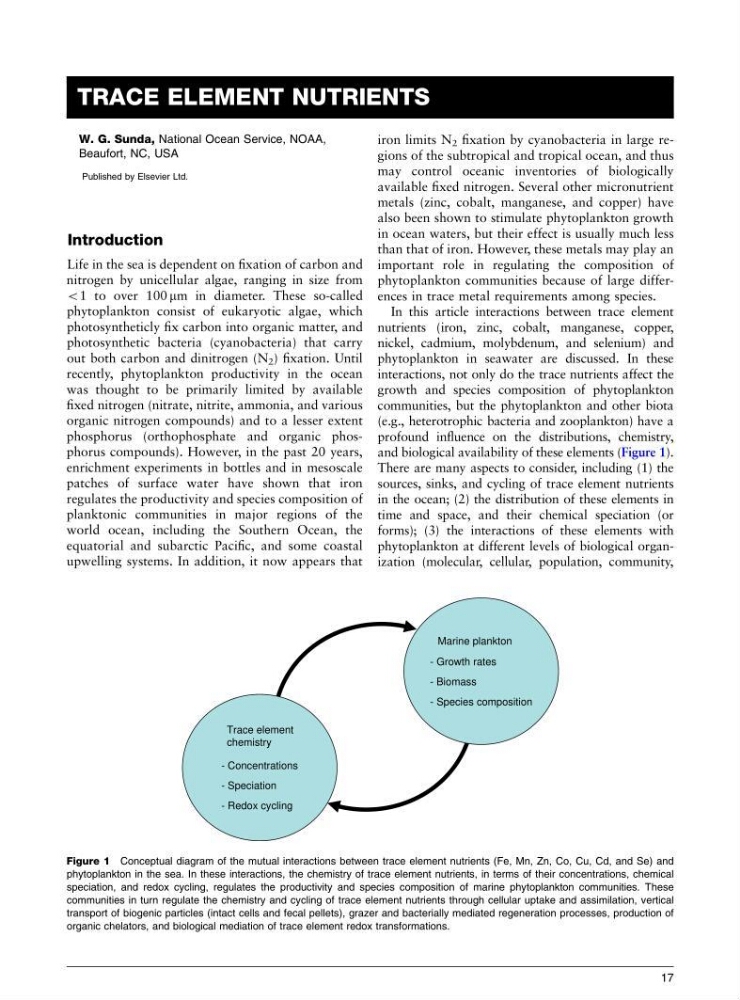
phytoplankton in seawater are discussed. In these
interactions, not only do the trace nutrients affect the
growth and species composition of phytoplankton
communities, but the phytoplankton and other biota
(e.g., heterotrophic bacteria and zooplankton) have a
profound influence on the distributions, chemistry,
and biological availability of these elements (Figure 1).
There are many aspects to consider, including (1) the
sources, sinks, and cycling of trace element nutrients
in the ocean; (2) the distribution of these elements in
time and space, and their chemical speciation (or
forms); (3) the interactions of these elements with
phytoplankton at different levels of biological organization (molecular, cellular, population, community,
Marine plankton
- Growth rates
- Biomass
- Species composition
Trace element
chemistry
- Concentrations
- Speciation
- Redox cycling
Figure 1 Conceptual diagram of the mutual interactions between trace element nutrients (Fe, Mn, Zn, Co, Cu, Cd, and Se) and
phytoplankton in the sea. In these interactions, the chemistry of trace element nutrients, in terms of their concentrations, chemical
speciation, and redox cycling, regulates the productivity and species composition of marine phytoplankton communities. These
communities in turn regulate the chemistry and cycling of trace element nutrients through cellular uptake and assimilation, vertical
transport of biogenic particles (intact cells and fecal pellets), grazer and bacterially mediated regeneration processes, production of
organic chelators, and biological mediation of trace element redox transformations.
17
W. G. Sunda, National Ocean Service, NOAA,
Beaufort, NC, USA
Published by Elsevier Ltd.
Introduction
Life in the sea is dependent on fixation of carbon and
nitrogen by unicellular algae, ranging in size from
o1 to over 100 mm in diameter. These so-called
phytoplankton consist of eukaryotic algae, which
photosyntheticly fix carbon into organic matter, and
photosynthetic bacteria (cyanobacteria) that carry
out both carbon and dinitrogen (N 2 ) fixation. Until
recently, phytoplankton productivity in the ocean
was thought to be primarily limited by available
fixed nitrogen (nitrate, nitrite, ammonia, and various
organic nitrogen compounds) and to a lesser extent
phosphorus (orthophosphate and organic phosphorus compounds). However, in the past 20 years,
enrichment experiments in bottles and in mesoscale
patches of surface water have shown that iron
regulates the productivity and species composition of
planktonic communities in major regions of the
world ocean, including the Southern Ocean, the
equatorial and subarctic Pacific, and some coastal
upwelling systems. In addition, it now appears that
iron limits N 2 fixation by cyanobacteria in large regions of the subtropical and tropical ocean, and thus
may control oceanic inventories of biologically
available fixed nitrogen. Several other micronutrient
metals (zinc, cobalt, manganese, and copper) have
also been shown to stimulate phytoplankton growth
in ocean waters, but their effect is usually much less
than that of iron. However, these metals may play an
important role in regulating the composition of
phytoplankton communities because of large differences in trace metal requirements among species.
In this article interactions between trace element
nutrients (iron, zinc, cobalt, manganese, copper,
nickel, cadmium, molybdenum, and selenium) and
phytoplankton in seawater are discussed. In these
interactions, not only do the trace nutrients affect the
growth and species composition of phytoplankton
communities, but the phytoplankton and other biota
(e.g., heterotrophic bacteria and zooplankton) have a
profound influence on the distributions, chemistry,
and biological availability of these elements (Figure 1).
There are many aspects to consider, including (1) the
sources, sinks, and cycling of trace element nutrients
in the ocean; (2) the distribution of these elements in
time and space, and their chemical speciation (or
forms); (3) the interactions of these elements with
phytoplankton at different levels of biological organization (molecular, cellular, population, community,
Marine plankton
- Growth rates
- Biomass
- Species composition
Trace element
chemistry
- Concentrations
- Speciation
- Redox cycling
Figure 1 Conceptual diagram of the mutual interactions between trace element nutrients (Fe, Mn, Zn, Co, Cu, Cd, and Se) and
phytoplankton in the sea. In these interactions, the chemistry of trace element nutrients, in terms of their concentrations, chemical
speciation, and redox cycling, regulates the productivity and species composition of marine phytoplankton communities. These
communities in turn regulate the chemistry and cycling of trace element nutrients through cellular uptake and assimilation, vertical
transport of biogenic particles (intact cells and fecal pellets), grazer and bacterially mediated regeneration processes, production of
organic chelators, and biological mediation of trace element redox transformations.
17