

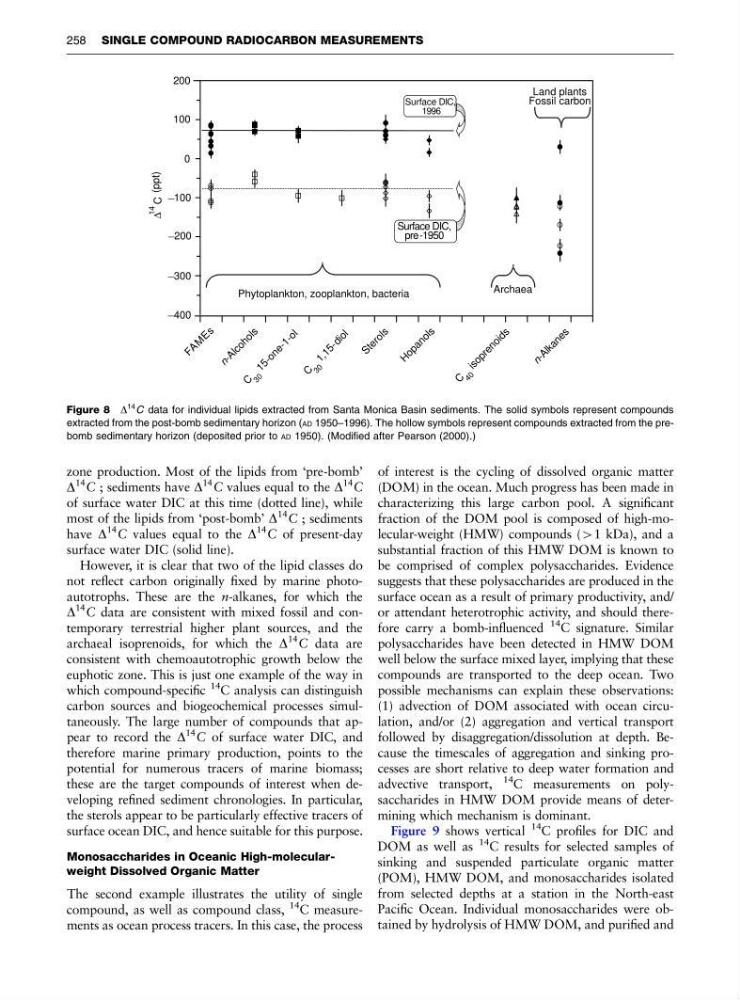
zone production. Most of the lipids from ‘pre-bomb’
D
14 C ; sediments have D
14 C values equal to the D
14 C
of surface water DIC at this time (dotted line), while
most of the lipids from ‘post-bomb’ D
14 C ; sediments
have D
14 C values equal to the D
14 C of present-day
surface water DIC (solid line).
However, it is clear that two of the lipid classes do
not reflect carbon originally fixed by marine photoautotrophs. These are the n-alkanes, for which the
D
14 C data are consistent with mixed fossil and contemporary terrestrial higher plant sources, and the
archaeal isoprenoids, for which the D
14 C data are
consistent with chemoautotrophic growth below the
euphotic zone. This is just one example of the way in
which compound-specific
14
C analysis can distinguish
carbon sources and biogeochemical processes simultaneously. The large number of compounds that appear to record the D
14 C of surface water DIC, and
therefore marine primary production, points to the
potential for numerous tracers of marine biomass;
these are the target compounds of interest when developing refined sediment chronologies. In particular,
the sterols appear to be particularly effective tracers of
surface ocean DIC, and hence suitable for this purpose.
Monosaccharides in Oceanic High-molecularweight Dissolved Organic Matter
The second example illustrates the utility of single
compound, as well as compound class,
14
C measurements as ocean process tracers. In this case, the process
of interest is the cycling of dissolved organic matter
(DOM) in the ocean. Much progress has been made in
characterizing this large carbon pool. A significant
fraction of the DOM pool is composed of high-molecular-weight (HMW) compounds (41 kDa), and a
substantial fraction of this HMW DOM is known to
be comprised of complex polysaccharides. Evidence
suggests that these polysaccharides are produced in the
surface ocean as a result of primary productivity, and/
or attendant heterotrophic activity, and should therefore carry a bomb-influenced
14
C signature. Similar
polysaccharides have been detected in HMW DOM
well below the surface mixed layer, implying that these
compounds are transported to the deep ocean. Two
possible mechanisms can explain these observations:
(1) advection of DOM associated with ocean circulation, and/or (2) aggregation and vertical transport
followed by disaggregation/dissolution at depth. Because the timescales of aggregation and sinking processes are short relative to deep water formation and
advective transport,
14
C measurements on polysaccharides in HMW DOM provide means of determining which mechanism is dominant.
Figure 9 shows vertical
14
C profiles for DIC and
DOM as well as
14
C results for selected samples of
sinking and suspended particulate organic matter
(POM), HMW DOM, and monosaccharides isolated
from selected depths at a station in the North-east
Pacific Ocean. Individual monosaccharides were obtained by hydrolysis of HMW DOM, and purified and
_ 400
_ 300
_ 200
_ 100
0
100
200
F A
M
E
s
n
- A l c o h o l s
C
3 0
1 5 - o n e - 1 - o l
C
3 0
1 , 1 5 - d i o l
S t e r o l s
H o p a n o l s
C 4 0
i s o p r e n o i d s
n
- A l k a n e s
Δ
14
C (ppt)
Surface DIC,
1996
Land plants
Fossil carbon
Surface DIC,
pre -1950
Archaea
Phytoplankton, zooplankton, bacteria
Figure 8 D
14 C data for individual lipids extracted from Santa Monica Basin sediments. The solid symbols represent compounds
extracted from the post-bomb sedimentary horizon (AD 1950–1996). The hollow symbols represent compounds extracted from the prebomb sedimentary horizon (deposited prior to AD 1950). (Modified after Pearson (2000).)
258 SINGLE COMPOUND RADIOCARBON MEASUREMENTS
D
14 C ; sediments have D
14 C values equal to the D
14 C
of surface water DIC at this time (dotted line), while
most of the lipids from ‘post-bomb’ D
14 C ; sediments
have D
14 C values equal to the D
14 C of present-day
surface water DIC (solid line).
However, it is clear that two of the lipid classes do
not reflect carbon originally fixed by marine photoautotrophs. These are the n-alkanes, for which the
D
14 C data are consistent with mixed fossil and contemporary terrestrial higher plant sources, and the
archaeal isoprenoids, for which the D
14 C data are
consistent with chemoautotrophic growth below the
euphotic zone. This is just one example of the way in
which compound-specific
14
C analysis can distinguish
carbon sources and biogeochemical processes simultaneously. The large number of compounds that appear to record the D
14 C of surface water DIC, and
therefore marine primary production, points to the
potential for numerous tracers of marine biomass;
these are the target compounds of interest when developing refined sediment chronologies. In particular,
the sterols appear to be particularly effective tracers of
surface ocean DIC, and hence suitable for this purpose.
Monosaccharides in Oceanic High-molecularweight Dissolved Organic Matter
The second example illustrates the utility of single
compound, as well as compound class,
14
C measurements as ocean process tracers. In this case, the process
of interest is the cycling of dissolved organic matter
(DOM) in the ocean. Much progress has been made in
characterizing this large carbon pool. A significant
fraction of the DOM pool is composed of high-molecular-weight (HMW) compounds (41 kDa), and a
substantial fraction of this HMW DOM is known to
be comprised of complex polysaccharides. Evidence
suggests that these polysaccharides are produced in the
surface ocean as a result of primary productivity, and/
or attendant heterotrophic activity, and should therefore carry a bomb-influenced
14
C signature. Similar
polysaccharides have been detected in HMW DOM
well below the surface mixed layer, implying that these
compounds are transported to the deep ocean. Two
possible mechanisms can explain these observations:
(1) advection of DOM associated with ocean circulation, and/or (2) aggregation and vertical transport
followed by disaggregation/dissolution at depth. Because the timescales of aggregation and sinking processes are short relative to deep water formation and
advective transport,
14
C measurements on polysaccharides in HMW DOM provide means of determining which mechanism is dominant.
Figure 9 shows vertical
14
C profiles for DIC and
DOM as well as
14
C results for selected samples of
sinking and suspended particulate organic matter
(POM), HMW DOM, and monosaccharides isolated
from selected depths at a station in the North-east
Pacific Ocean. Individual monosaccharides were obtained by hydrolysis of HMW DOM, and purified and
_ 400
_ 300
_ 200
_ 100
0
100
200
F A
M
E
s
n
- A l c o h o l s
C
3 0
1 5 - o n e - 1 - o l
C
3 0
1 , 1 5 - d i o l
S t e r o l s
H o p a n o l s
C 4 0
i s o p r e n o i d s
n
- A l k a n e s
Δ
14
C (ppt)
Surface DIC,
1996
Land plants
Fossil carbon
Surface DIC,
pre -1950
Archaea
Phytoplankton, zooplankton, bacteria
Figure 8 D
14 C data for individual lipids extracted from Santa Monica Basin sediments. The solid symbols represent compounds
extracted from the post-bomb sedimentary horizon (AD 1950–1996). The hollow symbols represent compounds extracted from the prebomb sedimentary horizon (deposited prior to AD 1950). (Modified after Pearson (2000).)
258 SINGLE COMPOUND RADIOCARBON MEASUREMENTS