

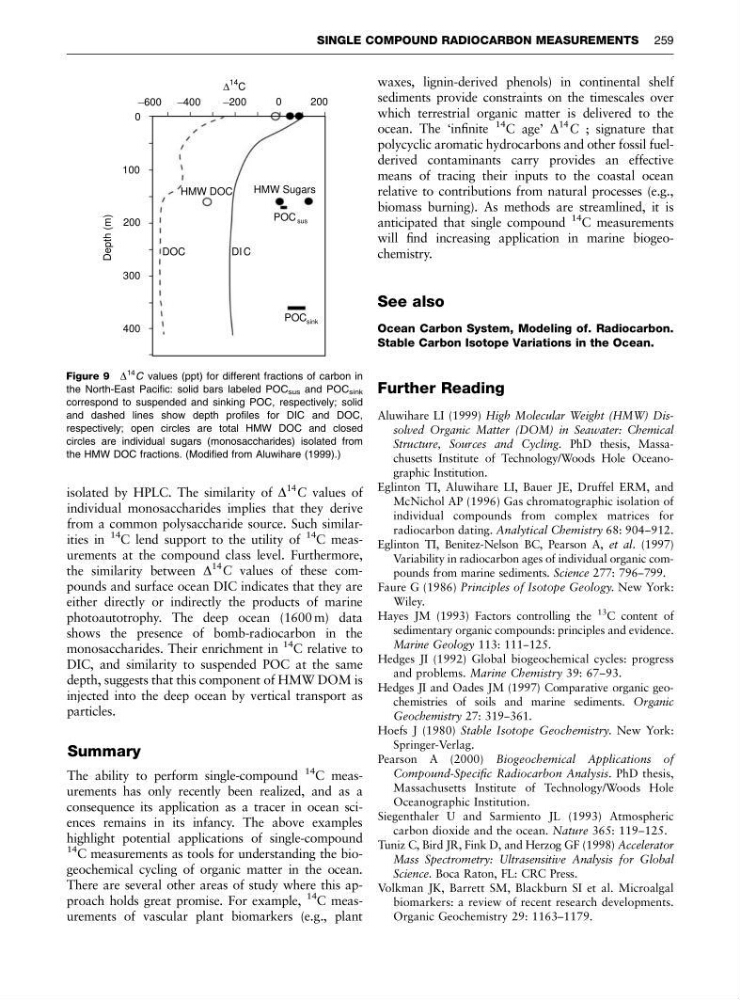
isolated by HPLC. The similarity of D
14 C values of
individual monosaccharides implies that they derive
from a common polysaccharide source. Such similarities in
14
C lend support to the utility of
14
C measurements at the compound class level. Furthermore,
the similarity between D
14 C values of these compounds and surface ocean DIC indicates that they are
either directly or indirectly the products of marine
photoautotrophy. The deep ocean (1600 m) data
shows the presence of bomb-radiocarbon in the
monosaccharides. Their enrichment in
14
C relative to
DIC, and similarity to suspended POC at the same
depth, suggests that this component of HMW DOM is
injected into the deep ocean by vertical transport as
particles.
Summary
The ability to perform single-compound
14
C measurements has only recently been realized, and as a
consequence its application as a tracer in ocean sciences remains in its infancy. The above examples
highlight potential applications of single-compound
14
C measurements as tools for understanding the biogeochemical cycling of organic matter in the ocean.
There are several other areas of study where this approach holds great promise. For example,
14
C measurements of vascular plant biomarkers (e.g., plant
waxes, lignin-derived phenols) in continental shelf
sediments provide constraints on the timescales over
which terrestrial organic matter is delivered to the
ocean. The ‘infinite
14
C age’ D
14 C ; signature that
polycyclic aromatic hydrocarbons and other fossil fuelderived contaminants carry provides an effective
means of tracing their inputs to the coastal ocean
relative to contributions from natural processes (e.g.,
biomass burning). As methods are streamlined, it is
anticipated that single compound
14
C measurements
will find increasing application in marine biogeochemistry.
See also
Ocean Carbon System, Modeling of. Radiocarbon.
Stable Carbon Isotope Variations in the Ocean.
Further Reading
Aluwihare LI (1999) High Molecular Weight (HMW) Dissolved Organic Matter (DOM) in Seawater: Chemical
Structure, Sources and Cycling. PhD thesis, Massachusetts Institute of Technology/Woods Hole Oceanographic Institution.
Eglinton TI, Aluwihare LI, Bauer JE, Druffel ERM, and
McNichol AP (1996) Gas chromatographic isolation of
individual compounds from complex matrices for
radiocarbon dating. Analytical Chemistry 68: 904--912.
Eglinton TI, Benitez-Nelson BC, Pearson A, et al. (1997)
Variability in radiocarbon ages of individual organic compounds from marine sediments. Science 277: 796--799.
Faure G (1986) Principles of Isotope Geology. New York:
Wiley.
Hayes JM (1993) Factors controlling the
13
C content of
sedimentary organic compounds: principles and evidence.
Marine Geology 113: 111--125.
Hedges JI (1992) Global biogeochemical cycles: progress
and problems. Marine Chemistry 39: 67--93.
Hedges JI and Oades JM (1997) Comparative organic geochemistries of soils and marine sediments. Organic
Geochemistry 27: 319--361.
Hoefs J (1980) Stable Isotope Geochemistry. New York:
Springer-Verlag.
Pearson A (2000) Biogeochemical Applications of
Compound-Specific Radiocarbon Analysis. PhD thesis,
Massachusetts Institute of Technology/Woods Hole
Oceanographic Institution.
Siegenthaler U and Sarmiento JL (1993) Atmospheric
carbon dioxide and the ocean. Nature 365: 119--125.
Tuniz C, Bird JR, Fink D, and Herzog GF (1998) Accelerator
Mass Spectrometry: Ultrasensitive Analysis for Global
Science. Boca Raton, FL: CRC Press.
Volkman JK, Barrett SM, Blackburn SI et al. Microalgal
biomarkers: a review of recent research developments.
Organic Geochemistry 29: 1163–1179.
200
0
_ 200
_ 400
_ 600
0
100
200
300
400
HMW DOC
HMW Sugars
DI C
POC sin k
POC sus
Depth (m)
DOC
Δ
14
C
Figure 9 D
14 C values (ppt) for different fractions of carbon in
the North-East Pacific: solid bars labeled POC sus and POC sink
correspond to suspended and sinking POC, respectively; solid
and dashed lines show depth profiles for DIC and DOC,
respectively; open circles are total HMW DOC and closed
circles are individual sugars (monosaccharides) isolated from
the HMW DOC fractions. (Modified from Aluwihare (1999).)
SINGLE COMPOUND RADIOCARBON MEASUREMENTS 259
14 C values of
individual monosaccharides implies that they derive
from a common polysaccharide source. Such similarities in
14
C lend support to the utility of
14
C measurements at the compound class level. Furthermore,
the similarity between D
14 C values of these compounds and surface ocean DIC indicates that they are
either directly or indirectly the products of marine
photoautotrophy. The deep ocean (1600 m) data
shows the presence of bomb-radiocarbon in the
monosaccharides. Their enrichment in
14
C relative to
DIC, and similarity to suspended POC at the same
depth, suggests that this component of HMW DOM is
injected into the deep ocean by vertical transport as
particles.
Summary
The ability to perform single-compound
14
C measurements has only recently been realized, and as a
consequence its application as a tracer in ocean sciences remains in its infancy. The above examples
highlight potential applications of single-compound
14
C measurements as tools for understanding the biogeochemical cycling of organic matter in the ocean.
There are several other areas of study where this approach holds great promise. For example,
14
C measurements of vascular plant biomarkers (e.g., plant
waxes, lignin-derived phenols) in continental shelf
sediments provide constraints on the timescales over
which terrestrial organic matter is delivered to the
ocean. The ‘infinite
14
C age’ D
14 C ; signature that
polycyclic aromatic hydrocarbons and other fossil fuelderived contaminants carry provides an effective
means of tracing their inputs to the coastal ocean
relative to contributions from natural processes (e.g.,
biomass burning). As methods are streamlined, it is
anticipated that single compound
14
C measurements
will find increasing application in marine biogeochemistry.
See also
Ocean Carbon System, Modeling of. Radiocarbon.
Stable Carbon Isotope Variations in the Ocean.
Further Reading
Aluwihare LI (1999) High Molecular Weight (HMW) Dissolved Organic Matter (DOM) in Seawater: Chemical
Structure, Sources and Cycling. PhD thesis, Massachusetts Institute of Technology/Woods Hole Oceanographic Institution.
Eglinton TI, Aluwihare LI, Bauer JE, Druffel ERM, and
McNichol AP (1996) Gas chromatographic isolation of
individual compounds from complex matrices for
radiocarbon dating. Analytical Chemistry 68: 904--912.
Eglinton TI, Benitez-Nelson BC, Pearson A, et al. (1997)
Variability in radiocarbon ages of individual organic compounds from marine sediments. Science 277: 796--799.
Faure G (1986) Principles of Isotope Geology. New York:
Wiley.
Hayes JM (1993) Factors controlling the
13
C content of
sedimentary organic compounds: principles and evidence.
Marine Geology 113: 111--125.
Hedges JI (1992) Global biogeochemical cycles: progress
and problems. Marine Chemistry 39: 67--93.
Hedges JI and Oades JM (1997) Comparative organic geochemistries of soils and marine sediments. Organic
Geochemistry 27: 319--361.
Hoefs J (1980) Stable Isotope Geochemistry. New York:
Springer-Verlag.
Pearson A (2000) Biogeochemical Applications of
Compound-Specific Radiocarbon Analysis. PhD thesis,
Massachusetts Institute of Technology/Woods Hole
Oceanographic Institution.
Siegenthaler U and Sarmiento JL (1993) Atmospheric
carbon dioxide and the ocean. Nature 365: 119--125.
Tuniz C, Bird JR, Fink D, and Herzog GF (1998) Accelerator
Mass Spectrometry: Ultrasensitive Analysis for Global
Science. Boca Raton, FL: CRC Press.
Volkman JK, Barrett SM, Blackburn SI et al. Microalgal
biomarkers: a review of recent research developments.
Organic Geochemistry 29: 1163–1179.
200
0
_ 200
_ 400
_ 600
0
100
200
300
400
HMW DOC
HMW Sugars
DI C
POC sin k
POC sus
Depth (m)
DOC
Δ
14
C
Figure 9 D
14 C values (ppt) for different fractions of carbon in
the North-East Pacific: solid bars labeled POC sus and POC sink
correspond to suspended and sinking POC, respectively; solid
and dashed lines show depth profiles for DIC and DOC,
respectively; open circles are total HMW DOC and closed
circles are individual sugars (monosaccharides) isolated from
the HMW DOC fractions. (Modified from Aluwihare (1999).)
SINGLE COMPOUND RADIOCARBON MEASUREMENTS 259