

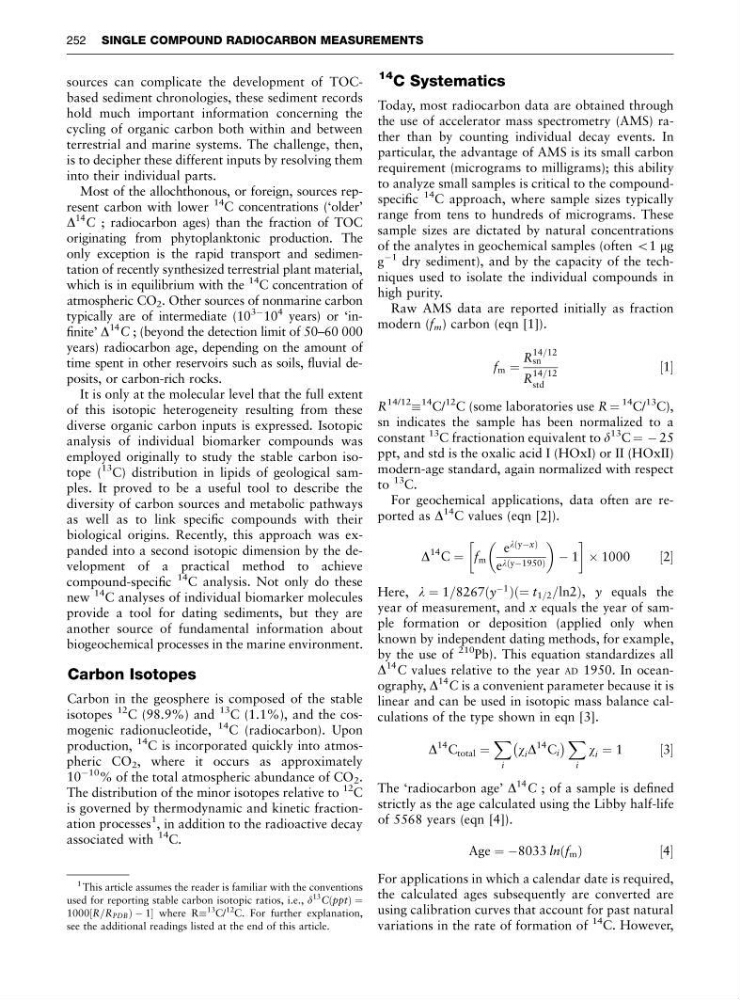
sources can complicate the development of TOCbased sediment chronologies, these sediment records
hold much important information concerning the
cycling of organic carbon both within and between
terrestrial and marine systems. The challenge, then,
is to decipher these different inputs by resolving them
into their individual parts.
Most of the allochthonous, or foreign, sources represent carbon with lower
14
C concentrations (‘older’
D
14 C ; radiocarbon ages) than the fraction of TOC
originating from phytoplanktonic production. The
only exception is the rapid transport and sedimentation of recently synthesized terrestrial plant material,
which is in equilibrium with the
14
C concentration of
atmospheric CO 2 . Other sources of nonmarine carbon
typically are of intermediate (10
3À 10
4 years) or ‘infinite’ D
14 C ; (beyond the detection limit of 50–60 000
years) radiocarbon age, depending on the amount of
time spent in other reservoirs such as soils, fluvial deposits, or carbon-rich rocks.
It is only at the molecular level that the full extent
of this isotopic heterogeneity resulting from these
diverse organic carbon inputs is expressed. Isotopic
analysis of individual biomarker compounds was
employed originally to study the stable carbon isotope (
13 C) distribution in lipids of geological samples. It proved to be a useful tool to describe the
diversity of carbon sources and metabolic pathways
as well as to link specific compounds with their
biological origins. Recently, this approach was expanded into a second isotopic dimension by the development of a practical method to achieve
compound-specific
14 C analysis. Not only do these
new
14 C analyses of individual biomarker molecules
provide a tool for dating sediments, but they are
another source of fundamental information about
biogeochemical processes in the marine environment.
Carbon Isotopes
Carbon in the geosphere is composed of the stable
isotopes
12 C (98.9%) and
13 C (1.1%), and the cosmogenic radionucleotide,
14 C (radiocarbon). Upon
production,
14 C is incorporated quickly into atmospheric CO 2 , where it occurs as approximately
10
À10 % of the total atmospheric abundance of CO 2 .
The distribution of the minor isotopes relative to
12
C
is governed by thermodynamic and kinetic fractionation processes
1
, in addition to the radioactive decay
associated with
14
C.
14
C Systematics
Today, most radiocarbon data are obtained through
the use of accelerator mass spectrometry (AMS) rather than by counting individual decay events. In
particular, the advantage of AMS is its small carbon
requirement (micrograms to milligrams); this ability
to analyze small samples is critical to the compoundspecific
14
C approach, where sample sizes typically
range from tens to hundreds of micrograms. These
sample sizes are dictated by natural concentrations
of the analytes in geochemical samples (often o1 mg
g
À1 dry sediment), and by the capacity of the techniques used to isolate the individual compounds in
high purity.
Raw AMS data are reported initially as fraction
modern (f m ) carbon (eqn [1]).
f m ¼
R
14=12
sn
R
14=12
std
½1
R
14/12
14 C/
12 C (some laboratories use R ¼
14 C/
13
C),
sn indicates the sample has been normalized to a
constant
13
C fractionation equivalent to d
13 C ¼ À 25
ppt, and std is the oxalic acid I (HOxI) or II (HOxII)
modern-age standard, again normalized with respect
to
13
C.
For geochemical applications, data often are reported as D
14 C values (eqn [2]).
D
14 C ¼ f m
e
l yÀx
ð
Þ
e l yÀ1950
ð
Þ
À 1
!
 1000
½2
Here, l ¼ 1=8267ðy
À1 Þð¼ t 1=2 =ln2Þ, y equals the
year of measurement, and x equals the year of sample formation or deposition (applied only when
known by independent dating methods, for example,
by the use of
210 Pb). This equation standardizes all
D
14 C values relative to the year AD 1950. In oceanography, D
14 C is a convenient parameter because it is
linear and can be used in isotopic mass balance calculations of the type shown in eqn [3].
D
14 C total ¼
X
i
w i D
14 C i
À
Á X
i
w i ¼ 1
½3
The ‘radiocarbon age’ D
14 C ; of a sample is defined
strictly as the age calculated using the Libby half-life
of 5568 years (eqn [4]).
Age ¼ À8033 ln f m
ð Þ
½4
For applications in which a calendar date is required,
the calculated ages subsequently are converted are
using calibration curves that account for past natural
variations in the rate of formation of
14
C. However,
1 This article assumes the reader is familiar with the conventions
used for reporting stable carbon isotopic ratios, i.e., d
13 CðpptÞ ¼
1000½R=R PDB Þ À 1 where R
13 C/
12
C. For further explanation,
see the additional readings listed at the end of this article.
252 SINGLE COMPOUND RADIOCARBON MEASUREMENTS
hold much important information concerning the
cycling of organic carbon both within and between
terrestrial and marine systems. The challenge, then,
is to decipher these different inputs by resolving them
into their individual parts.
Most of the allochthonous, or foreign, sources represent carbon with lower
14
C concentrations (‘older’
D
14 C ; radiocarbon ages) than the fraction of TOC
originating from phytoplanktonic production. The
only exception is the rapid transport and sedimentation of recently synthesized terrestrial plant material,
which is in equilibrium with the
14
C concentration of
atmospheric CO 2 . Other sources of nonmarine carbon
typically are of intermediate (10
3À 10
4 years) or ‘infinite’ D
14 C ; (beyond the detection limit of 50–60 000
years) radiocarbon age, depending on the amount of
time spent in other reservoirs such as soils, fluvial deposits, or carbon-rich rocks.
It is only at the molecular level that the full extent
of this isotopic heterogeneity resulting from these
diverse organic carbon inputs is expressed. Isotopic
analysis of individual biomarker compounds was
employed originally to study the stable carbon isotope (
13 C) distribution in lipids of geological samples. It proved to be a useful tool to describe the
diversity of carbon sources and metabolic pathways
as well as to link specific compounds with their
biological origins. Recently, this approach was expanded into a second isotopic dimension by the development of a practical method to achieve
compound-specific
14 C analysis. Not only do these
new
14 C analyses of individual biomarker molecules
provide a tool for dating sediments, but they are
another source of fundamental information about
biogeochemical processes in the marine environment.
Carbon Isotopes
Carbon in the geosphere is composed of the stable
isotopes
12 C (98.9%) and
13 C (1.1%), and the cosmogenic radionucleotide,
14 C (radiocarbon). Upon
production,
14 C is incorporated quickly into atmospheric CO 2 , where it occurs as approximately
10
À10 % of the total atmospheric abundance of CO 2 .
The distribution of the minor isotopes relative to
12
C
is governed by thermodynamic and kinetic fractionation processes
1
, in addition to the radioactive decay
associated with
14
C.
14
C Systematics
Today, most radiocarbon data are obtained through
the use of accelerator mass spectrometry (AMS) rather than by counting individual decay events. In
particular, the advantage of AMS is its small carbon
requirement (micrograms to milligrams); this ability
to analyze small samples is critical to the compoundspecific
14
C approach, where sample sizes typically
range from tens to hundreds of micrograms. These
sample sizes are dictated by natural concentrations
of the analytes in geochemical samples (often o1 mg
g
À1 dry sediment), and by the capacity of the techniques used to isolate the individual compounds in
high purity.
Raw AMS data are reported initially as fraction
modern (f m ) carbon (eqn [1]).
f m ¼
R
14=12
sn
R
14=12
std
½1
R
14/12
14 C/
12 C (some laboratories use R ¼
14 C/
13
C),
sn indicates the sample has been normalized to a
constant
13
C fractionation equivalent to d
13 C ¼ À 25
ppt, and std is the oxalic acid I (HOxI) or II (HOxII)
modern-age standard, again normalized with respect
to
13
C.
For geochemical applications, data often are reported as D
14 C values (eqn [2]).
D
14 C ¼ f m
e
l yÀx
ð
Þ
e l yÀ1950
ð
Þ
À 1
!
 1000
½2
Here, l ¼ 1=8267ðy
À1 Þð¼ t 1=2 =ln2Þ, y equals the
year of measurement, and x equals the year of sample formation or deposition (applied only when
known by independent dating methods, for example,
by the use of
210 Pb). This equation standardizes all
D
14 C values relative to the year AD 1950. In oceanography, D
14 C is a convenient parameter because it is
linear and can be used in isotopic mass balance calculations of the type shown in eqn [3].
D
14 C total ¼
X
i
w i D
14 C i
À
Á X
i
w i ¼ 1
½3
The ‘radiocarbon age’ D
14 C ; of a sample is defined
strictly as the age calculated using the Libby half-life
of 5568 years (eqn [4]).
Age ¼ À8033 ln f m
ð Þ
½4
For applications in which a calendar date is required,
the calculated ages subsequently are converted are
using calibration curves that account for past natural
variations in the rate of formation of
14
C. However,
1 This article assumes the reader is familiar with the conventions
used for reporting stable carbon isotopic ratios, i.e., d
13 CðpptÞ ¼
1000½R=R PDB Þ À 1 where R
13 C/
12
C. For further explanation,
see the additional readings listed at the end of this article.
252 SINGLE COMPOUND RADIOCARBON MEASUREMENTS