

SINGLE COMPOUND RADIOCARBON
MEASUREMENTS
T. I. Eglinton and A. Pearson, Woods Hole
Oceanographic Institution, Woods Hole, MA,
USA
Copyright & 2001 Elsevier Ltd.
Introduction
Many areas of scientific research use radiocarbon
(carbon-14,
14
C) measurements to determine the age
of carbon-containing materials. Radiocarbon’s
B5700-year half-life means that this naturally occurring radioisotope can provide information over decadal to millennial timescales. Radiocarbon is uniquely
suited to biogeochemical studies, where much research
is focused on carbon cycling at various spatial and
temporal scales. In oceanography, investigators use the
14
C concentration of dissolved inorganic carbon (DIC)
to monitor the movement of water masses throughout
the global ocean. In marine sediment geochemistry, a
major application is the dating of total organic carbon
(TOC) in order to calculate sediment accumulation
rates. Such chronologies frequently rely on the premise
that most of the TOC derives from marine biomass
production in the overlying water column.
However, the
14
C content of TOC in sediments, as
well as other organic pools in the ocean (dissolved
and particulate organic matter in the water column)
often does not reflect a single input source. Multiple
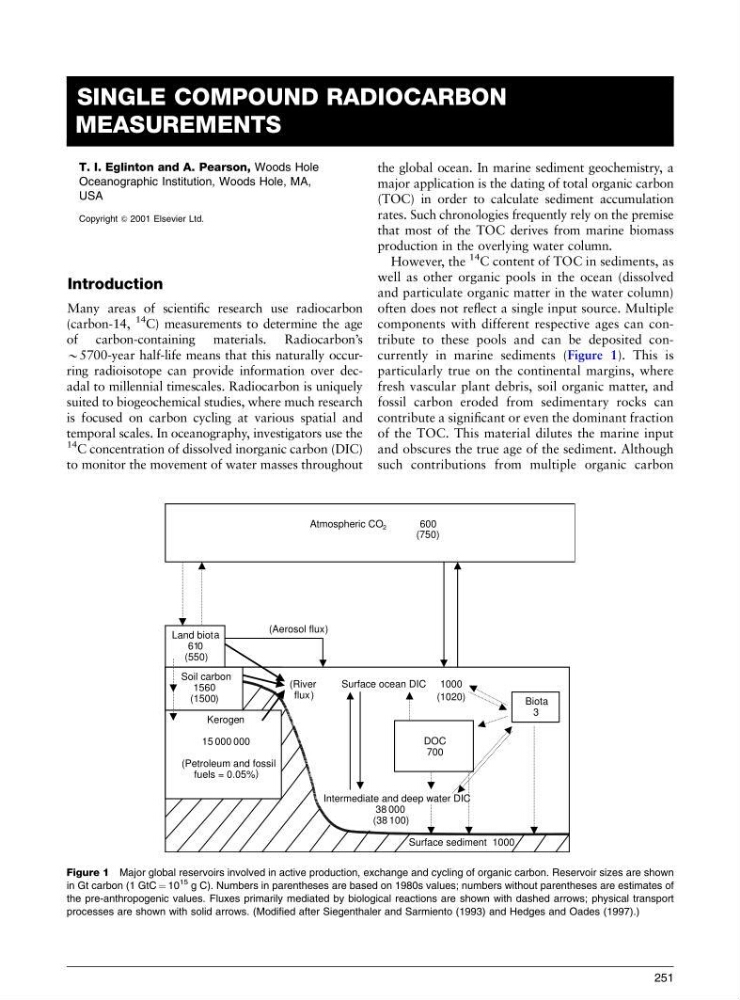
components with different respective ages can contribute to these pools and can be deposited concurrently in marine sediments (Figure 1). This is
particularly true on the continental margins, where
fresh vascular plant debris, soil organic matter, and
fossil carbon eroded from sedimentary rocks can
contribute a significant or even the dominant fraction
of the TOC. This material dilutes the marine input
and obscures the true age of the sediment. Although
such contributions from multiple organic carbon
Surface sediment 1000
Kerogen
15 000 000
(Petroleum and fossil
fuels = 0.05%)
Land biota
610
(550)
Soil carbon
1560
(1500)
DOC
700
Biota
3
Surface ocean DIC 1000
Intermediate and deep water DIC
38 000
(38 100)
Atmospheric CO 2
600
(750)
(River
flux)
(Aerosol flux)
(1020)
Figure 1 Major global reservoirs involved in active production, exchange and cycling of organic carbon. Reservoir sizes are shown
in Gt carbon (1 GtC ¼ 10
15 g C). Numbers in parentheses are based on 1980s values; numbers without parentheses are estimates of
the pre-anthropogenic values. Fluxes primarily mediated by biological reactions are shown with dashed arrows; physical transport
processes are shown with solid arrows. (Modified after Siegenthaler and Sarmiento (1993) and Hedges and Oades (1997).)
251
MEASUREMENTS
T. I. Eglinton and A. Pearson, Woods Hole
Oceanographic Institution, Woods Hole, MA,
USA
Copyright & 2001 Elsevier Ltd.
Introduction
Many areas of scientific research use radiocarbon
(carbon-14,
14
C) measurements to determine the age
of carbon-containing materials. Radiocarbon’s
B5700-year half-life means that this naturally occurring radioisotope can provide information over decadal to millennial timescales. Radiocarbon is uniquely
suited to biogeochemical studies, where much research
is focused on carbon cycling at various spatial and
temporal scales. In oceanography, investigators use the
14
C concentration of dissolved inorganic carbon (DIC)
to monitor the movement of water masses throughout
the global ocean. In marine sediment geochemistry, a
major application is the dating of total organic carbon
(TOC) in order to calculate sediment accumulation
rates. Such chronologies frequently rely on the premise
that most of the TOC derives from marine biomass
production in the overlying water column.
However, the
14
C content of TOC in sediments, as
well as other organic pools in the ocean (dissolved
and particulate organic matter in the water column)
often does not reflect a single input source. Multiple
components with different respective ages can contribute to these pools and can be deposited concurrently in marine sediments (Figure 1). This is
particularly true on the continental margins, where
fresh vascular plant debris, soil organic matter, and
fossil carbon eroded from sedimentary rocks can
contribute a significant or even the dominant fraction
of the TOC. This material dilutes the marine input
and obscures the true age of the sediment. Although
such contributions from multiple organic carbon
Surface sediment 1000
Kerogen
15 000 000
(Petroleum and fossil
fuels = 0.05%)
Land biota
610
(550)
Soil carbon
1560
(1500)
DOC
700
Biota
3
Surface ocean DIC 1000
Intermediate and deep water DIC
38 000
(38 100)
Atmospheric CO 2
600
(750)
(River
flux)
(Aerosol flux)
(1020)
Figure 1 Major global reservoirs involved in active production, exchange and cycling of organic carbon. Reservoir sizes are shown
in Gt carbon (1 GtC ¼ 10
15 g C). Numbers in parentheses are based on 1980s values; numbers without parentheses are estimates of
the pre-anthropogenic values. Fluxes primarily mediated by biological reactions are shown with dashed arrows; physical transport
processes are shown with solid arrows. (Modified after Siegenthaler and Sarmiento (1993) and Hedges and Oades (1997).)
251