

measurements to date are in good agreement with
the theoretically predicted values of their distribution
in the oceans (cf. Tables 3 and 4).
In many cases these nuclides serve as tracers for
the study of physical, chemical, and biological processes in the oceans. Several radiotracers successfully
provide chronology of sediments, corals, and manganese nodules, but learning about large-scale ocean
circulation is another matter. The ability merely to
make measurements of a tracer in the marine environment is not sufficient to use it as an effective
tracer for delineating important oceanic variables.
Tracer data must be examined in terms of ocean
models. Constructing ocean models is an iterative
process between data acquisition and model building, forcing model outputs, to become compatible
with the observations. The oceanic processes are very
complex, exhibiting significant spatial and temporal
variability on a wide range of scales. For the tracer
data to be useful in developing meaningful coupled
atmosphere–ocean circulation models, which may be
considered as the goal of tracer studies, one would
require three-dimensional tracer data with sufficient
resolution in the horizontal direction. The latter are
not available, except for
14 C, where a considerable
database is growing as a result of recent WOCE
(World Ocean Circulation Experiment) expeditions.
Tracers in Oceanography: Why We
Need Them and What We Learn From
Them
The oceans represent a large mass of water endowed
with a large amount of diverse substances and heat.
The dissolved and particulate oceanic ‘complex’ is in
continuous exchange with the land surface and
the atmosphere. An appreciable part of the dissolved
phases is recycled within the oceans through
biogeochemical cycles, which are maintained by the
large-scale oceanic circulation. The latter is a
manifestation of the continuous exchange of heat
between the atmosphere and the ocean. Large-scale
oceanic circulation replenishes nutrients in the surface waters, which are rapidly removed by biological
productivity. Biological recycling changes the chemical makeup of ocean waters at all depths.
Thus there is a complex cause–effect relationship
with significant feedbacks between oceanic circulation, biogeochemical cycling within the oceans,
and composition of sea water. Understanding these
processes is essential for understanding oceanographic processes, earth’s climate, terrestrial biogeochemistry, and the proxy records contained in the
oceanic sediments. Success in achieving this goal requires sensitive multidisciplinary techniques in which
tracers play an important part.
Chemical and isotopic tracers have been used
successfully for the past five decades. Oceanic
water masses are conventionally characterized by
their chemical and isotopic composition, and temperature. A central problem in oceanography is to
understand the origins and the processes which determine the evolution of different water masses.
Radioactive isotope tracers provide additional information on timescales, specifically on the rate
constants of different processes. The most attractive
feature of radioisotopes is that they provide time
integrals of evolution of water masses through
space, influenced by exchange/mixing processes,
and radioactive decay of the tracer, which introduces
the element of time in the model(s). In steadystate situations, all losses and gains balance out. By
combining with information on stable isotopes,
one can then determine effective time required for
the water mass to reach equilibrium between
gain and loss terms, i.e. get an estimate of the
effective equilibration time of the water mass as it
evolves.
Tracers fall into two broad categories:
1. Transient tracers which are introduced sporadically in a system, e.g., radionuclides introduced by
testing of nuclear weapons, and from discharges
from nuclear reactors.
2. Steady tracers which are introduced continuously
in a system, e.g., those produced by nuclear
interactions of cosmic rays on the earth, and by
radioactive decay of dissolved uranium in the
oceans.
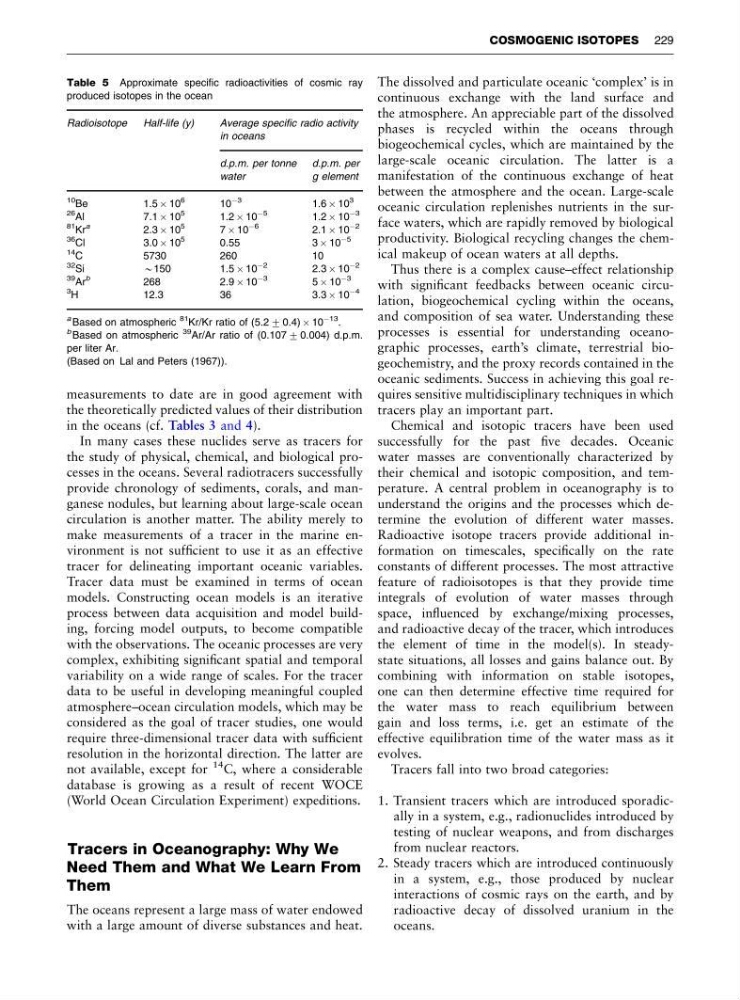
Table 5 Approximate specific radioactivities of cosmic ray
produced isotopes in the ocean
Radioisotope
Half-life (y)
Average specific radio activity
in oceans
d.p.m. per tonne
water
d.p.m. per
g element
10
Be
1.5 Â 10
6
10
À3
1.6 Â 10
3
26
Al
7.1 Â 10
5
1.2 Â 10
À5
1.2 Â 10
À3
81 Kr
a
2.3 Â 10
5
7 Â 10
À6
2.1 Â 10
À2
36 Cl
3.0 Â 10
5
0.55
3 Â 10
À5
14
C
5730
260
10
32
Si
B150
1.5 Â 10
À2
2.3 Â 10
À2
39 Ar
b
268
2.9 Â 10
À3
5 Â 10
À3
3
H
12.3
36
3.3 Â 10
À4
a Based on atmospheric
81 Kr/Kr ratio of (5.2 7 0.4) Â 10
À13 .
b Based on atmospheric
39 Ar/Ar ratio of (0.107 7 0.004) d.p.m.
per liter Ar.
(Based on Lal and Peters (1967)).
COSMOGENIC ISOTOPES 229
the theoretically predicted values of their distribution
in the oceans (cf. Tables 3 and 4).
In many cases these nuclides serve as tracers for
the study of physical, chemical, and biological processes in the oceans. Several radiotracers successfully
provide chronology of sediments, corals, and manganese nodules, but learning about large-scale ocean
circulation is another matter. The ability merely to
make measurements of a tracer in the marine environment is not sufficient to use it as an effective
tracer for delineating important oceanic variables.
Tracer data must be examined in terms of ocean
models. Constructing ocean models is an iterative
process between data acquisition and model building, forcing model outputs, to become compatible
with the observations. The oceanic processes are very
complex, exhibiting significant spatial and temporal
variability on a wide range of scales. For the tracer
data to be useful in developing meaningful coupled
atmosphere–ocean circulation models, which may be
considered as the goal of tracer studies, one would
require three-dimensional tracer data with sufficient
resolution in the horizontal direction. The latter are
not available, except for
14 C, where a considerable
database is growing as a result of recent WOCE
(World Ocean Circulation Experiment) expeditions.
Tracers in Oceanography: Why We
Need Them and What We Learn From
Them
The oceans represent a large mass of water endowed
with a large amount of diverse substances and heat.
The dissolved and particulate oceanic ‘complex’ is in
continuous exchange with the land surface and
the atmosphere. An appreciable part of the dissolved
phases is recycled within the oceans through
biogeochemical cycles, which are maintained by the
large-scale oceanic circulation. The latter is a
manifestation of the continuous exchange of heat
between the atmosphere and the ocean. Large-scale
oceanic circulation replenishes nutrients in the surface waters, which are rapidly removed by biological
productivity. Biological recycling changes the chemical makeup of ocean waters at all depths.
Thus there is a complex cause–effect relationship
with significant feedbacks between oceanic circulation, biogeochemical cycling within the oceans,
and composition of sea water. Understanding these
processes is essential for understanding oceanographic processes, earth’s climate, terrestrial biogeochemistry, and the proxy records contained in the
oceanic sediments. Success in achieving this goal requires sensitive multidisciplinary techniques in which
tracers play an important part.
Chemical and isotopic tracers have been used
successfully for the past five decades. Oceanic
water masses are conventionally characterized by
their chemical and isotopic composition, and temperature. A central problem in oceanography is to
understand the origins and the processes which determine the evolution of different water masses.
Radioactive isotope tracers provide additional information on timescales, specifically on the rate
constants of different processes. The most attractive
feature of radioisotopes is that they provide time
integrals of evolution of water masses through
space, influenced by exchange/mixing processes,
and radioactive decay of the tracer, which introduces
the element of time in the model(s). In steadystate situations, all losses and gains balance out. By
combining with information on stable isotopes,
one can then determine effective time required for
the water mass to reach equilibrium between
gain and loss terms, i.e. get an estimate of the
effective equilibration time of the water mass as it
evolves.
Tracers fall into two broad categories:
1. Transient tracers which are introduced sporadically in a system, e.g., radionuclides introduced by
testing of nuclear weapons, and from discharges
from nuclear reactors.
2. Steady tracers which are introduced continuously
in a system, e.g., those produced by nuclear
interactions of cosmic rays on the earth, and by
radioactive decay of dissolved uranium in the
oceans.
Table 5 Approximate specific radioactivities of cosmic ray
produced isotopes in the ocean
Radioisotope
Half-life (y)
Average specific radio activity
in oceans
d.p.m. per tonne
water
d.p.m. per
g element
10
Be
1.5 Â 10
6
10
À3
1.6 Â 10
3
26
Al
7.1 Â 10
5
1.2 Â 10
À5
1.2 Â 10
À3
81 Kr
a
2.3 Â 10
5
7 Â 10
À6
2.1 Â 10
À2
36 Cl
3.0 Â 10
5
0.55
3 Â 10
À5
14
C
5730
260
10
32
Si
B150
1.5 Â 10
À2
2.3 Â 10
À2
39 Ar
b
268
2.9 Â 10
À3
5 Â 10
À3
3
H
12.3
36
3.3 Â 10
À4
a Based on atmospheric
81 Kr/Kr ratio of (5.2 7 0.4) Â 10
À13 .
b Based on atmospheric
39 Ar/Ar ratio of (0.107 7 0.004) d.p.m.
per liter Ar.
(Based on Lal and Peters (1967)).
COSMOGENIC ISOTOPES 229