

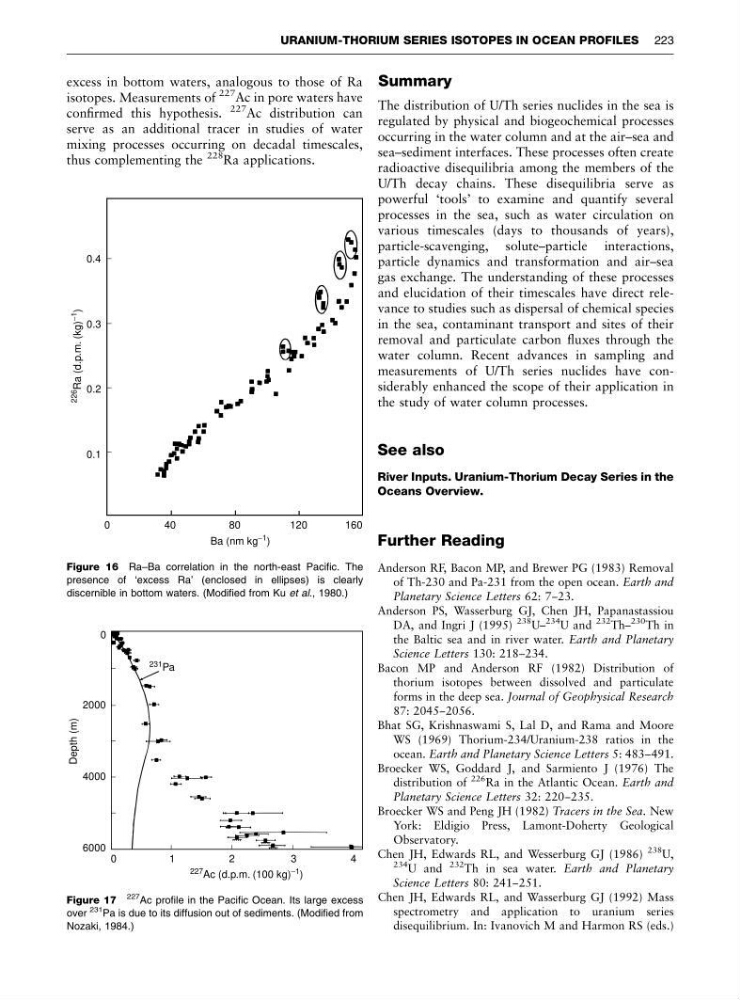
excess in bottom waters, analogous to those of Ra
isotopes. Measurements of
227 Ac in pore waters have
confirmed this hypothesis.
227 Ac distribution can
serve as an additional tracer in studies of water
mixing processes occurring on decadal timescales,
thus complementing the
228 Ra applications.
Summary
The distribution of U/Th series nuclides in the sea is
regulated by physical and biogeochemical processes
occurring in the water column and at the air–sea and
sea–sediment interfaces. These processes often create
radioactive disequilibria among the members of the
U/Th decay chains. These disequilibria serve as
powerful ‘tools’ to examine and quantify several
processes in the sea, such as water circulation on
various timescales (days to thousands of years),
particle-scavenging, solute–particle interactions,
particle dynamics and transformation and air–sea
gas exchange. The understanding of these processes
and elucidation of their timescales have direct relevance to studies such as dispersal of chemical species
in the sea, contaminant transport and sites of their
removal and particulate carbon fluxes through the
water column. Recent advances in sampling and
measurements of U/Th series nuclides have considerably enhanced the scope of their application in
the study of water column processes.
See also
River Inputs. Uranium-Thorium Decay Series in the
Oceans Overview.
Further Reading
Anderson RF, Bacon MP, and Brewer PG (1983) Removal
of Th-230 and Pa-231 from the open ocean. Earth and
Planetary Science Letters 62: 7--23.
Anderson PS, Wasserburg GJ, Chen JH, Papanastassiou
DA, and Ingri J (1995)
238 U–
234
U and
232 Th–
230 Th in
the Baltic sea and in river water. Earth and Planetary
Science Letters 130: 218--234.
Bacon MP and Anderson RF (1982) Distribution of
thorium isotopes between dissolved and particulate
forms in the deep sea. Journal of Geophysical Research
87: 2045--2056.
Bhat SG, Krishnaswami S, Lal D, and Rama and Moore
WS (1969) Thorium-234/Uranium-238 ratios in the
ocean. Earth and Planetary Science Letters 5: 483--491.
Broecker WS, Goddard J, and Sarmiento J (1976) The
distribution of
226 Ra in the Atlantic Ocean. Earth and
Planetary Science Letters 32: 220--235.
Broecker WS and Peng JH (1982) Tracers in the Sea. New
York: Eldigio Press, Lamont-Doherty Geological
Observatory.
Chen JH, Edwards RL, and Wesserburg GJ (1986)
238
U,
234 U and
232 Th in sea water. Earth and Planetary
Science Letters 80: 241--251.
Chen JH, Edwards RL, and Wasserburg GJ (1992) Mass
spectrometry and application to uranium series
disequilibrium. In: Ivanovich M and Harmon RS (eds.)
0.4
226
Ra (d.p.m. (kg)
−1
)
Ba (nm kg
−1 )
0.3
0.2
0.1
0
40
80
120
160
Figure 16 Ra–Ba correlation in the north-east Pacific. The
presence of ‘excess Ra’ (enclosed in ellipses) is clearly
discernible in bottom waters. (Modified from Ku et al., 1980.)
0
0
1
2
3
4
2000
Depth (m)
231 Pa
227
Ac (d.p.m. (100 kg)
−1
)
4000
6000
Figure 17
227
Ac profile in the Pacific Ocean. Its large excess
over
231 Pa is due to its diffusion out of sediments. (Modified from
Nozaki, 1984.)
URANIUM-THORIUM SERIES ISOTOPES IN OCEAN PROFILES 223
isotopes. Measurements of
227 Ac in pore waters have
confirmed this hypothesis.
227 Ac distribution can
serve as an additional tracer in studies of water
mixing processes occurring on decadal timescales,
thus complementing the
228 Ra applications.
Summary
The distribution of U/Th series nuclides in the sea is
regulated by physical and biogeochemical processes
occurring in the water column and at the air–sea and
sea–sediment interfaces. These processes often create
radioactive disequilibria among the members of the
U/Th decay chains. These disequilibria serve as
powerful ‘tools’ to examine and quantify several
processes in the sea, such as water circulation on
various timescales (days to thousands of years),
particle-scavenging, solute–particle interactions,
particle dynamics and transformation and air–sea
gas exchange. The understanding of these processes
and elucidation of their timescales have direct relevance to studies such as dispersal of chemical species
in the sea, contaminant transport and sites of their
removal and particulate carbon fluxes through the
water column. Recent advances in sampling and
measurements of U/Th series nuclides have considerably enhanced the scope of their application in
the study of water column processes.
See also
River Inputs. Uranium-Thorium Decay Series in the
Oceans Overview.
Further Reading
Anderson RF, Bacon MP, and Brewer PG (1983) Removal
of Th-230 and Pa-231 from the open ocean. Earth and
Planetary Science Letters 62: 7--23.
Anderson PS, Wasserburg GJ, Chen JH, Papanastassiou
DA, and Ingri J (1995)
238 U–
234
U and
232 Th–
230 Th in
the Baltic sea and in river water. Earth and Planetary
Science Letters 130: 218--234.
Bacon MP and Anderson RF (1982) Distribution of
thorium isotopes between dissolved and particulate
forms in the deep sea. Journal of Geophysical Research
87: 2045--2056.
Bhat SG, Krishnaswami S, Lal D, and Rama and Moore
WS (1969) Thorium-234/Uranium-238 ratios in the
ocean. Earth and Planetary Science Letters 5: 483--491.
Broecker WS, Goddard J, and Sarmiento J (1976) The
distribution of
226 Ra in the Atlantic Ocean. Earth and
Planetary Science Letters 32: 220--235.
Broecker WS and Peng JH (1982) Tracers in the Sea. New
York: Eldigio Press, Lamont-Doherty Geological
Observatory.
Chen JH, Edwards RL, and Wesserburg GJ (1986)
238
U,
234 U and
232 Th in sea water. Earth and Planetary
Science Letters 80: 241--251.
Chen JH, Edwards RL, and Wasserburg GJ (1992) Mass
spectrometry and application to uranium series
disequilibrium. In: Ivanovich M and Harmon RS (eds.)
0.4
226
Ra (d.p.m. (kg)
−1
)
Ba (nm kg
−1 )
0.3
0.2
0.1
0
40
80
120
160
Figure 16 Ra–Ba correlation in the north-east Pacific. The
presence of ‘excess Ra’ (enclosed in ellipses) is clearly
discernible in bottom waters. (Modified from Ku et al., 1980.)
0
0
1
2
3
4
2000
Depth (m)
231 Pa
227
Ac (d.p.m. (100 kg)
−1
)
4000
6000
Figure 17
227
Ac profile in the Pacific Ocean. Its large excess
over
231 Pa is due to its diffusion out of sediments. (Modified from
Nozaki, 1984.)
URANIUM-THORIUM SERIES ISOTOPES IN OCEAN PROFILES 223