

through water mixing, particulate scavenging and
regeneration. It has been shown that particulate
scavenging and regeneration plays a crucial role in
contributing to the progressive increase in
226 Ra
deep water concentration from the Atlantic to the
Pacific. Attempts to learn more about particulate
transport processes in influencing
226 Ra distribution
using Ba as its stable analogue and Ra–Ba and Ra–Si
correlations have met with limited success and have
clearly brought out the presence of more
226 Ra in
deep waters than expected from their Ba content
(Figure 16). This ‘excess’ is the nascent
226 Ra diffusing out of deep sea sediments and which is yet to
take part in particulate scavenging and recycling.
Such excesses are quite significant and are easily
discernible in the bottom waters of the eastern
Pacific.
227 Ac
The first measurement of
227 Ac in sea water was only
reported in the mid-1980s. These results showed that
its concentration increases steadily from surface to
bottom water (Figure 17) and that its activity in
ocean interior and deep waters is considerably in
excess of its parent
231 Pa (Figure 17). The diffusion
of
227
Ac out of bottom sediments is the source of its
K y = 4 ×10
7 cm
2 s
−1
K y = 4 ×10
5 cm
2 s
−1
228
Ra (d.p.m. (100 kg)
−1
)
Distance offshore (km)
2.0
0.5
0.2
0.1
0
400
800
1200
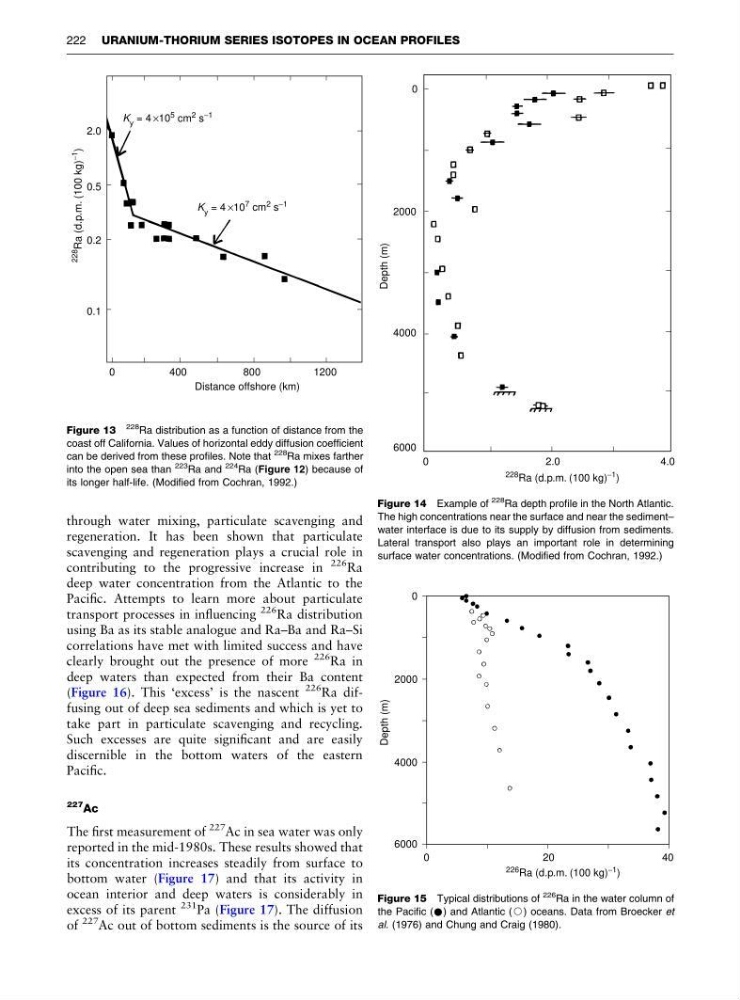
Figure 13
228 Ra distribution as a function of distance from the
coast off California. Values of horizontal eddy diffusion coefficient
can be derived from these profiles. Note that
228
Ra mixes farther
into the open sea than
223 Ra and
224 Ra (Figure 12) because of
its longer half-life. (Modified from Cochran, 1992.)
0
2000
4000
Depth (m)
6000
0
2.0
4.0
228 Ra (d.p.m. (100 kg)
−1
)
Figure 14 Example of
228 Ra depth profile in the North Atlantic.
The high concentrations near the surface and near the sediment–
water interface is due to its supply by diffusion from sediments.
Lateral transport also plays an important role in determining
surface water concentrations. (Modified from Cochran, 1992.)
0
0
2 0
4 0
2000
Depth (m)
226 Ra (d.p.m. (100 kg)
−1 )
4000
6000
Figure 15 Typical distributions of
226 Ra in the water column of
the Pacific ( ) and Atlantic (J) oceans. Data from Broecker et
al. (1976) and Chung and Craig (1980).
222 URANIUM-THORIUM SERIES ISOTOPES IN OCEAN PROFILES
regeneration. It has been shown that particulate
scavenging and regeneration plays a crucial role in
contributing to the progressive increase in
226 Ra
deep water concentration from the Atlantic to the
Pacific. Attempts to learn more about particulate
transport processes in influencing
226 Ra distribution
using Ba as its stable analogue and Ra–Ba and Ra–Si
correlations have met with limited success and have
clearly brought out the presence of more
226 Ra in
deep waters than expected from their Ba content
(Figure 16). This ‘excess’ is the nascent
226 Ra diffusing out of deep sea sediments and which is yet to
take part in particulate scavenging and recycling.
Such excesses are quite significant and are easily
discernible in the bottom waters of the eastern
Pacific.
227 Ac
The first measurement of
227 Ac in sea water was only
reported in the mid-1980s. These results showed that
its concentration increases steadily from surface to
bottom water (Figure 17) and that its activity in
ocean interior and deep waters is considerably in
excess of its parent
231 Pa (Figure 17). The diffusion
of
227
Ac out of bottom sediments is the source of its
K y = 4 ×10
7 cm
2 s
−1
K y = 4 ×10
5 cm
2 s
−1
228
Ra (d.p.m. (100 kg)
−1
)
Distance offshore (km)
2.0
0.5
0.2
0.1
0
400
800
1200
Figure 13
228 Ra distribution as a function of distance from the
coast off California. Values of horizontal eddy diffusion coefficient
can be derived from these profiles. Note that
228
Ra mixes farther
into the open sea than
223 Ra and
224 Ra (Figure 12) because of
its longer half-life. (Modified from Cochran, 1992.)
0
2000
4000
Depth (m)
6000
0
2.0
4.0
228 Ra (d.p.m. (100 kg)
−1
)
Figure 14 Example of
228 Ra depth profile in the North Atlantic.
The high concentrations near the surface and near the sediment–
water interface is due to its supply by diffusion from sediments.
Lateral transport also plays an important role in determining
surface water concentrations. (Modified from Cochran, 1992.)
0
0
2 0
4 0
2000
Depth (m)
226 Ra (d.p.m. (100 kg)
−1 )
4000
6000
Figure 15 Typical distributions of
226 Ra in the water column of
the Pacific ( ) and Atlantic (J) oceans. Data from Broecker et
al. (1976) and Chung and Craig (1980).
222 URANIUM-THORIUM SERIES ISOTOPES IN OCEAN PROFILES