

supply rate of
210 Pb from the atmosphere if it is removed only through its radioactive decay. This led to
the proposal that
210
Pb is scavenged from surface to
deep waters on timescales of a few years. In many
profiles, excess
210 Pb shows exponential decrease
with depth (Figure 9), which has been modeled to
derive apparent eddy diffusion coefficients. Measurements of
210 Pb–
226 Ra in the deep sea produced a
surprise result in that
210
Pb was found to be deficient
relative to
226 Ra with
210
Pb/
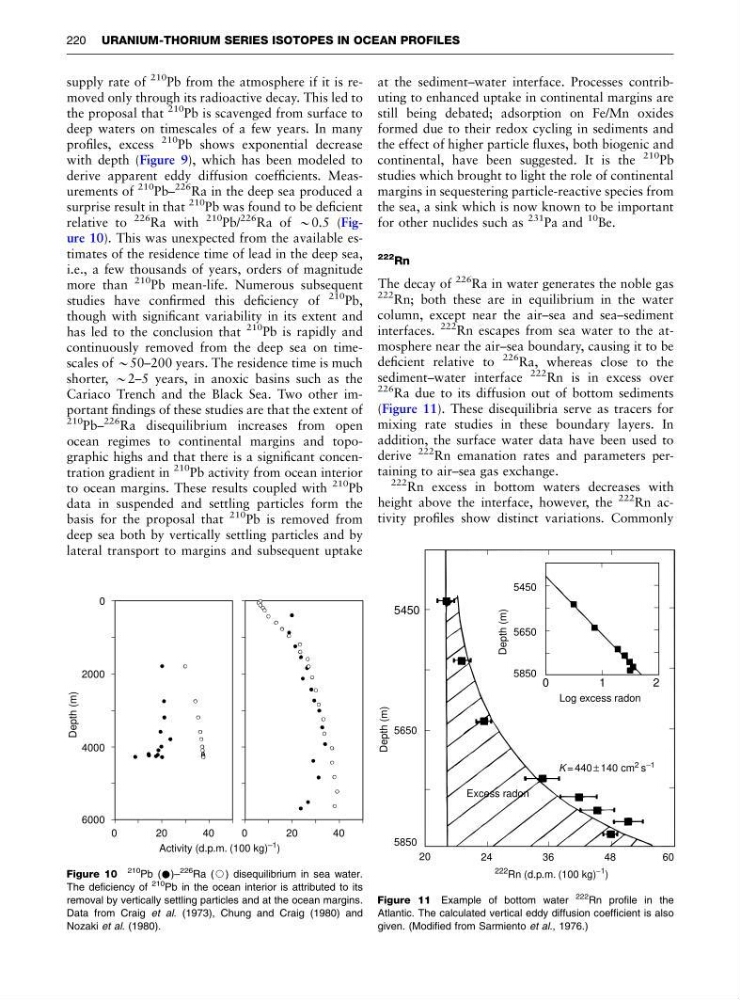
226 Ra of B0.5 (Figure 10). This was unexpected from the available estimates of the residence time of lead in the deep sea,
i.e., a few thousands of years, orders of magnitude
more than
210 Pb mean-life. Numerous subsequent
studies have confirmed this deficiency of
210 Pb,
though with significant variability in its extent and
has led to the conclusion that
210 Pb is rapidly and
continuously removed from the deep sea on timescales of B50–200 years. The residence time is much
shorter, B2–5 years, in anoxic basins such as the
Cariaco Trench and the Black Sea. Two other important findings of these studies are that the extent of
210 Pb–
226
Ra disequilibrium increases from open
ocean regimes to continental margins and topographic highs and that there is a significant concentration gradient in
210 Pb activity from ocean interior
to ocean margins. These results coupled with
210 Pb
data in suspended and settling particles form the
basis for the proposal that
210 Pb is removed from
deep sea both by vertically settling particles and by
lateral transport to margins and subsequent uptake
at the sediment–water interface. Processes contributing to enhanced uptake in continental margins are
still being debated; adsorption on Fe/Mn oxides
formed due to their redox cycling in sediments and
the effect of higher particle fluxes, both biogenic and
continental, have been suggested. It is the
210 Pb
studies which brought to light the role of continental
margins in sequestering particle-reactive species from
the sea, a sink which is now known to be important
for other nuclides such as
231 Pa and
10 Be.
222
Rn
The decay of
226
Ra in water generates the noble gas
222 Rn; both these are in equilibrium in the water
column, except near the air–sea and sea–sediment
interfaces.
222 Rn escapes from sea water to the atmosphere near the air–sea boundary, causing it to be
deficient relative to
226
Ra, whereas close to the
sediment–water interface
222 Rn is in excess over
226 Ra due to its diffusion out of bottom sediments
(Figure 11). These disequilibria serve as tracers for
mixing rate studies in these boundary layers. In
addition, the surface water data have been used to
derive
222 Rn emanation rates and parameters pertaining to air–sea gas exchange.
222 Rn excess in bottom waters decreases with
height above the interface, however, the
222 Rn activity profiles show distinct variations. Commonly
Depth (m)
Activity (d.p.m. (100 kg)
–1 )
0
0
20
40
0
20
40
2000
4000
6000
Figure 10
210
Pb ( )–
226 Ra (J) disequilibrium in sea water.
The deficiency of
210 Pb in the ocean interior is attributed to its
removal by vertically settling particles and at the ocean margins.
Data from Craig et al. (1973), Chung and Craig (1980) and
Nozaki et al. (1980).
5450
5450
Log excess radon
K = 440 ± 140 cm
2 s
−1
Excess radon
5650
5650
Depth (m)
Depth (m)
5850
5850
0
1
2
24
222
Rn (d.p.m. (100 kg)
−1
)
36
48
60
20
Figure 11 Example of bottom water
222 Rn profile in the
Atlantic. The calculated vertical eddy diffusion coefficient is also
given. (Modified from Sarmiento et al., 1976.)
220 URANIUM-THORIUM SERIES ISOTOPES IN OCEAN PROFILES
210 Pb from the atmosphere if it is removed only through its radioactive decay. This led to
the proposal that
210
Pb is scavenged from surface to
deep waters on timescales of a few years. In many
profiles, excess
210 Pb shows exponential decrease
with depth (Figure 9), which has been modeled to
derive apparent eddy diffusion coefficients. Measurements of
210 Pb–
226 Ra in the deep sea produced a
surprise result in that
210
Pb was found to be deficient
relative to
226 Ra with
210
Pb/
226 Ra of B0.5 (Figure 10). This was unexpected from the available estimates of the residence time of lead in the deep sea,
i.e., a few thousands of years, orders of magnitude
more than
210 Pb mean-life. Numerous subsequent
studies have confirmed this deficiency of
210 Pb,
though with significant variability in its extent and
has led to the conclusion that
210 Pb is rapidly and
continuously removed from the deep sea on timescales of B50–200 years. The residence time is much
shorter, B2–5 years, in anoxic basins such as the
Cariaco Trench and the Black Sea. Two other important findings of these studies are that the extent of
210 Pb–
226
Ra disequilibrium increases from open
ocean regimes to continental margins and topographic highs and that there is a significant concentration gradient in
210 Pb activity from ocean interior
to ocean margins. These results coupled with
210 Pb
data in suspended and settling particles form the
basis for the proposal that
210 Pb is removed from
deep sea both by vertically settling particles and by
lateral transport to margins and subsequent uptake
at the sediment–water interface. Processes contributing to enhanced uptake in continental margins are
still being debated; adsorption on Fe/Mn oxides
formed due to their redox cycling in sediments and
the effect of higher particle fluxes, both biogenic and
continental, have been suggested. It is the
210 Pb
studies which brought to light the role of continental
margins in sequestering particle-reactive species from
the sea, a sink which is now known to be important
for other nuclides such as
231 Pa and
10 Be.
222
Rn
The decay of
226
Ra in water generates the noble gas
222 Rn; both these are in equilibrium in the water
column, except near the air–sea and sea–sediment
interfaces.
222 Rn escapes from sea water to the atmosphere near the air–sea boundary, causing it to be
deficient relative to
226
Ra, whereas close to the
sediment–water interface
222 Rn is in excess over
226 Ra due to its diffusion out of bottom sediments
(Figure 11). These disequilibria serve as tracers for
mixing rate studies in these boundary layers. In
addition, the surface water data have been used to
derive
222 Rn emanation rates and parameters pertaining to air–sea gas exchange.
222 Rn excess in bottom waters decreases with
height above the interface, however, the
222 Rn activity profiles show distinct variations. Commonly
Depth (m)
Activity (d.p.m. (100 kg)
–1 )
0
0
20
40
0
20
40
2000
4000
6000
Figure 10
210
Pb ( )–
226 Ra (J) disequilibrium in sea water.
The deficiency of
210 Pb in the ocean interior is attributed to its
removal by vertically settling particles and at the ocean margins.
Data from Craig et al. (1973), Chung and Craig (1980) and
Nozaki et al. (1980).
5450
5450
Log excess radon
K = 440 ± 140 cm
2 s
−1
Excess radon
5650
5650
Depth (m)
Depth (m)
5850
5850
0
1
2
24
222
Rn (d.p.m. (100 kg)
−1
)
36
48
60
20
Figure 11 Example of bottom water
222 Rn profile in the
Atlantic. The calculated vertical eddy diffusion coefficient is also
given. (Modified from Sarmiento et al., 1976.)
220 URANIUM-THORIUM SERIES ISOTOPES IN OCEAN PROFILES