

equilibrium with
234 U, B2.7 d.p.m. l
À1 , reinforcing
the intense particle-reactive nature of Th isotopes
and the occurrence of particle scavenging throughout
the seawater column. More importantly, these studies showed that both the soluble and particulate
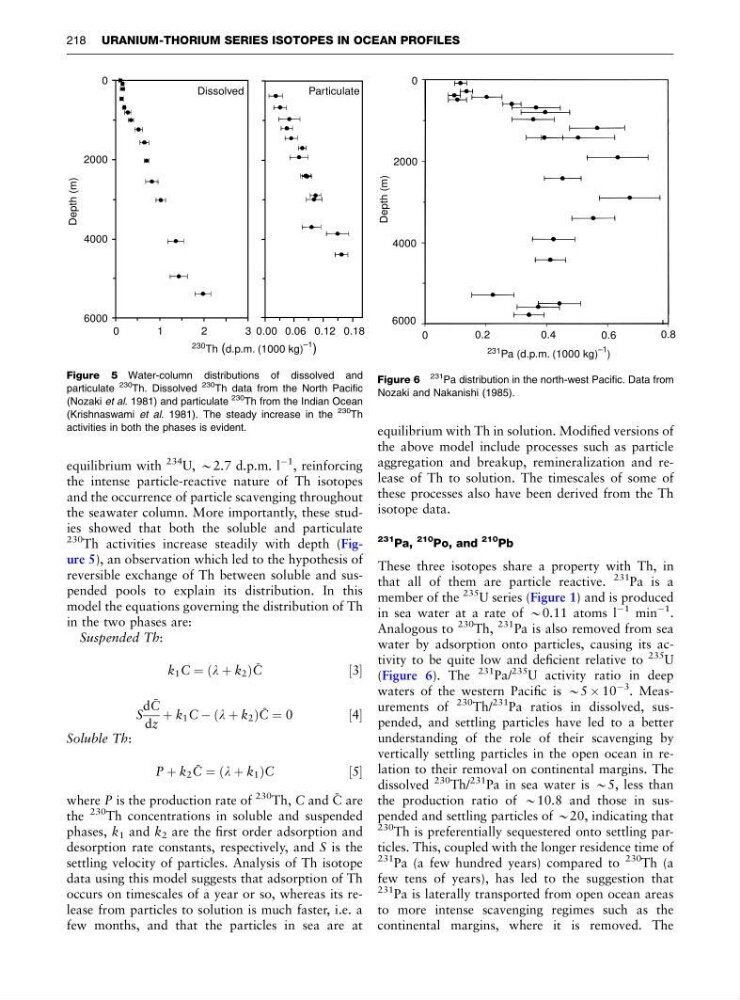
230 Th activities increase steadily with depth (Figure 5), an observation which led to the hypothesis of
reversible exchange of Th between soluble and suspended pools to explain its distribution. In this
model the equations governing the distribution of Th
in the two phases are:
Suspended Th:
k 1 C ¼ ðl þ k 2 Þ ¯
C
½3
S
d ¯
C
dz
þ k 1 C À ðl þ k 2 Þ ¯
C ¼ 0
½4
Soluble Th:
P þ k 2 ¯
C ¼ ðl þ k 1 ÞC
½5
where P is the production rate of
230 Th, C and C ¯ are
the
230
Th concentrations in soluble and suspended
phases, k 1 and k 2 are the first order adsorption and
desorption rate constants, respectively, and S is the
settling velocity of particles. Analysis of Th isotope
data using this model suggests that adsorption of Th
occurs on timescales of a year or so, whereas its release from particles to solution is much faster, i.e. a
few months, and that the particles in sea are at
equilibrium with Th in solution. Modified versions of
the above model include processes such as particle
aggregation and breakup, remineralization and release of Th to solution. The timescales of some of
these processes also have been derived from the Th
isotope data.
231
Pa,
210 Po, and
210 Pb
These three isotopes share a property with Th, in
that all of them are particle reactive.
231
Pa is a
member of the
235 U series (Figure 1) and is produced
in sea water at a rate of B0.11 atoms l
À1 min
À1
.
Analogous to
230
Th,
231 Pa is also removed from sea
water by adsorption onto particles, causing its activity to be quite low and deficient relative to
235 U
(Figure 6). The
231 Pa/
235 U activity ratio in deep
waters of the western Pacific is B5 Â 10
À3
. Measurements of
230 Th/
231 Pa ratios in dissolved, suspended, and settling particles have led to a better
understanding of the role of their scavenging by
vertically settling particles in the open ocean in relation to their removal on continental margins. The
dissolved
230 Th/
231 Pa in sea water is B5, less than
the production ratio of B10.8 and those in suspended and settling particles of B20, indicating that
230 Th is preferentially sequestered onto settling particles. This, coupled with the longer residence time of
231 Pa (a few hundred years) compared to
230
Th (a
few tens of years), has led to the suggestion that
231 Pa is laterally transported from open ocean areas
to more intense scavenging regimes such as the
continental margins, where it is removed. The
Dissolved
Particulate
0
0
1
2
3 0.00 0.06 0.12 0.18
2000
Depth (m)
4000
6000
230 Th (d.p.m. (1000 kg)
–1
)
Figure 5 Water-column distributions of dissolved and
particulate
230
Th. Dissolved
230 Th data from the North Pacific
(Nozaki et al. 1981) and particulate
230 Th from the Indian Ocean
(Krishnaswami et al. 1981). The steady increase in the
230 Th
activities in both the phases is evident.
0
2000
4000
6000
0
0.2
0.4
0.6
0.8
Depth (m)
231 Pa (d.p.m. (1000 kg)
–1
)
Figure 6
231 Pa distribution in the north-west Pacific. Data from
Nozaki and Nakanishi (1985).
218 URANIUM-THORIUM SERIES ISOTOPES IN OCEAN PROFILES
234 U, B2.7 d.p.m. l
À1 , reinforcing
the intense particle-reactive nature of Th isotopes
and the occurrence of particle scavenging throughout
the seawater column. More importantly, these studies showed that both the soluble and particulate
230 Th activities increase steadily with depth (Figure 5), an observation which led to the hypothesis of
reversible exchange of Th between soluble and suspended pools to explain its distribution. In this
model the equations governing the distribution of Th
in the two phases are:
Suspended Th:
k 1 C ¼ ðl þ k 2 Þ ¯
C
½3
S
d ¯
C
dz
þ k 1 C À ðl þ k 2 Þ ¯
C ¼ 0
½4
Soluble Th:
P þ k 2 ¯
C ¼ ðl þ k 1 ÞC
½5
where P is the production rate of
230 Th, C and C ¯ are
the
230
Th concentrations in soluble and suspended
phases, k 1 and k 2 are the first order adsorption and
desorption rate constants, respectively, and S is the
settling velocity of particles. Analysis of Th isotope
data using this model suggests that adsorption of Th
occurs on timescales of a year or so, whereas its release from particles to solution is much faster, i.e. a
few months, and that the particles in sea are at
equilibrium with Th in solution. Modified versions of
the above model include processes such as particle
aggregation and breakup, remineralization and release of Th to solution. The timescales of some of
these processes also have been derived from the Th
isotope data.
231
Pa,
210 Po, and
210 Pb
These three isotopes share a property with Th, in
that all of them are particle reactive.
231
Pa is a
member of the
235 U series (Figure 1) and is produced
in sea water at a rate of B0.11 atoms l
À1 min
À1
.
Analogous to
230
Th,
231 Pa is also removed from sea
water by adsorption onto particles, causing its activity to be quite low and deficient relative to
235 U
(Figure 6). The
231 Pa/
235 U activity ratio in deep
waters of the western Pacific is B5 Â 10
À3
. Measurements of
230 Th/
231 Pa ratios in dissolved, suspended, and settling particles have led to a better
understanding of the role of their scavenging by
vertically settling particles in the open ocean in relation to their removal on continental margins. The
dissolved
230 Th/
231 Pa in sea water is B5, less than
the production ratio of B10.8 and those in suspended and settling particles of B20, indicating that
230 Th is preferentially sequestered onto settling particles. This, coupled with the longer residence time of
231 Pa (a few hundred years) compared to
230
Th (a
few tens of years), has led to the suggestion that
231 Pa is laterally transported from open ocean areas
to more intense scavenging regimes such as the
continental margins, where it is removed. The
Dissolved
Particulate
0
0
1
2
3 0.00 0.06 0.12 0.18
2000
Depth (m)
4000
6000
230 Th (d.p.m. (1000 kg)
–1
)
Figure 5 Water-column distributions of dissolved and
particulate
230
Th. Dissolved
230 Th data from the North Pacific
(Nozaki et al. 1981) and particulate
230 Th from the Indian Ocean
(Krishnaswami et al. 1981). The steady increase in the
230 Th
activities in both the phases is evident.
0
2000
4000
6000
0
0.2
0.4
0.6
0.8
Depth (m)
231 Pa (d.p.m. (1000 kg)
–1
)
Figure 6
231 Pa distribution in the north-west Pacific. Data from
Nozaki and Nakanishi (1985).
218 URANIUM-THORIUM SERIES ISOTOPES IN OCEAN PROFILES