

234 Th is continuously produced in sea water from
the decay of
238 U at a nearly uniform rate of B2.4
atoms l
À1 min
À1
. It has been observed that
234 Th
activity in the surface B200 m is generally deficient
relative to its parent
238
U suggesting its removal by
particles, the mechanism of how this is accomplished, however, is not well understood. This result
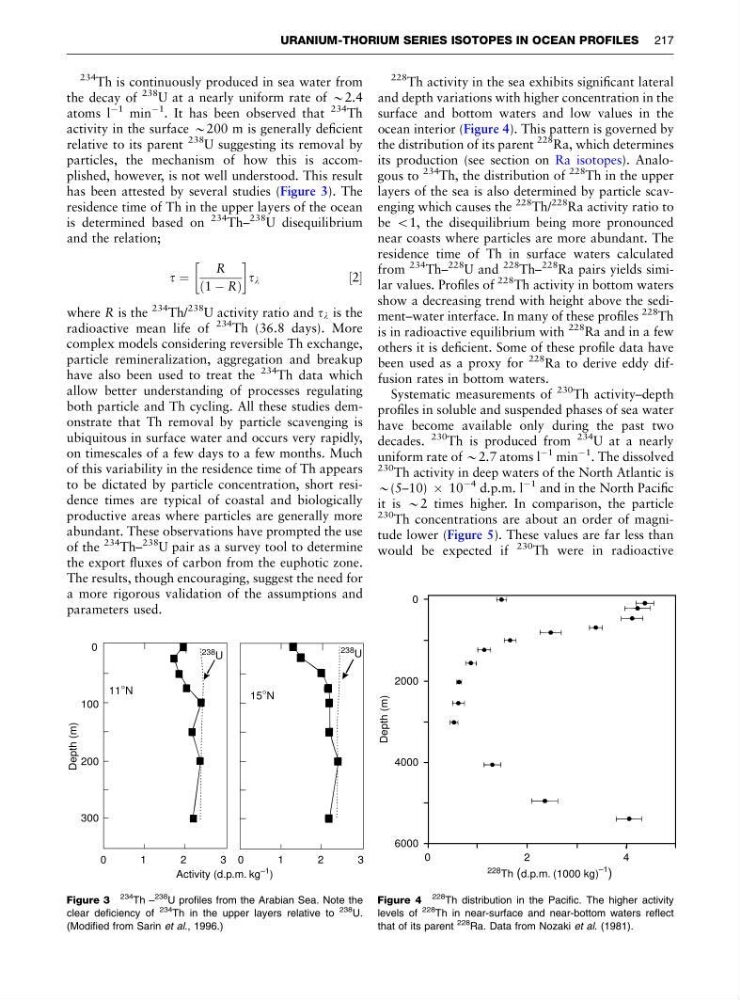
has been attested by several studies (Figure 3). The
residence time of Th in the upper layers of the ocean
is determined based on
234 Th–
238 U disequilibrium
and the relation;
t ¼
R
ð1 À RÞ
!
t l
½2
where R is the
234 Th/
238
U activity ratio and t l is the
radioactive mean life of
234 Th (36.8 days). More
complex models considering reversible Th exchange,
particle remineralization, aggregation and breakup
have also been used to treat the
234 Th data which
allow better understanding of processes regulating
both particle and Th cycling. All these studies demonstrate that Th removal by particle scavenging is
ubiquitous in surface water and occurs very rapidly,
on timescales of a few days to a few months. Much
of this variability in the residence time of Th appears
to be dictated by particle concentration, short residence times are typical of coastal and biologically
productive areas where particles are generally more
abundant. These observations have prompted the use
of the
234
Th–
238 U pair as a survey tool to determine
the export fluxes of carbon from the euphotic zone.
The results, though encouraging, suggest the need for
a more rigorous validation of the assumptions and
parameters used.
228 Th activity in the sea exhibits significant lateral
and depth variations with higher concentration in the
surface and bottom waters and low values in the
ocean interior (Figure 4). This pattern is governed by
the distribution of its parent
228 Ra, which determines
its production (see section on Ra isotopes). Analogous to
234
Th, the distribution of
228 Th in the upper
layers of the sea is also determined by particle scavenging which causes the
228 Th/
228 Ra activity ratio to
be o1, the disequilibrium being more pronounced
near coasts where particles are more abundant. The
residence time of Th in surface waters calculated
from
234 Th–
228 U and
228
Th–
228 Ra pairs yields similar values. Profiles of
228 Th activity in bottom waters
show a decreasing trend with height above the sediment–water interface. In many of these profiles
228
Th
is in radioactive equilibrium with
228 Ra and in a few
others it is deficient. Some of these profile data have
been used as a proxy for
228 Ra to derive eddy diffusion rates in bottom waters.
Systematic measurements of
230 Th activity–depth
profiles in soluble and suspended phases of sea water
have become available only during the past two
decades.
230
Th is produced from
234 U at a nearly
uniform rate of B2.7 atoms l
À1 min
À1
. The dissolved
230 Th activity in deep waters of the North Atlantic is
B(5–10) Â 10
À4 d.p.m. l
À1 and in the North Pacific
it is B2 times higher. In comparison, the particle
230 Th concentrations are about an order of magnitude lower (Figure 5). These values are far less than
would be expected if
230 Th were in radioactive
11°N
238
U
0
0
Activity (d.p.m. kg
–1
)
Depth (m)
1
2
3 0
1
2
3
100
200
300
15°N
238 U
Figure 3
234
Th –
238 U profiles from the Arabian Sea. Note the
clear deficiency of
234
Th in the upper layers relative to
238 U.
(Modified from Sarin et al., 1996.)
0
2000
4000
6000
0
228 Th (d.p.m. (1000 kg)
–1
)
Depth (m)
2
4
Figure 4
228 Th distribution in the Pacific. The higher activity
levels of
228 Th in near-surface and near-bottom waters reflect
that of its parent
228 Ra. Data from Nozaki et al. (1981).
URANIUM-THORIUM SERIES ISOTOPES IN OCEAN PROFILES 217
the decay of
238 U at a nearly uniform rate of B2.4
atoms l
À1 min
À1
. It has been observed that
234 Th
activity in the surface B200 m is generally deficient
relative to its parent
238
U suggesting its removal by
particles, the mechanism of how this is accomplished, however, is not well understood. This result
has been attested by several studies (Figure 3). The
residence time of Th in the upper layers of the ocean
is determined based on
234 Th–
238 U disequilibrium
and the relation;
t ¼
R
ð1 À RÞ
!
t l
½2
where R is the
234 Th/
238
U activity ratio and t l is the
radioactive mean life of
234 Th (36.8 days). More
complex models considering reversible Th exchange,
particle remineralization, aggregation and breakup
have also been used to treat the
234 Th data which
allow better understanding of processes regulating
both particle and Th cycling. All these studies demonstrate that Th removal by particle scavenging is
ubiquitous in surface water and occurs very rapidly,
on timescales of a few days to a few months. Much
of this variability in the residence time of Th appears
to be dictated by particle concentration, short residence times are typical of coastal and biologically
productive areas where particles are generally more
abundant. These observations have prompted the use
of the
234
Th–
238 U pair as a survey tool to determine
the export fluxes of carbon from the euphotic zone.
The results, though encouraging, suggest the need for
a more rigorous validation of the assumptions and
parameters used.
228 Th activity in the sea exhibits significant lateral
and depth variations with higher concentration in the
surface and bottom waters and low values in the
ocean interior (Figure 4). This pattern is governed by
the distribution of its parent
228 Ra, which determines
its production (see section on Ra isotopes). Analogous to
234
Th, the distribution of
228 Th in the upper
layers of the sea is also determined by particle scavenging which causes the
228 Th/
228 Ra activity ratio to
be o1, the disequilibrium being more pronounced
near coasts where particles are more abundant. The
residence time of Th in surface waters calculated
from
234 Th–
228 U and
228
Th–
228 Ra pairs yields similar values. Profiles of
228 Th activity in bottom waters
show a decreasing trend with height above the sediment–water interface. In many of these profiles
228
Th
is in radioactive equilibrium with
228 Ra and in a few
others it is deficient. Some of these profile data have
been used as a proxy for
228 Ra to derive eddy diffusion rates in bottom waters.
Systematic measurements of
230 Th activity–depth
profiles in soluble and suspended phases of sea water
have become available only during the past two
decades.
230
Th is produced from
234 U at a nearly
uniform rate of B2.7 atoms l
À1 min
À1
. The dissolved
230 Th activity in deep waters of the North Atlantic is
B(5–10) Â 10
À4 d.p.m. l
À1 and in the North Pacific
it is B2 times higher. In comparison, the particle
230 Th concentrations are about an order of magnitude lower (Figure 5). These values are far less than
would be expected if
230 Th were in radioactive
11°N
238
U
0
0
Activity (d.p.m. kg
–1
)
Depth (m)
1
2
3 0
1
2
3
100
200
300
15°N
238 U
Figure 3
234
Th –
238 U profiles from the Arabian Sea. Note the
clear deficiency of
234
Th in the upper layers relative to
238 U.
(Modified from Sarin et al., 1996.)
0
2000
4000
6000
0
228 Th (d.p.m. (1000 kg)
–1
)
Depth (m)
2
4
Figure 4
228 Th distribution in the Pacific. The higher activity
levels of
228 Th in near-surface and near-bottom waters reflect
that of its parent
228 Ra. Data from Nozaki et al. (1981).
URANIUM-THORIUM SERIES ISOTOPES IN OCEAN PROFILES 217