

Distribution in the Oceans
Uranium
238 U and
235
U are progenitors of a number of particle-reactive nuclides in sea water which find applications in the study of several water column and
sedimentary processes. The study of uranium distribution in the sea is therefore essential to a better
understanding of the radioactive disequilibrium between
238 U–
234 Th,
234
U–
230 Th,
238 U–
234 U, and
235 U–
231 Pa in sea water. Uranium in sea water is
almost entirely in solution as UO 2 (CO 3 ) 3
À4 . Considerable data on its concentration and
234 U/
238 U
activity ratios are available in the literature, most of
which are based on a-spectrometry. These results
show that uranium concentration in salinity normalized open ocean sea water (35%) are the same
within experimental uncertainties, 3.370.2 mg l
À1
.
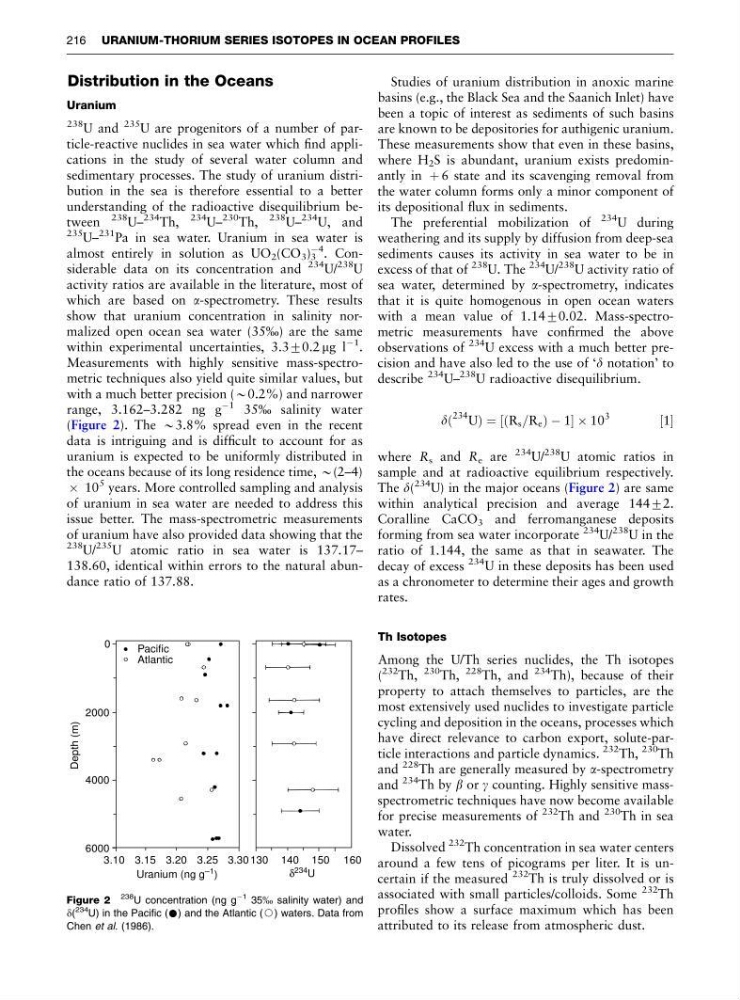
Measurements with highly sensitive mass-spectrometric techniques also yield quite similar values, but
with a much better precision (B0.2%) and narrower
range, 3.162–3.282 ng g
À1 35% salinity water
(Figure 2). The B3.8% spread even in the recent
data is intriguing and is difficult to account for as
uranium is expected to be uniformly distributed in
the oceans because of its long residence time, B(2–4)
 10
5 years. More controlled sampling and analysis
of uranium in sea water are needed to address this
issue better. The mass-spectrometric measurements
of uranium have also provided data showing that the
238 U/
235
U atomic ratio in sea water is 137.17–
138.60, identical within errors to the natural abundance ratio of 137.88.
Studies of uranium distribution in anoxic marine
basins (e.g., the Black Sea and the Saanich Inlet) have
been a topic of interest as sediments of such basins
are known to be depositories for authigenic uranium.
These measurements show that even in these basins,
where H 2 S is abundant, uranium exists predominantly in þ 6 state and its scavenging removal from
the water column forms only a minor component of
its depositional flux in sediments.
The preferential mobilization of
234 U during
weathering and its supply by diffusion from deep-sea
sediments causes its activity in sea water to be in
excess of that of
238
U. The
234
U/
238 U activity ratio of
sea water, determined by a-spectrometry, indicates
that it is quite homogenous in open ocean waters
with a mean value of 1.1470.02. Mass-spectrometric measurements have confirmed the above
observations of
234 U excess with a much better precision and have also led to the use of ‘d notation’ to
describe
234 U–
238 U radioactive disequilibrium.
dð
234 UÞ ¼ ½ðR s =R e Þ À 1  10
3
½1
where R s and R e are
234 U/
238 U atomic ratios in
sample and at radioactive equilibrium respectively.
The d(
234 U) in the major oceans (Figure 2) are same
within analytical precision and average 14472.
Coralline CaCO 3 and ferromanganese deposits
forming from sea water incorporate
234 U/
238 U in the
ratio of 1.144, the same as that in seawater. The
decay of excess
234 U in these deposits has been used
as a chronometer to determine their ages and growth
rates.
Th Isotopes
Among the U/Th series nuclides, the Th isotopes
(
232
Th,
230 Th,
228 Th, and
234 Th), because of their
property to attach themselves to particles, are the
most extensively used nuclides to investigate particle
cycling and deposition in the oceans, processes which
have direct relevance to carbon export, solute-particle interactions and particle dynamics.
232 Th,
230
Th
and
228 Th are generally measured by a-spectrometry
and
234
Th by b or g counting. Highly sensitive massspectrometric techniques have now become available
for precise measurements of
232 Th and
230 Th in sea
water.
Dissolved
232 Th concentration in sea water centers
around a few tens of picograms per liter. It is uncertain if the measured
232 Th is truly dissolved or is
associated with small particles/colloids. Some
232
Th
profiles show a surface maximum which has been
attributed to its release from atmospheric dust.
Pacific
Atlantic
0
Uranium (ng g
–1
)
3.10 3.15 3.20 3.25 3.30 130 140 150 160
δ
234
U
2000
Depth (m)
4000
6000
Figure 2
238
U concentration (ng g
À1 35% salinity water) and
d(
234
U) in the Pacific ( ) and the Atlantic (J) waters. Data from
Chen et al. (1986).
216 URANIUM-THORIUM SERIES ISOTOPES IN OCEAN PROFILES
Uranium
238 U and
235
U are progenitors of a number of particle-reactive nuclides in sea water which find applications in the study of several water column and
sedimentary processes. The study of uranium distribution in the sea is therefore essential to a better
understanding of the radioactive disequilibrium between
238 U–
234 Th,
234
U–
230 Th,
238 U–
234 U, and
235 U–
231 Pa in sea water. Uranium in sea water is
almost entirely in solution as UO 2 (CO 3 ) 3
À4 . Considerable data on its concentration and
234 U/
238 U
activity ratios are available in the literature, most of
which are based on a-spectrometry. These results
show that uranium concentration in salinity normalized open ocean sea water (35%) are the same
within experimental uncertainties, 3.370.2 mg l
À1
.
Measurements with highly sensitive mass-spectrometric techniques also yield quite similar values, but
with a much better precision (B0.2%) and narrower
range, 3.162–3.282 ng g
À1 35% salinity water
(Figure 2). The B3.8% spread even in the recent
data is intriguing and is difficult to account for as
uranium is expected to be uniformly distributed in
the oceans because of its long residence time, B(2–4)
 10
5 years. More controlled sampling and analysis
of uranium in sea water are needed to address this
issue better. The mass-spectrometric measurements
of uranium have also provided data showing that the
238 U/
235
U atomic ratio in sea water is 137.17–
138.60, identical within errors to the natural abundance ratio of 137.88.
Studies of uranium distribution in anoxic marine
basins (e.g., the Black Sea and the Saanich Inlet) have
been a topic of interest as sediments of such basins
are known to be depositories for authigenic uranium.
These measurements show that even in these basins,
where H 2 S is abundant, uranium exists predominantly in þ 6 state and its scavenging removal from
the water column forms only a minor component of
its depositional flux in sediments.
The preferential mobilization of
234 U during
weathering and its supply by diffusion from deep-sea
sediments causes its activity in sea water to be in
excess of that of
238
U. The
234
U/
238 U activity ratio of
sea water, determined by a-spectrometry, indicates
that it is quite homogenous in open ocean waters
with a mean value of 1.1470.02. Mass-spectrometric measurements have confirmed the above
observations of
234 U excess with a much better precision and have also led to the use of ‘d notation’ to
describe
234 U–
238 U radioactive disequilibrium.
dð
234 UÞ ¼ ½ðR s =R e Þ À 1  10
3
½1
where R s and R e are
234 U/
238 U atomic ratios in
sample and at radioactive equilibrium respectively.
The d(
234 U) in the major oceans (Figure 2) are same
within analytical precision and average 14472.
Coralline CaCO 3 and ferromanganese deposits
forming from sea water incorporate
234 U/
238 U in the
ratio of 1.144, the same as that in seawater. The
decay of excess
234 U in these deposits has been used
as a chronometer to determine their ages and growth
rates.
Th Isotopes
Among the U/Th series nuclides, the Th isotopes
(
232
Th,
230 Th,
228 Th, and
234 Th), because of their
property to attach themselves to particles, are the
most extensively used nuclides to investigate particle
cycling and deposition in the oceans, processes which
have direct relevance to carbon export, solute-particle interactions and particle dynamics.
232 Th,
230
Th
and
228 Th are generally measured by a-spectrometry
and
234
Th by b or g counting. Highly sensitive massspectrometric techniques have now become available
for precise measurements of
232 Th and
230 Th in sea
water.
Dissolved
232 Th concentration in sea water centers
around a few tens of picograms per liter. It is uncertain if the measured
232 Th is truly dissolved or is
associated with small particles/colloids. Some
232
Th
profiles show a surface maximum which has been
attributed to its release from atmospheric dust.
Pacific
Atlantic
0
Uranium (ng g
–1
)
3.10 3.15 3.20 3.25 3.30 130 140 150 160
δ
234
U
2000
Depth (m)
4000
6000
Figure 2
238
U concentration (ng g
À1 35% salinity water) and
d(
234
U) in the Pacific ( ) and the Atlantic (J) waters. Data from
Chen et al. (1986).
216 URANIUM-THORIUM SERIES ISOTOPES IN OCEAN PROFILES