

In surface current systems away from the continents,
228
Ra becomes a powerful tracer for waters that
have been in contact with the continental shelf. The
228 Ra enrichment in surface waters in the equatorial
Pacific point to shelf sources off New Guinea, from
where the isotope is carried eastward in the North
Equatorial Counter Current. In this plume, the vertical distribution of the isotope has been used to
derive vertical mixing rates. A very high accumulation of
228 Ra is observed in the transpolar drift in
the central Arctic Ocean, a signal derived from the
extensive Siberian shelves.
Due to their short half lives,
224 Ra (3.4 days) and
223 Ra (11.4 days) are interesting only in the immediate vicinity of their sources. In the open ocean they
are close to secular equilibrium with their parents
228 Th and
227 Ac, but in coastal waters these tracers
are being developed to study mixing rates. Their
distribution is controlled here by sources in the estuary and on the shelf, mixing and decay. Horizontal
mixing rates have been obtained from the distribution of
223 Ra and
224 Ra across the shelf using eqn
[13]. As with
228 Ra, this procedure is limited to cases
where the mixing can be considered to be one-dimensional, but the steady-state requirement is more
easily met at these short timescales. The
223 Ra/
224
Ra
activity ratio, which decays with a half-life of 5.4
days, yields the age of a water mass since its contact
with the source, irrespective of the nature of the
mixing process with offshore waters.
0
0
1.0
2.0
228 Ra Activity (10
_ 2 dpm kg
_ 1 )
3.0
4.0
1
2
3
4
5
Depth (km)
6
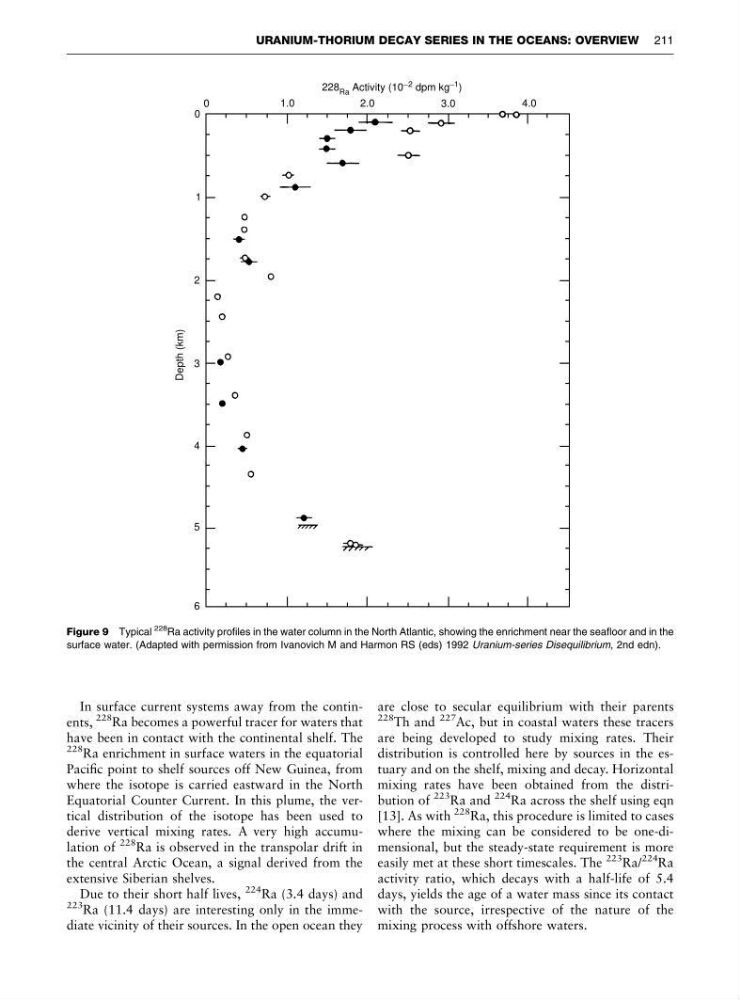
Figure 9 Typical
228 Ra activity profiles in the water column in the North Atlantic, showing the enrichment near the seafloor and in the
surface water. (Adapted with permission from Ivanovich M and Harmon RS (eds) 1992 Uranium-series Disequilibrium, 2nd edn).
URANIUM-THORIUM DECAY SERIES IN THE OCEANS: OVERVIEW 211
228
Ra becomes a powerful tracer for waters that
have been in contact with the continental shelf. The
228 Ra enrichment in surface waters in the equatorial
Pacific point to shelf sources off New Guinea, from
where the isotope is carried eastward in the North
Equatorial Counter Current. In this plume, the vertical distribution of the isotope has been used to
derive vertical mixing rates. A very high accumulation of
228 Ra is observed in the transpolar drift in
the central Arctic Ocean, a signal derived from the
extensive Siberian shelves.
Due to their short half lives,
224 Ra (3.4 days) and
223 Ra (11.4 days) are interesting only in the immediate vicinity of their sources. In the open ocean they
are close to secular equilibrium with their parents
228 Th and
227 Ac, but in coastal waters these tracers
are being developed to study mixing rates. Their
distribution is controlled here by sources in the estuary and on the shelf, mixing and decay. Horizontal
mixing rates have been obtained from the distribution of
223 Ra and
224 Ra across the shelf using eqn
[13]. As with
228 Ra, this procedure is limited to cases
where the mixing can be considered to be one-dimensional, but the steady-state requirement is more
easily met at these short timescales. The
223 Ra/
224
Ra
activity ratio, which decays with a half-life of 5.4
days, yields the age of a water mass since its contact
with the source, irrespective of the nature of the
mixing process with offshore waters.
0
0
1.0
2.0
228 Ra Activity (10
_ 2 dpm kg
_ 1 )
3.0
4.0
1
2
3
4
5
Depth (km)
6
Figure 9 Typical
228 Ra activity profiles in the water column in the North Atlantic, showing the enrichment near the seafloor and in the
surface water. (Adapted with permission from Ivanovich M and Harmon RS (eds) 1992 Uranium-series Disequilibrium, 2nd edn).
URANIUM-THORIUM DECAY SERIES IN THE OCEANS: OVERVIEW 211